11 Best Places To Live In England In 2026
The best place to live is not the one that looks good on a sunny bank holiday. It is the one that still works on an ordinary Tuesday. That is how these eleven towns earned their spot. Some sit on the coast and others sit up in the hills. Each one keeps the everyday things close at hand. Markets, walkable streets, good schools, and reliable trains are the whole point here.
Saffron Walden

Saffron Walden has kept its rhythm for centuries. A market fills the square twice a week, hemmed in by timber-framed houses, and the whole medieval core is walkable with open countryside a short stroll away. The Cross Keys Hotel, a timber-framed inn and restaurant that goes back to the 15th century, holds down one corner of the town centre. Over by the ruins of Walden Castle, the Saffron Walden Museum runs through archaeology, natural sciences, and decorative arts.
The schools are a big part of the appeal. Saffron Walden County High School is one of Essex's best-regarded state secondaries, and Dame Bradbury's covers the independent route for younger children. Just outside town, Audley End House and Gardens makes for a proper English Heritage day out, and Audley End station gets you into London Liverpool Street in about 50 minutes. The average sold price sits around £455,000.
Petersfield

Petersfield hands families a 60-acre heath and lake a few minutes from its Georgian centre, and the spot is protected as a Site of Special Scientific Interest. You can be out there in no time for rowing boats, pedalos, and heathland paths. There is open-air swimming nearby too, at the heated 25-metre Petersfield Lido. Come summer, the calendar fills with outdoor theatre on the heath, the Petersfield Festival, and a regular farmers' market.
The town wears its culture lightly. Petersfield Museum and Art Gallery is an easy family stop, and the centre keeps a good run of cafés and independent bookshops like the Petersfield Bookshop and One Tree Books. The Petersfield School handles secondary pupils while Churcher's College offers an independent path. The average sold price is about £517,000, which buys Georgian streets, heath-side living, and trains to London Waterloo in under an hour.
Marlow

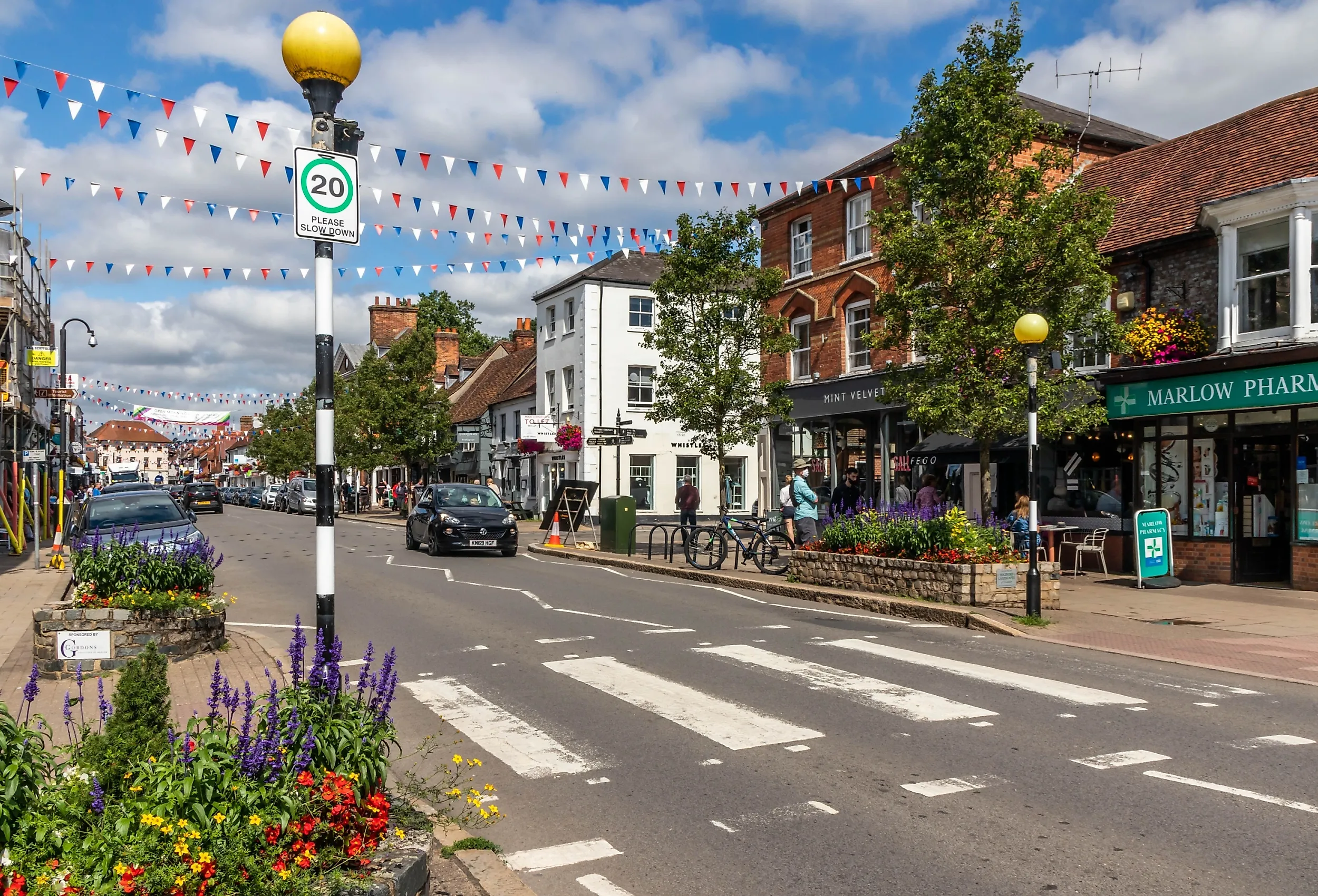
Marlow's High Street runs right down to the Thames, where a graceful suspension bridge built in 1832 by William Tierney Clark carries walkers and cyclists across the water. Higginson Park spreads riverside lawns and tennis courts along the bank, and the Chilterns National Landscape starts close by, with beech woods and chalk hills laced by footpaths and bridleways. Back on the High Street, the food scene is led by The Hand and Flowers, Tom Kerridge's two-Michelin-starred pub.
Some residents can even walk to work at Globe Park on the edge of town. For everyone else, the fastest trains reach London Paddington via Maidenhead in about 46 minutes, and the M40 and M4 open up Reading and High Wycombe. At an average sold price near £693,000, Marlow charges a premium for river access, schools like Sir William Borlase's Grammar School, and a centre that stays busy well past the morning rush.
Stroud

Every Saturday, Stroud throws one of the biggest farmers' markets in the country, with organic veg, artisan cheese, sourdough, and a crowd that rolls in from the surrounding valleys. The Subscription Rooms, a Georgian venue from 1833, keeps live music and theatre going, and the Stroud Book Festival pulls in authors each autumn. For a town of around 13,500, that is a lot of cultural life, yet the average sold price stays near £387,000, below many better-known Cotswold towns.
The countryside is right there. The Cotswold Way passes close on its 164-kilometre run between Chipping Campden and Bath, and from Selsley Common a clear day opens up views across the Severn Vale to Wales. Woodchester Park, southwest of town, hides a Victorian mansion and a chain of lakes in a wooded valley. The trains help too, reaching London Paddington in about an hour and a half and Bristol Temple Meads in a bit over an hour.
Hebden Bridge

The Rochdale Canal runs straight through Hebden Bridge, and its towpath will take you west toward Manchester or east on National Cycle Route 66 toward Brighouse, mostly traffic-free. The water shapes the town, but its independent streak shapes it more. Bookshops, vegan cafés, and small independent shops line the streets, and the Trades Club, a music venue in an old working men's club, has hosted everyone from Patti Smith to touring folk acts.
It also stays far more affordable than the southern towns, with average sold prices under £262,000. The outdoors is on the doorstep. Hardcastle Crags, a National Trust site of about 400 acres, sits just north of town with riverside paths through oak and birch woodland, and the Pennine Way crosses within a mile. Nearby Mytholmroyd adds the Calder Learning Trust for school-age children.
Morpeth

Morpeth sits a short drive from Druridge Bay, where 11 kilometres of Northumberland coast unrolls in beaches, dunes, and a country park, much of it National Trust land. That coastline is a real draw for retirees, alongside a walkable centre, reasonable prices, and solid healthcare, with the Northumbria Specialist Emergency Care Hospital in nearby Cramlington running 24-hour A&E. The average sold price is around £299,000.
In the centre, a Wednesday market fills Market Place with produce, crafts, and street food, and Bridge Street leads past cafés to Morpeth Chantry, a bagpipe museum set in a 13th-century building that once served as a toll house and school. A short drive northwest reaches Northumberland National Park, part of the Northumberland International Dark Sky Park along with Kielder Water and Forest Park. Newcastle International Airport, just south, keeps family visits and trips abroad simple.
Market Harborough

The Old Grammar School is Market Harborough's signature sight, a 1614 building raised on timber posts above what was once the butter-market. It works as a community and events space now, while the nearby Harborough Museum tells local stories through the Hallaton Treasure and the Symington collection. The River Welland threads through town, Welland Park gives the centre its green space, and the Grand Union Canal's Market Harborough Arm reaches Union Wharf on the northern edge, with a towpath toward Foxton Locks.
For commuters, it is a practical Midlands base. Trains reach London St Pancras in about 50 minutes, and the A14 and M1 put Birmingham, Cambridge, and Leicester within reach by road. The average sold price is about £359,000, well under many south-eastern towns with similar links. Robert Smyth Academy and Welland Park Academy serve local secondary pupils.
Faversham

Shepherd Neame, Britain's oldest brewer, sits right in the middle of Faversham and runs tours of its 17th-century cellars that end with a tasting. The market runs three times a week with seafood, Kentish apples, and bread, and Faversham Creek anchors a careful regeneration, with the 2024 Neighbourhood Plan steering heritage protection and new life around Town Quay. The result is a town that still has industry, market life, and a working waterfront close to its centre.
The landscape rounds it out. Oare Marshes, on the Swale estuary north of town, is a strong birdwatching spot for avocets and marsh harriers, while the Kent Downs National Landscape brings orchard and chalk-grassland paths to the south and west. Queen Elizabeth's Grammar School and The Abbey School cover the main secondary options. With an average sold price around £358,000 and fast trains to London St Pancras from about an hour and five minutes, Faversham still reads as good value for Kent.
Oakham

Rutland Water sets the pace in Oakham. The reservoir, one of Europe's largest artificial lakes, sits just east of town for sailing, fishing, cycling, and birdwatching, and in spring the osprey viewing station becomes a weekend fixture. The cycle route runs about 27 kilometres around the water, with another 10 kilometres if you add the Hambleton Peninsula. On the north shore, Barnsdale Gardens keeps eight acres of themed plots going in the spirit of the late Geoff Hamilton.
The centre is compact, with independent shops, the great hall of Oakham Castle, and a weekly market by the buttercross. The average sold price is around £314,000. Catmose College teaches pupils aged 11 to 16, Harington School runs a state sixth form on the same site, and Oakham School adds an independent option. With the lake, the schools, and the castle all close, Oakham works as a town in its own right rather than a commuter fallback.
Ramsgate

Ramsgate's Royal Harbour is the only one in the country, a title granted by King George IV in 1821, and it is Grade II* listed. It still works like a real port, with marina berths, fishing boats, and wind-farm vessels, but hotels, cafés, and restaurants keep the waterfront lively. The Royal Harbour Brasserie sits out on the harbour arm with views over the marina and the English Channel. Nearby Addington Street forms the Creative Quarter, with independent galleries and studios in restored Victorian buildings.
There is more history underground. The Ramsgate Tunnels run guided tours through Victorian and wartime passages beneath the town. North of the harbour, Botany Bay and Joss Bay bring sandy beaches and surf, while Pegwell Bay to the west adds mudflats and birdlife. The 51-kilometre Viking Coastal Trail links Ramsgate with Broadstairs and Margate along the clifftops. At an average sold price around £279,000, Ramsgate is one of the more affordable spots on the south-eastern coast.
Sherborne

Benedictine monks founded Sherborne Abbey in 705 CE, and it still anchors the town centre, drawing visitors for its fan vaulting, medieval misericords, and later stained glass. Just east, Sherborne Castle stands in a parkland estate, built in 1594 and once home to Sir Walter Raleigh, now open for tours and events. The neighbouring Old Castle, a 12th-century ruin, adds one more layer of history.
North and east, the Blackmore Vale opens into dairy farms, hedgerows, and quiet lanes. Sherborne School and Sherborne Girls handle independent education while the Gryphon School serves the state sector. The average sold price is about £376,000. People who pick Sherborne tend to stay, because it keeps schools, history, countryside, and daily errands within easy reach.
Living Well in England, 2026
The right town comes down to the life you want. Families need a short school run, useful shops, and somewhere to spend a weekend without a long drive. Professionals want good trains, cafés, markets, and a social life that does not depend on London. Retirees tend to look for safe streets, healthcare close by, and easy reach of the coast or the hills. These eleven towns stand out because they make ordinary life easier, with the markets, footpaths, schools, and stations that people actually use.