10 of the Most Hospitable Small Towns in Texas
Hospitality in these small Texas towns means a festival on the courthouse square, a hotel owner who greets regulars by name, and a local who points a stranger toward the next stop with a story attached. Blanco hosts a lavender festival on its square every June. Rocksprings gathers on a courthouse lawn it treats as a shared front yard. Comfort still honors the German freethinkers who founded it on conviction rather than ceremony. Here are the towns where that welcome is strongest.
Blanco

Blanco fills its town square every June for the Blanco Lavender Festival. Growers and craftspeople set up stalls and demonstrations for the weekend. The town calls itself the Lavender Capital of Texas. Hill Country Lavender Farm, just south of town, opened in 1999. It was the first commercial lavender operation in the state. Visitors still walk the rows during the late-May and June harvest. Locals hand out directions with a story attached.
The Old Blanco County Courthouse dates to 1885, when Blanco held the county seat. Its Second Empire lines still draw photographers. Blanco State Park covers 104 acres along the Blanco River. It is one of the smallest state parks in Texas. The park has swimming holes, fishing, and a campground the Civilian Conservation Corps built in the 1930s. Real Ale Brewing Company keeps a taproom in town. Locals treat it as the weekend social hub.
Rocksprings

Rocksprings treats its courthouse lawn like a shared front porch. The 1891 Edwards County Courthouse still presides over the square. The town is the seat of Edwards County, and it has no stoplight. The Historic Rocksprings Hotel opened in 1916. It operates as a working bed-and-breakfast. The owner greets each guest by name.
Devil's Sinkhole State Natural Area lies about 7 miles northeast of town. It shelters one of the largest Mexican free-tailed bat colonies in Texas. The 350-foot vertical cavern sends more than three million bats into the sky at sunset between April and October. The Devil's Sinkhole Society leads guided tours to the viewing platform. The National Park Service named the site a National Natural Landmark in 1972. Edwards County once ranked as the Angora goat capital of the world. The square still carries reminders of that era.
Alpine

Alpine is the largest town in the Big Bend region. Nearly everyone heading into the country stops here to fuel up, sleep, and ask for advice. The town stands at 4,475 feet in the high desert near the Davis Mountains. Sul Ross State University brings about 1,800 students to Alpine. It takes its name from Lawrence Sullivan "Sul" Ross, a Texas Ranger, Confederate general, and former governor. The Museum of the Big Bend, on campus, charges no admission. It holds the deepest collection on the region's history.
Big Bend National Park spreads across 800,000 acres about 100 miles south. It takes in Chihuahuan Desert, mountains, and Rio Grande canyon. Fort Davis National Historic Site lies 25 miles north. It preserves one of the best-surviving frontier military posts in the Southwest, with adobe buildings standing since 1854. The McDonald Observatory is another 17 miles past Fort Davis. It hosts star parties three nights a week under some of the darkest skies in North America. Reata Restaurant on 5th Street serves the cowboy cooking locals actually order.
Dripping Springs

Dripping Springs lies about 23 miles west of Austin. Dozens of Hill Country wedding venues ring the town. That earned it the unofficial title Wedding Capital of Texas. It also became the first International Dark Sky Community in Texas. The night sky stays dark enough for the Milky Way overhead. The Founders Day Festival fills Mercer Street every April with a parade, live music, and barbecue. Christmas on Mercer brings the tree lighting and a Saturday-morning parade in early December.
Pedernales Falls State Park lies 30 minutes out. It offers five miles of trail along the limestone cascades of the Pedernales River. Milton Reimers Ranch Park is closer, with 18 miles of mountain-biking trail and a swimming hole. Treaty Oak, Deep Eddy, and Dripping Springs Vodka pour tastings around town most weekends. The original Salt Lick outpost smokes brisket in nearby Driftwood. Mercer Street Dance Hall fills up for the Saturday-night two-step.
Canyon

Canyon greets newcomers with a Panhandle ease, about 17 miles south of Amarillo. The pace traces back to its early-1900s ranching days. West Texas A&M University keeps the town busy. Students mix easily with longtime residents. The Panhandle-Plains Historical Museum stands on campus. It is the largest history museum in Texas. Its three million artifacts cover pioneer history, petroleum, fine art, and Native American collections.
Palo Duro Canyon State Park opens up 12 miles east of town. It holds the second-largest canyon in the United States, with rim-to-floor depth reaching 820 feet. Palo Duro means "hard wood" in Spanish, a nod to the juniper along the walls. The Lighthouse, a 310-foot rock formation, marks the turnaround of a six-mile out-and-back hike. The outdoor musical "TEXAS" plays in the Pioneer Amphitheatre from late May through early August.
Llano

Llano calls itself the Deer Capital of Texas. The town fills up every November when deer season opens. Hunters arrive, and the families who feed them follow. The Llano River cuts straight through downtown. The Roy B. Inks Bridge crosses it on the south side of the square. The 1893 Llano County Courthouse holds the square in Romanesque Revival style. Its buff brick carries trim of sandstone, marble, and granite. The Austin firm of Larmour and Watson designed it.
Cooper's Old Time Pit Bar-B-Que opened in Llano in 1962. It still pulls brisket and pork ribs straight from open mesquite pits out back. The Llano Earth Art Fest draws stone-balancing artists from around the world each March. They work along the riverbanks. The Llano Crawfish Open holds a Cajun cook-off every May for local charities. Robinson City Park covers 60 acres along the river. It has swimming holes, fishing, and walking trails close to downtown.
Woodway

Woodway pulls people outdoors with shaded streets. Its community arboretum knows the regulars by name. The Carleen Bright Arboretum covers 20 acres of native gardens and walking trails. It also holds the Whitehall Center, a wedding chapel locals call the Jewel of Woodway. The town keeps to the southwest edge of Waco and holds its own pace.
Lake Waco stretches across 7,270 acres of fishable water just to the north. It has several public swim beaches. Cameron Park is the largest city park in Waco at 416 acres. Its 20 miles of trail follow the Brazos River bluffs nearby. The Woodway Family Center has carried the town's recreation calendar for more than 30 years. It offers youth leagues and community programming.
Comfort

German freethinkers founded Comfort in 1854 between Kerrville and Boerne. They built a town on conviction rather than ceremony. Comfort went without a church for much of its early existence. That set it apart from most German towns in the Hill Country and reflected its founders' secular philosophy. The historic downtown holds dozens of pre-1900 limestone buildings. Alfred Giles designed many of them. The whole district carries a place on the National Register of Historic Places.
The Treue der Union Monument on High Street honors Union dead. It is one of the few such memorials outside the federal cemetery system. It marks the 1862 Nueces Massacre, when Confederate forces killed German freethinkers fleeing toward Mexico. The Hygieostatic Bat Roost rose on the edge of town in 1918. Albert Steves built it on his property to a design by Dr. Charles Campbell. It remains one of only a handful of Campbell's bat towers still standing. The roost drew bats for natural mosquito control. The Comfort Art Festival brings Hill Country artisans to the town square each November.
Bulverde

Bulverde calls itself the Front Porch of the Texas Hill Country, about 25 miles north of San Antonio. The welcome lives up to the nickname. German immigrants settled the area in 1850 as Pieper Settlement. The town later took its name from Luciano Bulverdo, an early Tejano landowner of Spanish descent. The local post office carried his name. Newcomers tend to leave with phone numbers and standing dinner invitations.
Guadalupe River State Park lies about 15 minutes north. Its 1,938 acres include cypress-lined river and swimming holes. Guided tours reach the neighboring Honey Creek State Natural Area. The Tejas Rodeo Company holds sanctioned rodeos every Saturday night from March through November. Food vendors, live country music, and a two-step floor round out the night. The floor fills by 10 p.m. Bracken Cave lies just south of town. It holds the largest known bat colony in the world. An estimated 15 to 20 million Mexican free-tailed bats roost there through the summer.
West

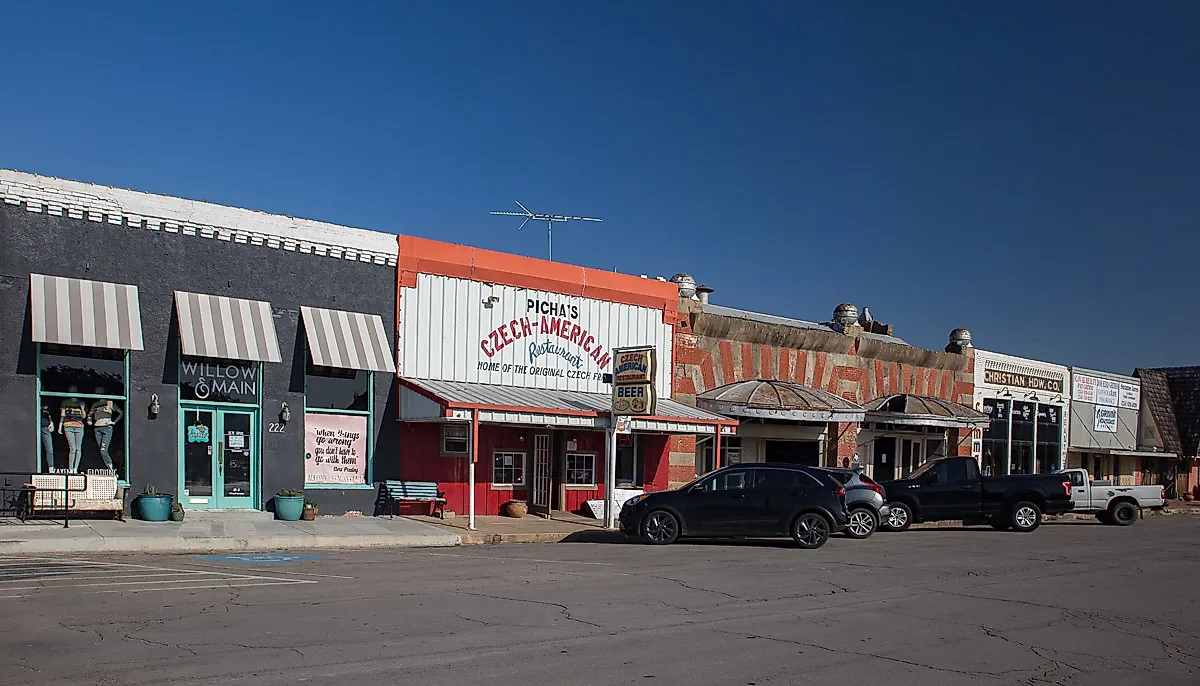
West introduces itself with the warmth of Czech village tradition. The town goes by the title Czech Heritage Capital of Texas, about 20 miles north of Waco. The first Czech immigrants arrived in the 1880s for railroad work. They found farmland cheaper than home in Moravia, then part of Austria-Hungary. That heritage still shapes how the town meets a stranger.
The Czech Stop stays open 24 hours on the I-35 frontage road. It turns out more than 5,000 kolaches a day, the small fruit- or cream-cheese-filled pastries. The meat-filled version is a klobasnek. Westfest has filled the fairgrounds every Labor Day weekend since 1976. It brings polka bands, traditional dance, and Czech beer. Downtown West holds a stretch of pre-1920 buildings. Several were rebuilt after the 2013 West Fertilizer Company explosion that leveled part of town.
Where The Door Stays Open
Texas hospitality looks different in every small town on this list. In Alpine it is a stranger pointing you toward the darkest skies in the state for a McDonald Observatory star party. In Llano it is brisket pulled from a mesquite pit and handed over with a nod. In West it is a warm kolache at two in the morning. In Bulverde it is a Saturday-night rodeo and a two-step that lasts past midnight. Pick any of these towns and you will leave knowing more people than when you arrived.