10 Of The Most Adorable Small Towns In Michigan
The most adorable small towns in Michigan owe their appeal to the distinct identities they've preserved over generations. Hand-stacked mushroom houses curve along one harbor, and a working Dutch windmill built in 1761 still grinds flour beside another. A fort fires its cannon on schedule, while a shoreline packs fossilized coral worth hunting down. These ten destinations hug the coast of Lake Superior and run down through the Lower Peninsula, each one earning its place on its own terms.
Charlevoix

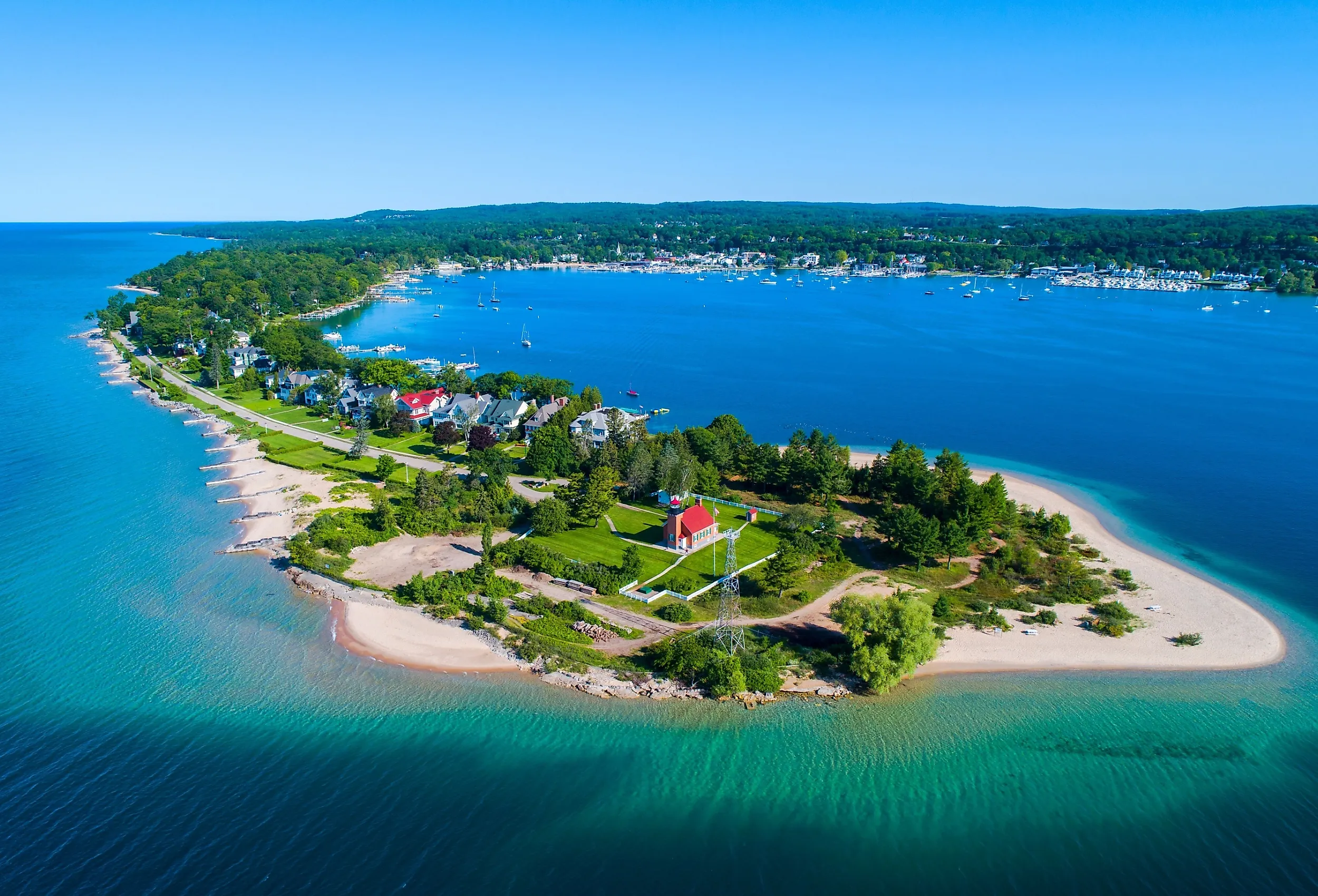
Roughly 50 minutes north of Traverse City, Charlevoix is squeezed onto a narrow spit of land between Lake Michigan and Round Lake. Walking down Park Avenue reveals Earl Young's Mushroom Houses, built using salvaged stone and glacial boulders. Young worked without blueprints or straight lines, stacking stones by hand under roofs that ripple like waves and shaping each house to fit its site. Following the street down to the harbor leads to the Charlevoix Memorial Drawbridge, a bascule bridge that lifts on the hour and the half hour during the warm boating season to give way to large watercraft. Michigan Beach Park stretches along the channel, giving visitors a front-row seat to boats moving between Round Lake and Lake Michigan. At the end of the waterfront path stands the red metal Charlevoix South Pierhead Light, marking the entrance to the harbor.
Petoskey

Set on a hillside above Little Traverse Bay, the Gaslight District frames Petoskey with cast-iron gas lamps lighting its sidewalks. Century-old brick buildings house independent bookstores and local artisan shops. McLean & Eakin Booksellers stacks a wide selection of books and vinyl records across various genres, while NorthGoods carries handcrafted gifts. Bayfront Park is steps from the commercial district. The rocky shoreline draws visitors hunting for Petoskey stones, the fossilized coral named after the town, which in turn honors the Odawa leader Petosegay. Just past the park, the Little Traverse History Museum sits inside a restored 1892 passenger train depot. Exhibits inside track the summers Ernest Hemingway spent in the region, along with an extensive collection of Odawa artifacts.
Harbor Springs

Across the bay from Petoskey, Harbor Springs wraps around a serene waterfront lined with sailboats. South of Main Street, Zoll Street Beach offers a quiet sandy shore where visitors can wade into the shallow waters of Little Traverse Bay. A few blocks over, the Ephraim Shay Works Museum occupies a hexagonal home built from stamped steel plates that mimic tile and brick. The Harbor Springs Area Historical Society restored the house and opened it as a museum of Shay's inventiveness, with hands-on galleries built into the main-floor rooms.
From the marina, Highway M-119 climbs out of town and becomes the Tunnel of Trees. The 20-mile stretch runs so narrow it carries no centerline, arching overhead in a canopy of maple and cedar with gaps that frame Lake Michigan below. Five miles up that road sits Pond Hill Farm, a 238-acre spread that works as a winery and brewery with a livestock barn attached. Its Gnome House Hunt turns the farm loop trail into a scavenger hunt, with twelve hand-built gnome houses hiding the letters of a single word.
Frankenmuth

Frankenmuth wears its German heritage on its sleeve, with timber-framed facades running along the length of its Bavarian streetscape. Along the riverfront, River Place Shops form an outdoor village with over 40 storefronts circling a courtyard. A short walk up the street leads to the Frankenmuth Cheese Haus, a local deli carrying over 270 cheese varieties, including a chocolate cheese made in-house.
At the southern edge of town, Grandpa Tiny's Farm keeps a working farm alive on the land William "Tiny" Zehnder started farming in 1938. Wagon rides run through the growing season, and the sunflower fields open for picking during the town's flower festival. Bronner's Christmas Wonderland is less than ten minutes away on foot. Open year-round, the showroom packs thousands of decorated trees and hand-painted nativity displays under one roof.
Holland

While Frankenmuth leans towards its Bavarian heritage, Holland showcases a distinctly Dutch character, located 30 miles west of Grand Rapids. De Zwaan, a working Dutch windmill shipped piece by piece from the Netherlands and assembled in Michigan, still turns its sails to grind grain into flour. It is part of Windmill Island Gardens, where manicured tulip beds frame a 36-acre park that also holds a Dutch street organ and an antique carousel.
The bright crimson square tower of Big Red Lighthouse guards the south side of the channel, and the north pier at Holland State Park is the closest the public can get to it. The wide Lake Michigan beach draws swimmers and sunset watchers right up to the water's edge. Just east, the Mt. Pisgah Dune Climb and Boardwalk tops out 157 feet above the lake, framing the lighthouse and the open water in a single view.
Mackinac Island

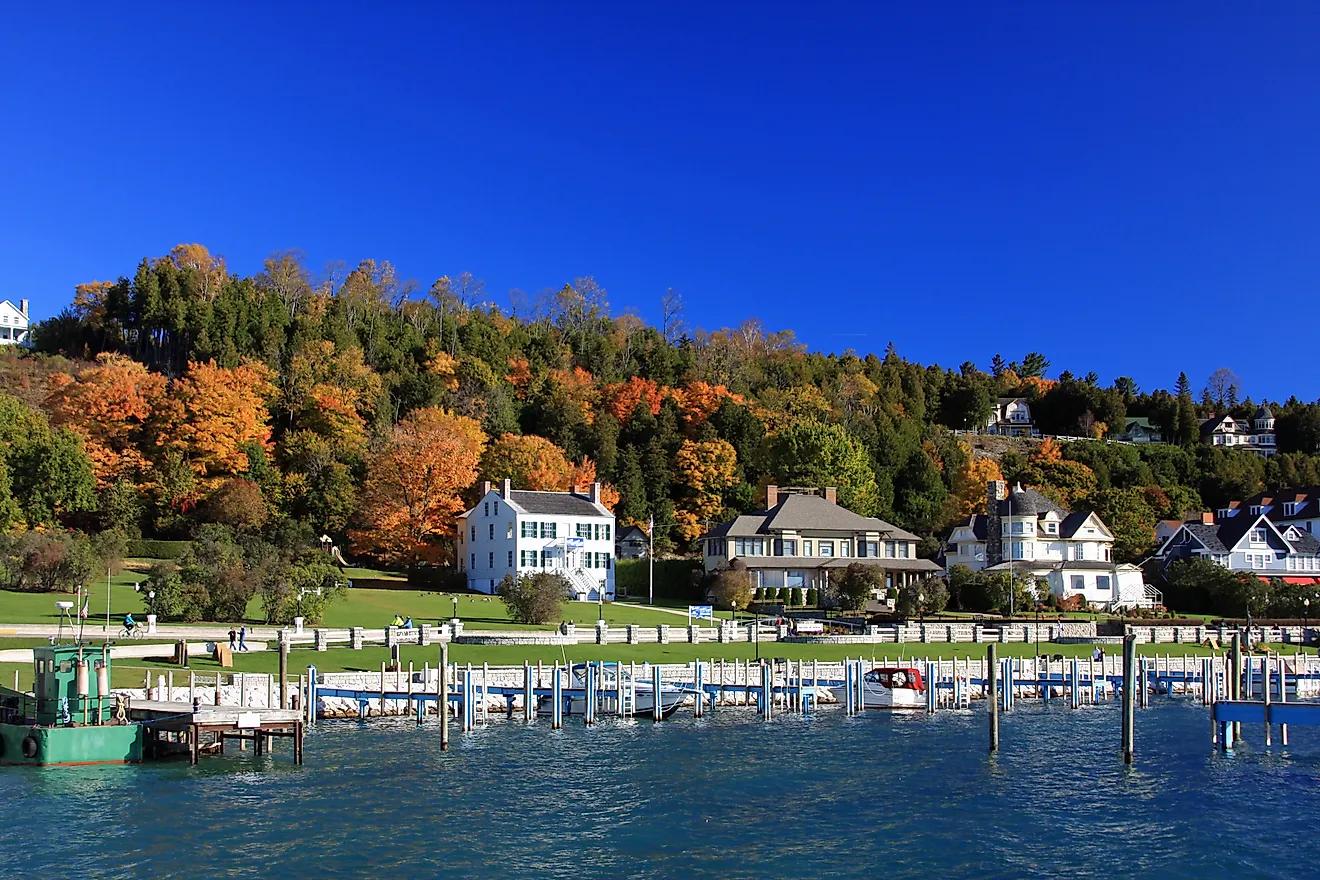
Horses first arrived on the shores of Mackinac Island in the 1700s to help build Fort Mackinac, and the fort has kept working ever since. Cannons still fire on schedule, and costumed interpreters fill the grounds to reenact garrison life. The fort sits inside Mackinac Island State Park, on an island that has barred motor vehicles since 1898, leaving horses to carry passengers.
More of its equestrian culture is on display at the Grand Hotel Stables. Working horses that transport guests across the island call it their home, while over 30 carriages and sleighs are on display, open for anyone to see for free. The scenery shifts at the Original Butterfly House and Insect World, founded in 1991 behind Ste. Anne's Church. Hundreds of butterflies from four continents fly loose inside a tropical glass garden. An attached gallery holds oversized walking sticks and giant beetles.
Marquette

Lake Superior's cold water defines Marquette's shoreline. The bright red Marquette Harbor Lighthouse has stood on Lighthouse Point since 1853, and because it sits on an active Coast Guard base, a guided tour is the only way inside. Tours run mid-May through mid-October out of the Marquette Maritime Museum. Further along the coast, Presque Isle Park covers a forested peninsula where black volcanic rock roughly 1.7 billion years old drops straight into the water. On the campus of Northern Michigan University, the DeVos Art Museum fills two galleries with rotating exhibits, highlighting the works of Upper Peninsula artists. Lakenenland Sculpture Park takes a different approach to art. Hundreds of sculptures welded from scrap iron and discarded machine parts line a winding trail shaded by trees.
South Haven

The Black River splits South Haven in two before spilling into Lake Michigan, and a red lighthouse marks the exact point where that happens. South Beach spreads out with a white sandy shore that gives clear views of passing boats. A short walk up the riverbank, Michigan Maritime Museum docks the Friends Good Will, a full-sized replica of an 1810 ship that sails with a costumed crew seasonally. Downtown, the South Haven Center for the Arts is housed inside a 1905 Carnegie library building that hosts year-round art shows and classes. Nature takes center stage at the Liberty Hyde Bailey Museum, a Greek Revival farmhouse surrounded by botanical gardens and a shaded trail.
Saugatuck

Billed as the "Art Coast of Michigan," Saugatuck developed an artistic identity early in the 20th century when painters established summer retreats along the Kalamazoo River. This creative legacy thrives at the Saugatuck Center for the Arts. An abandoned pie factory was converted into a cultural venue hosting theatrical productions and visual art exhibits.
Crossing the Kalamazoo River to reach the coastline preserves a piece of transit history. Operators turn a hand crank to push the Saugatuck Chain Ferry across the water, the last hand-cranked chain ferry still working in the United States, carrying passengers to the base of Mount Baldhead Park between Memorial Day and Labor Day. Climbing 303 wooden steps up the forested dune opens up the river valley and Lake Michigan before the trail descends toward the sandy shoreline of Oval Beach.
Northville

Northville sits roughly 30 minutes west of Detroit in a wooded pocket of Wayne County that feels farther from the city than the drive suggests. Main and Center Streets keep their original brick storefronts, filled with local shops instead of chains. Local creativity shines at the Dancing Eye Gallery, stocking its shelves with handcrafted tiles and Michigan-made gifts. Genitti's Hole-in-the-Wall is right across the intersection. The restaurant opened in 1971 when a hole was knocked through the wall of a former meat market and grocery store, now serving Italian meals alongside an interactive theater.
Mill Race Historical Village holds most of the town's past in one place. A cluster of 19th-century buildings moved here piece by piece, while others were built as replicas. The living history museum features a wooden schoolhouse and a blacksmith shop, lining the banks of the Middle Rouge River.
Ten Michigan Towns, Ten Different Experiences
Michigan's small towns tend to specialize, and these ten are no exception. Charlevoix committed to one stonemason's imagination, Frankenmuth to a Bavarian streetscape, Holland to a windmill it bought outright from the Dutch government, and Saugatuck to a ferry still cranked across the Kalamazoo by hand. In prioritizing the things that make them unique, they stand out as memorable destinations for those looking to explore Michigan at close range.