10 Best Towns In Sweden For A Two-Day Recharge
A restorative Swedish escape calls for a setting that makes slowing down feel inevitable. Sigtuna puts medieval ruins beside Lake Mälaren while Mariefred sends steam trains toward Taxinge Castle. Vadstena raises a Renaissance castle above Lake Vättern. Gränna twists peppermint sweets at Grenna Polkagriskokeri. Visby blooms with roses as Fjällbacka climbs toward Vetteberget. Trosa offers treetop thrills while Eksjö runs moose safaris through Skullaryd Älgpark. Ystad brings seaside spa time, and Hjo closes the trip with wooden streets beside Lake Vättern. These Swedish towns turn a two-day break into something worth remembering.
Sigtuna

Founded around CE 980 by Erik the Victorious and sitting on the shores of Lake Mälaren, the town of Sigtuna is deeply rooted in Viking history and its well-preserved medieval character, as it is home to several ruins from the days of kings and knights in shining armor. One of these is St. Olof Church, the stone remnants of a twelfth-century church dedicated to the Norwegian king Olaf II Haraldsson, later canonized as St. Olaf. It is one of three medieval church ruins in the old town, along with St. Per and St. Lars, and all three stand within a short walk of one another. For some time outdoors, Sigtuna's waterfront promenade runs right along the lake. You can walk the shoreline path or relax by the docks and enjoy the view. In summer, try your luck at the adventure golf course near the water, where the holes are built as miniature versions of Sigtuna's own historic buildings. The promenade is also a few minutes from the local cafes for coffee and pastries. For a castle-style stay near Sigtuna, Noors Slott in Knivsta offers bookable weekend accommodation. The building resembles an estate more than a castle, but its amenities will still have you feeling like royalty. There is free Wi-Fi, free parking, an on-site restaurant and bar, and a relaxation area with a sauna and hot tub. Garden areas surround the house, and a golf course nearby gives you a shot at a hole-in-one.
Vadstena

The town of Vadstena is a historic lakeside town with a well-preserved medieval core, and it is most famously known as the home of Vadstena Castle. The castle is Sweden's best-preserved Renaissance castle and was originally a defense fortress built by King Gustav Vasa on the shores of Lake Vättern. Its purpose now is to educate tourists and locals alike. It holds a museum displaying sixteenth- and seventeenth-century furniture, artifacts, and portraits of the people who once called the castle their home. To get up close and personal with nature, head for Omberg, the wooded ridge that rises straight off Vättern's eastern shore just south of town. Sveaskog manages the whole ridge as an ecopark, and it takes in several nature reserves along with hiking trails and long views over the lake. The trails also pass real history, including the grand ruins of the medieval Alvastra monastery at the foot of the ridge and the wall remnants of Drottning Ommas borg. At Omberg's southern foot in Alvastra, in the Ödeshög postal area, the year-round Ombergs Turisthotell offers lodging and an on-site restaurant. The big red house has taken in guests since 1914. It has a bar and lounge, and a terrace where you can enjoy a cool drink while looking out over Vättern and the Östgötaslätten plain.
Mariefred

Upon arriving at the town of Mariefred, you can expect a lakeside old town, vintage steam engines still running, and Gripsholm Castle standing over the water. The castle is a 16th-century fortress known for housing the Swedish National Portrait Gallery, a well-preserved 18th-century theatre, and historic Vasa-era rooms. It once served as a royal residence and occasionally as a prison for deposed monarchs, among them Erik XIV and Gustav IV Adolf. Now the castle is where tourists and locals go to learn about the purposes it has served and to see the artifacts of the past. As for the steam engine history of the town, you can ride the Museum Railway (ÖSLJ), a living, non-profit narrow-gauge heritage railway that preserves locomotives and carriages from the early 20th century. The train runs between Mariefred, Läggesta, and Taxinge-Näsby, where a cake buffet waits at Taxinge Castle. The castle promises at least sixty-five kinds of locally baked pastries, cookies, and tortes at any given time, and bills the spread as the largest cake buffet in northern Europe. If you have ever wanted to go camping in Sweden, Mariefreds Camping is a quiet, family-friendly site on Lake Mälaren. You can swim from a sandy beach, play round after round of mini-golf, and spend time at the playground. There is also bike riding, rowing, paddleboarding, and canoeing.
Gränna

The lakeside town of Gränna is best known for the invention and production of polkagrisar, the red-and-white peppermint rock sticks that Swedes still buy by the bag. To see how the treat is made, visit a historic shop like Grenna Polkagriskokeri. Inside, you can watch the bakers pulling, twisting, and cutting hot peppermint sugar and shaping it into the curved sticks generations have grown up on. The town is also the gateway to Visingsö Island, where a short ferry ride gets you to a nineteenth-century oak forest and medieval castle ruins. On the island, you can ride in a horse-drawn carriage or rent a bicycle and take a scenic route past its landmarks. Summer is the best time to go, as all of the local cafes and farm shops are up and running. For a place to sleep, Grännagården Hotell & Restaurang is a small family-run hotel in the middle of Gränna, with simple rooms and traditional Swedish food. A sandy beach on Lake Vättern is about a ten-minute walk away. Amenities include free breakfast, free Wi-Fi, an on-site restaurant, private bathrooms, and lake views from select rooms.
Ystad

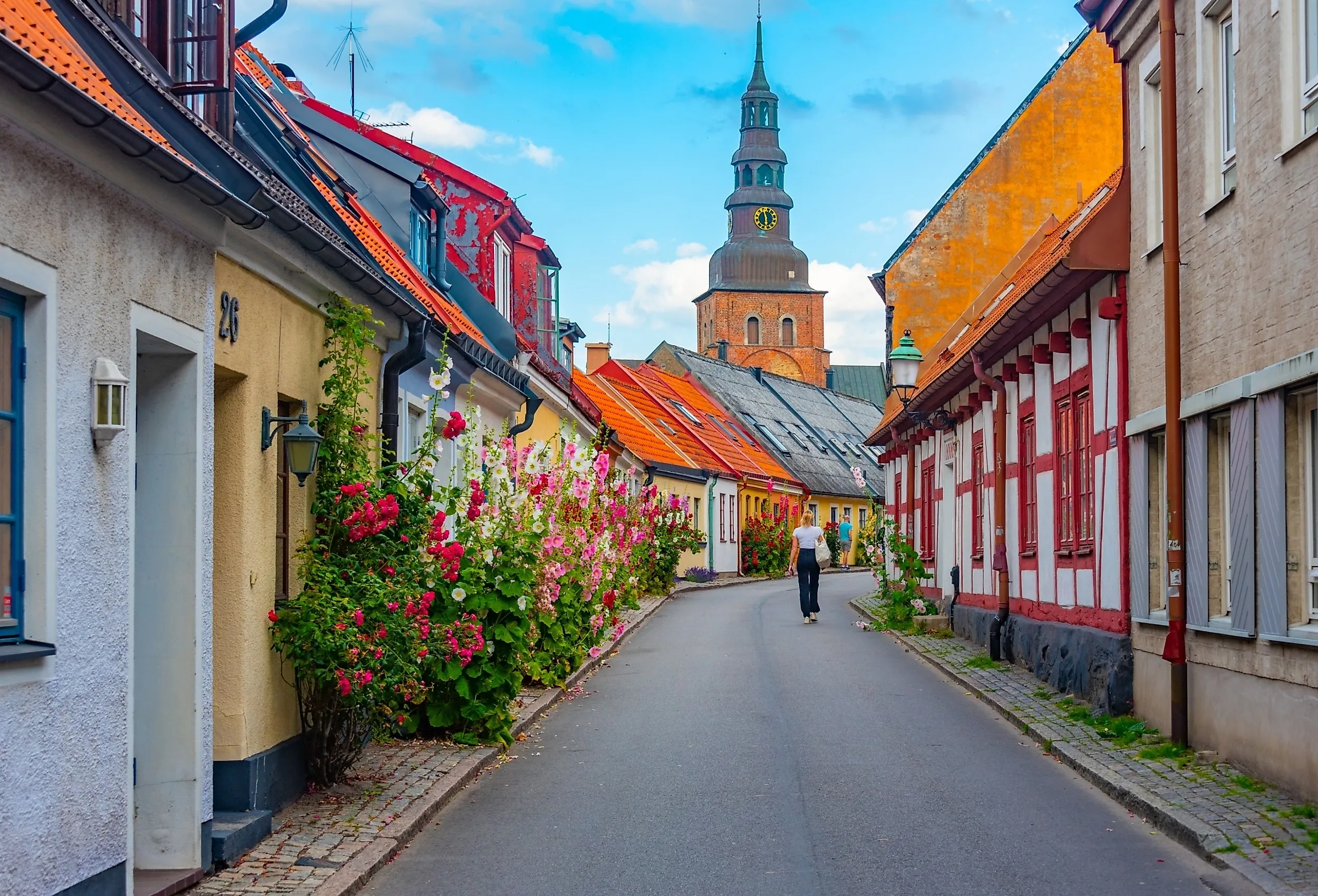
The town of Ystad traces its settlement to the 11th century and first appears in written records in 1244. Its half-timbered houses, most of them built between the 15th and 17th centuries, form the largest surviving complex of its kind in Scandinavia. The way to see them is to take a stroll through Old Town. Along the cobblestone path, you will pass landmarks like St. Mary's Church (Sankta Maria kyrka), Greyfriars Abbey, and Stortorget, the main square. Greyfriars Abbey was founded by Franciscan monks in 1267 and is one of the best-preserved medieval monasteries in the country. St. Mary's holds a tradition worth timing your walk around: since the 18th century, a watchman has sounded the horn from its tower through the night to signal that all is quiet. For fans of the television series Wallander, the Wallander Walks are a good way to revisit the show and browse the filming locations around town. You may also be able to pick up some memorabilia to take home. If you plan to stay by the sea, book a room at Ystad Saltsjöbad. It sits about a five-minute drive from central Ystad, looking straight out at the Baltic. Amenities include multiple pools, coastal dining, the Lido Club & Spa, saunas, and hot tubs, and every room comes with a balcony over the water.
Visby

Another well-preserved medieval town is Visby. Visby is also known as "The City of Roses," and rightfully so. Through spring and summer, the blossoms turn up in gardens and courtyards across the old town. The best place to see them is DBW's Botanical Garden, established in 1855 inside the ring wall, where roses of many species and colors bloom well into the autumn alongside fig and mulberry trees that survive on Gotland's mild island climate. The ruins of St. Olof Church stand in the middle of it, and the paths, benches, and small water features make it an easy place to lose an hour. An old town favorite for breakfast is Café Amalia, where the rustic dining room serves specialty porridge, yogurt bowls, homemade cakes, avocado toast, and omelettes alongside specialty coffees and matchas. At Hotel St. Clemens, you will find free Wi-Fi, cable TV, inner courtyards and gardens set against church ruins, a free organic local breakfast buffet, and daily cleaning, so you can spend your days walking the streets of Visby and seeing what the town has to offer.
Fjällbacka

Known for being a scenic fishing village on the Bohuslän coast, the town of Fjällbacka has a long maritime history and red-granite cliffs rising directly behind the harbor. The tallest of them is Vetteberget, 76 meters up, reached by a staircase from Ingrid Bergman's Square. Splitting the rock is Kungsklyftan, a 200-meter cleft that took its name after King Oscar II visited in 1886 and later stood in as a film location for Astrid Lindgren's Ronia, the Robber's Daughter. From the top, you get views over the harbor, and the islands of the archipelago, and Bronze Age cairns from around 1500 BC sit on the heights nearby. Fjällbacka is also the setting for the crime novels of Camilla Läckberg, who was born here, among them The Ice Princess and The Drowning. Fans can join the Camilla Läckberg Murder Mystery Tour, a guided walk of forty-five to fifty-five minutes through the author's hometown that visits the places behind the murder sites in her books. For a bed, the guesthouse Villa Evalotta has stood a few steps from the harbor since 1914. It offers guest rooms and self-catering apartments, and on the lower floor, there is a hair and beauty salon, so you can get your hair and nails done during your stay. Guests share a kitchen, a TV lounge, and balconies on each floor, plus a garden and picnic terrace for meals outdoors when the weather allows.
Trosa

Trosa carries the historical nickname "Världens ände," the End of the World, because the road once simply stopped here, and travelers had to turn around and head back the way they came. The journey back proves there is more to Trosa than meets the eye, with sights along the way that include Tureholm Castle. The structure is an eighteenth-century Swedish palace built on a former medieval estate along the Baltic coast. Visitors can see Tureholm's interiors on limited summer tours, and the surrounding grounds are worth the trip even when the house itself is closed. Trosa Aktivitetspark suits the adrenaline junkies in your group. There are high tree courses to climb, ziplines to ride, and park golf to play, along with outdoor games and campfire meals like barbecue and s'mores. It makes for a good day outside and a look at the more exhilarating side of Sweden. For glamping near Trosa, Havrevretens gård in Västerljung offers furnished lakeside tents, a wood-fired sauna, and home-cooked meals prepared by the staff. It is a nature retreat with the comforts of a hotel, and it is easy to forget you are spending the night outdoors.
Eksjö

In Eksjö, you get historic timber architecture, dramatic nature, and local culture in one small town. A short drive outside the center is Skullaryd Älgpark, where, unlike most zoos and wildlife parks, the residents roam a large tract of natural forest. The park opened in 2014, and a guide takes visitors into the enclosure on a tractor-drawn wagon for about fifty minutes, stopping to feed the moose, the red and fallow deer, and getting you within a few meters of animals that can weigh 600 kilograms. Back in town, a popular cafe in the heart of Eksjö is Lennarts Konditori, where you can order traditional Swedish pastries, breads, sandwiches, and coffee in a retro setting that draws locals and tourists alike. Right on the main square is the Eksjö Stadshotell, built in stone in 1862 to serve as the town hall after fire destroyed the old one, and left to the hotel and restaurant business when the town administration moved out in 1930. It has free Wi-Fi, a breakfast buffet, a bar and lounge, a sauna, and a relaxation area to put your feet up in after a long day.
Hjo

Located on Lake Vättern is the town of Hjo, an 18th- and 19th-century wooden town of narrow streets lined with timber houses and old artisan shops. Appropriately called The Wooden Town, it invites you to walk the narrow cobbled streets, admire the white and pastel wooden houses, and visit the boutiques and shops that call the town home. For a day out in nature, pay a visit to Hjoån's valley, a protected nature reserve on the edge of town. You can take a scenic walk there, spot historic mill sites and the sculptures set along the path, and watch for migrating fish in the stream when trout season comes around. If you want to sleep somewhere grander, book a stay at Hjällö Castle, an eighteenth-century house on the Vättern shore just south of Hjo. Guests get straight access to the lake and its beach. Amenities include budget-friendly lodging during the summer months, nature trails, views over the water, elegant rooms for events, a communal kitchen, and shared bathrooms.
A Two-Day Trip in Sweden Is Exactly What The Doctor Ordered
Modern life often means rushing from one place to another without making time to rest. The human body is not a machine, so occasional downtime matters whether it lasts two days or a full week. Sweden offers an inviting setting for a quick recharge with clean air, open landscapes, and abundant nature that can ease stress and encourage restful sleep. Even a two-day visit leaves enough time to enjoy the country’s quiet towns, lakeside scenery, and restorative atmosphere without committing to a weeklong trip.