8 Underrated Iowa Towns Worth The Drive In 2026
Iowa sits between two of the country's largest rivers, with the Mississippi on its eastern edge and the Missouri on its western one. The two-lane highways between them reward anyone willing to leave the interstate. This list of underrated Iowa towns covers eight places within easy driving distance of major hubs, each with a claim no other town shares. Sabula is the state's only island city, reached by a causeway over the Mississippi. In Le Mars, the Ice Cream Capital of the World, 55 six-foot fiberglass cones stand outside local businesses. Beyond those better-known oddities, these towns will take you through Danish settlements, former railroad communities, and towns preserving unusually specialized museums.
Mount Pleasant

A 95-minute drive southwest of Davenport, Mount Pleasant keeps a steam-engine showground open as a museum. The Old Threshers Heritage Museum puts visitors right up against the machines that ran Iowa farms. Climb aboard traction steam engines, including a Case 110, the largest in the collection, or sit behind the wheel of an antique tractor before walking through a 1915 farmhouse. On the same grounds, the Theatre Museum of Repertoire Americana keeps what is believed to be “the largest collection of painted stage backdrops in the United States,” some dating to the 1800s. Look for the actors' costume trunks and the Toby Tolliver Hall of Fame, honoring the red-haired comic who starred in rural tent shows.
Tracks running past both museums carry the Midwest Electric Railway, whose restored trolleys loop to a log village. Ride Waterloo Car 381, the last trolley in public service in Iowa, during the Labor Day reunion or October's Ghost Trolley rides. Downtown on Jefferson Street, The Grange Public House & Brewery brews its own beer and cider. Taste a flight with the Kornbinder and a plate of Kami shrimp.
Riverside

Twenty minutes south of Iowa City, Riverside has held the official title of Captain James T. Kirk's future birthplace since 1985. The proof stands on Greene Street, where the Future Birthplace of James T. Kirk stone lists his birth date as March 22, 2228. Fans pose beside the engraved slab, and the town has about two centuries left to prepare. Move down First Street to Railroad Park, where the Bronze Statue of James T. Kirk stands in front of a space-themed mural fence. Sculptor Jurek Jakowicz revealed it at Trek Fest in 2018, and locals still argue over whether it looks like William Shatner.
Across the road is the Voyage Home Museum. Visitors sit in a replica captain's chair, step onto a homemade transporter pad, and buy vials of "Kirk Dirt" scooped from the birth spot. For a round with less warp drive, Blue Top Ridge at Riverside Casino & Golf Resort sends golfers across more than 7,400 yards of Rees Jones-designed fairways overlooking two rivers. Golfweek has ranked it “Iowa's second-best course,” and it hosts the Iowa Open.
Le Mars

Attention, Ice Cream lovers. A 40-minute drive northeast of Sioux City, Le Mars has carried the “Ice Cream Capital of the World” title since 1994. The Wells Visitor Center & Ice Cream Parlor is an absolute dream with 40+ flavors available for sampling. Get a tasting flight or the Chocolate Volcano Sundae, then check out the interactive exhibits upstairs. Back outside, a self-guided map tracks down the Ice Cream Cone Sculptures, 56 six-foot fiberglass cones painted by local artists. The one outside the movie theater overflows with popcorn and wears a strip of film, and most others match the businesses they are around.
Not far, the Plymouth County Historical Museum covers five floors of Old Central, a 1905 high school. Its music room holds the Parkinson Instrument Collection, and Miller's Lunch recreates a downtown lunch counter. Dinner belongs to Archie's Waeside, a steakhouse open since 1949 and named a James Beard America's Classic in 2015. Third-generation owners still hand-cut and dry-age the steaks, and the dining room keeps its 1950s roadhouse look.
Elk Horn

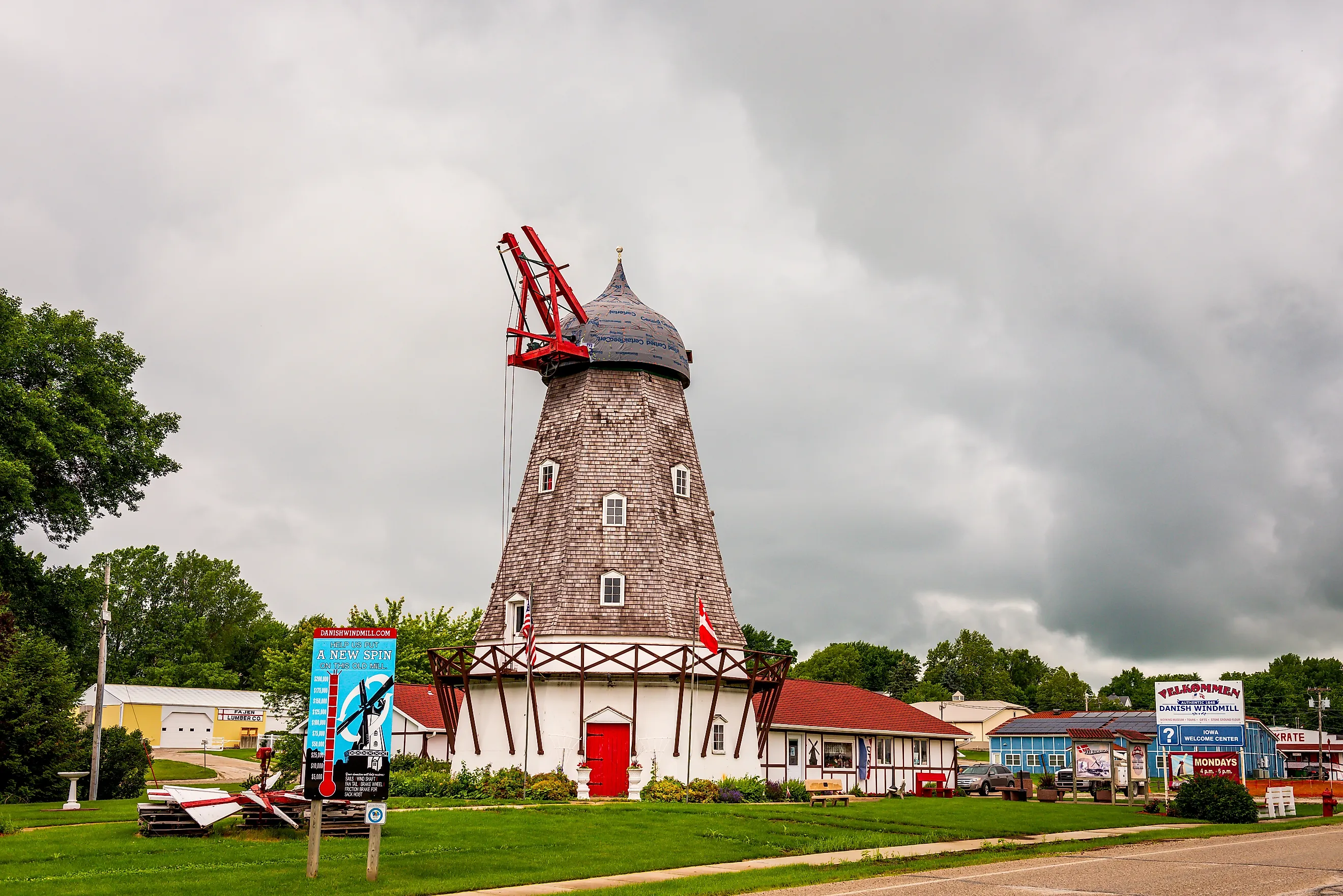
Eighty minutes west of Des Moines, Elk Horn is proud to be “the largest rural Danish settlement in the United States.” That heritage rises 60 feet at the Danish Windmill, constructed in the 1840s in Denmark, and reassembled here by 300+ volunteers in 1976. Climb the stairs and ladders to the fourth-floor deck to look up into the mill's cap, then step into the tiny Morning Star Chapel on the grounds. Six minutes up on Main Street, The Kringle Man bakes rectangular kringle from recipes collected from Danish grandmothers. Pair the almond-paste Danish letter with coffee, or carry home a family-size kringle.
Off Washington Street, the Museum of Danish America covers three floors with the story of Danish immigrants and what they brought with them. Look for a restored 1950 Nimbus motorcycle, Royal Copenhagen porcelain, and the current Vikingmania exhibit. Outside, the paved Friend's Trail loops through the museum's 35 acres of restored native prairie past an early 1900s cabin.
Decorah

If you drive 2 hours north from Cedar Rapids, Decorah will charm you with its reputation as a Norwegian-American cultural capital. Vesterheim is your first stop with silver bridal crowns, rosemaling, carved butter molds, and a boat that sailed the Atlantic. Book a class at its Folk Art School to try rosemaling, weaving, or knifemaking yourself. Across the Upper Iowa River, Dunning's Spring Park holds Iowa's tallest waterfall, a 200-foot cascade that snakes down limestone ledges in short drops. Cross the stone bridge and climb the steps to where the spring pours out of the cliff.
A half-mile walk east on Ice Cave Road leads to the Decorah Ice Cave, “one of the largest ice caves in the Midwest.” Ice coats its north wall from late spring into August, so a summer visit means stepping from warm air into a chill pocket of limestone. About five miles southeast, Toppling Goliath Brewing Co. pours more than 20 beers between two indoor bars and a beer garden with fire tables. Get a flight with Pseudo Sue, the citrusy pale ale that built the brewery's following well beyond Iowa.
Spillville

A 110-minute drive from Cedar Rapids, Spillville is where Czech composer Antonín Dvořák spent the summer of 1893. On South Main Street, the Bily Clocks Museum & Antonín Dvořák Exhibit showcases clocks built by brothers Joseph and Frank Billy. Some stand up to nine feet tall and and are covered in hundreds of carved figures.
Guides tell how the brothers turned down Henry Ford's $1 million offer for one, then send you upstairs to see where Dvořák's family lived while he wrote his "American" String Quartet. A few doors down, Wenzil Taylor Food & Brew is part of an 1871 merchandise store with pizza, drinks, and a bar shipped from Ireland. Head to the basement pub to eat in booths lining two parallel limestone tunnels.
Bridge Street then drops to the Turkey River and Riverside Park Campground, where campsites sit beside a canoe landing. Paddle the river or toss horseshoes before settling in for the night. The park is also the center for the Fourth of July Fireworks. It is a full day of bingo, a 5K, kids' games, and Little League.
Britt

Just under two hours north of Des Moines, Britt has hosted the National Hobo Convention every August since 1900 and keeps the country's only hobo museum on Main Avenue. The National Hobo Museum fills the old Chief Theater, where the slanted floor and some original seats still sit among the exhibits. Look for carved walking sticks, ball-in-cage whittling, and the belongings of hobos like Frisco Jack and Steam Train Maury. Those names come back to life each August at Hobo Days, when rail riders camp at the Hobo Jungle boxcar a block off Main Street. The four-day festival opens with a Four Winds fire lighting, serves free Mulligan stew, and crowns a new Hobo King and Queen.
On 2nd Street SE, the Armstrong House is an 1890s Victorian with stained glass windows, a wraparound porch, and two towers. Book a tour to see the hidden back stairway that let the family's Norwegian maids move between the kitchen and the second floor unseen. A few miles northeast of town, Eagle Lake State Park covers 21 acres on the edge of a 900-acre glacial marsh. Its observation deck and lakeside trail overlook a major migration stopover, and bald eagles are common in winter.
Eldon

About 1 hour 50 minutes southeast of Des Moines, Eldon keeps the 1880s farmhouse Grant Wood sketched in 1930 before painting American Gothic. At the American Gothic House, borrow a pitchfork and period costume from the visitor center and pose in front of the pointed Gothic window. The interior opens for monthly tours seasonally, and the center next door screens a 30-minute documentary on Wood. Right beside the center, the Chippewa Creek Trail & Disc Golf Course follows a walking trail through prairie grass and woods. The free course expanded to 18 holes in 2023, and a round covers about 2.3 miles.
Just under a mile away, the Rock Island Train Depot has served Eldon since the early 1870s and now displays telegraph gear, signals, and passenger-train items. On summer weekends, climb into the cab of the restored engine to blow the whistle, then check out the model railroad in the Rocket Room. Downtown on Elm Street, the McHaffey Opera House rises in bricks from David McHaffey's own brickyard. Rail lines once brought touring Broadway and vaudeville acts to its 1891 stage, and volunteers now open the restored hall for community events.
These underrated Iowa towns worth the drive in 2026 prove that memorable stops across the United States do not need to be major destinations. In Elk Horn, the Danish Windmill rises 60 feet above Main Street, while Eldon preserves the farmhouse that inspired Grant Wood’s American Gothic. Spillville adds another unusual stop with its towering Bily clocks and Dvořák connection. Together, these towns offer highly specific experiences that make the extra miles worthwhile.


.jpg)