The State Parks With The Best Fall Foliage Drives
Some of the best fall foliage views in the country aren't found at the end of a long trail, but visible instead from scenic drives that pass through state parks. Between late September and late October, bright days and cool nights intensify the yellows, golds, oranges, and reds in deciduous trees.
Across seven state parks, roads climb mountain notches, trace gorge rims, and wind through hardwood forests at peak color. Lakes and exposed granite create sharp contrast against the changing leaves. Scenic overlooks, roadside pull-offs, and short walks add wider views across valleys and gorges without straying far from the route.
Letchworth State Park, New York

Within Letchworth State Park, the 17-mile Park Road runs the length of the 14,350-acre landscape that strings together most of its scenic overlooks. The road has several immediate pull-offs for viewing foliage, including the Archery Field, Great Bend, and Eddy's Overlook. Hitting the drive just before sunset and right after sunrise until about 10:00 am provides soft, warm light that makes the autumn colors pop.
One of the most spectacular view is from Inspiration Point. Just off Park Drive is a small parking lot and very short walk that leads directly to a cliff edge. From this point, a canopy of bright red sugar maples and gold birches frames a view down the Genesee River gorge to both the Middle and Upper Falls. Mid-October brings some of the season’s richest fall color.
Hocking Hills State Park, Ohio

A 25-mile loop that forms the core of Hocking Hills Scenic Byway connects the noncontiguous sections of Hocking Hills State Park, winding through sandstone country dominated by yellow poplars, red and sugar maples, and several species of oaks.
This mature forest produces a visual feast in autumn along the byway. The peak foliage window for this region falls between early to mid October, when the deciduous canopy turns gold, orange, and red. The towering evergreen hemlocks within Hocking Hills produce a sharp contrast to the autumnal shades.
The shortest and most accessible walk directly off the drive is to Ash Cave, a 0.25-mile paved and wheelchair-accessible route that leads to the 700-foot wide entrance of a massive recess cave. In autumn, the gorge's forest surrounding the cave and its seasonal waterfall stand in colorful contrast to the sandstone entrance.
Smuggler's Notch State Park, Vermont

The main road through Smuggler's Notch gains about 1,000 feet of elevation through mixed maple forest on a winding four-mile route that traverses the park's core. Sugar and red maples line the road, turning a deep, saturated orange and crimson red that peaks between late September and mid October.
The notch's elevation tends to bring fall colors earlier than the valleys below. The Vermont Route 108 section that passes through the park, named Smuggler's Notch Scenic Highway, features a historic stone bridge, massive boulders, and several switchbacks that serve as natural overlooks. The road closes to vehicles with the first snowfall, usually in late October. The narrow, 3.5-mile route is full of tight curves, so oversized vehicles and tractor-trailers are banned.
The drive itself has incredible scenery, but a short stop at the 0.3-mile Barnes Camp Loop adds another perspective. The gravel and boardwalk path begins just off the road and passes beneath fall foliage with Smugglers' Notch cliffs and Mount Mansfield wetlands in the background. The walk takes about 10 minutes and opens onto panoramic views of the changing colors across the surrounding landscape.
Itasca State Park, Minnesota

Established in 1891 as Minnesota's first state park, Itasca frames its 10-mile Wilderness Drive around more than 32,000 acres of forest with stands of deciduous trees that develop brilliant shades of gold, yellow, and red beginning in late September.
The drive displays some of the best fall colors in Minnesota through the maple, oak, and birch stands that fill the gaps between old-growth red and white pines. A short, 0.2-mile hike from a parking area just off Wilderness Drive leads to the 100-foot Aiton Heights Fire Tower. The summit of the tower reveals panoramic views of brilliant fall foliage amid glacier-carved lakes.
The loop road passes the 2,000-acre Wilderness Sanctuary, one of the state's National Natural Landmarks. The route also skirts more than 100 lakes and connects to the Mississippi Headwaters area, where you can walk across the river surrounded by fall foliage at the exact point it leaves Lake Itasca.
Ricketts Glen State Park, Pennsylvania

The drive through Ricketts Glen State Park's 13,193 acres are accessed via a steep 13-mile loop road off Pennsylvania Route 118 and 487, which routes through a landscape dominated by old-growth hemlock, beech, and sugar maple.
Most people start at the lower, Route 118 entrance, a level stretch where the road runs close enough to Kitchen Creek that old-growth hemlock and beech crowd the shoulder. These dense, evergreen hemlocks give a sharp visual contrast to the orange-red maples and gold birch leaves mixed throughout the stands. For a short walk, the Evergreen Trail leaves from a parking lot right off the route, and it's only a few hundred feet to the 36-foot Adams Falls.
To reach the upper part of the park, continue on Route 118 before turning onto 487 at the town of Red Rock. The road climbs at a steep grade, reaching about 18 percent in some sections, onto Red Rock Mountain. The sharp elevation gain from 1,700 to 2,200 feet in elevation means fall foliage color at the bottom of the mountain and color change at the summit can be a week or more apart. Taking the drive during mid-October showcases the changing gradient, with the trees still turning at the bottom and already reaching a burst of color at the top. Near the summit is Lake Jean, where the lake mirrors the hardwood leaf colors on the far side of the shore.
Fall Creek Falls State Park, Tennessee

The about six-mile Scenic Loop Road inside Fall Creek Falls State Park passes through stands of maple, dogwood, and hickory that reach their fall peak in late October. The drive runs the western edge of the Cumberland Plateau around the Cane Creek Gorge, a limestone cleft that covers nearly eight miles and drops as much as 800 feet.
The Fall Creek Falls Overlook is a paved viewpoint less than a five-minute walk from the road that looks straight across the gorge at a 256-foot waterfall. The sheer plunge of white water and gray rocks splits the red, orange, and gold colors of the maple and hickory trees on either side of the canyon wall.
The drive also features overlooks above Cane Creek Falls and Cane Creek Cascades, both visible without a hike from turnouts near the nature center. Looking across these overlooks, maple, dogwood, sourwood, and hickory can be seen in autumnal shades on the gorge slopes against hemlock and pine that stay green through the season.
Franconia Notch State Park, New Hampshire

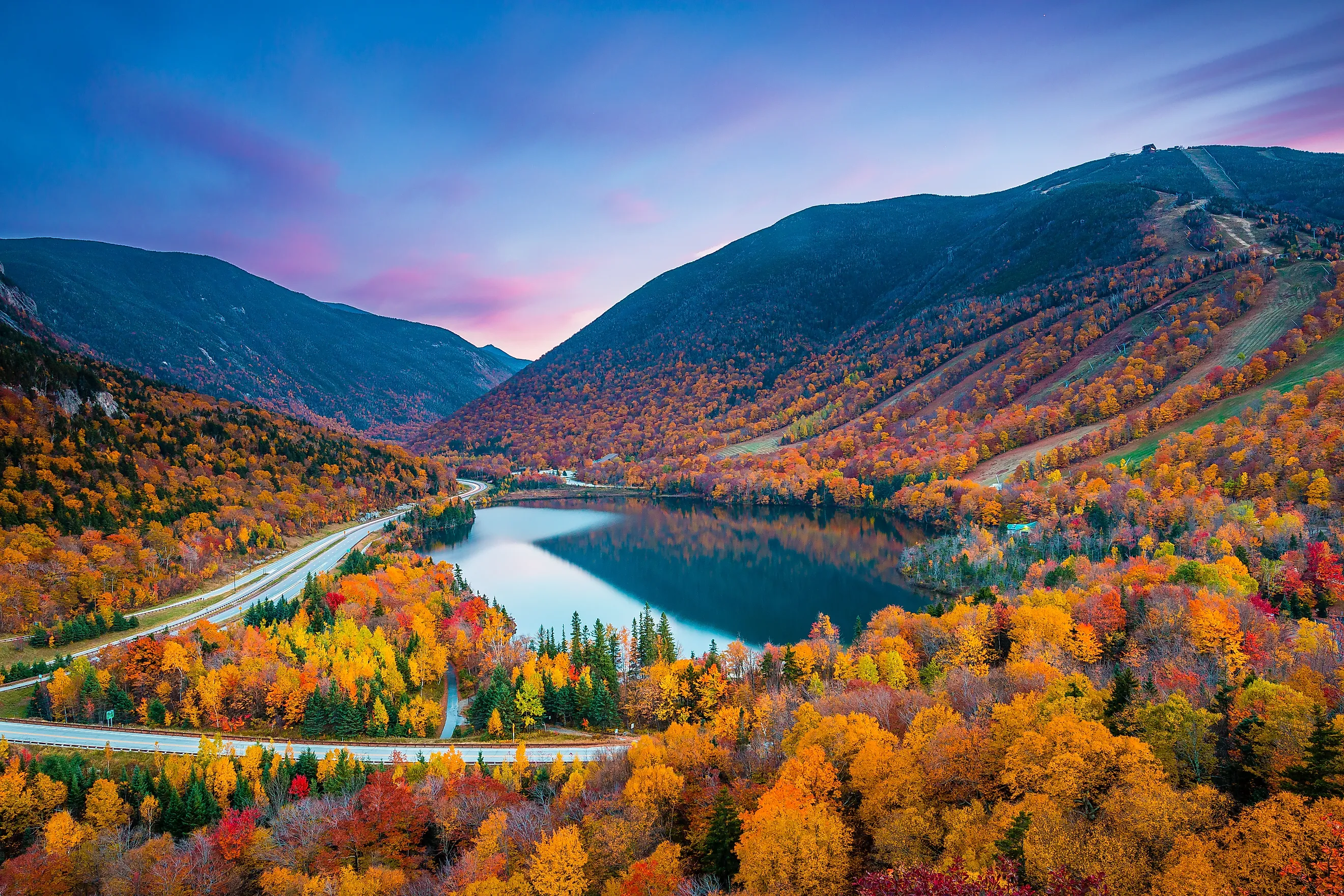
For eight miles, Interstate 93 narrows to a two-lane road as it passes through stands of autumn-colored hardwood forests in the Franconia Notch between the Kinsman and Franconia ranges. It is one of the only stretches of two-lane interstate left in the country, kept that way deliberately after a decades-long fight to protect the ecosystem of the notch that lines either side of the road. Numerous pullouts line the route, so it drives more like a scenic byway despite the interstate signage. Sugar maple, birch, and oak fill the lower slopes in red, orange, and yellows, while the granite ridgelines and cliffs of Cannon Mountain and the Franconia Range stay bare above the treeline. This contrast gives the fall foliage colors a hard gray backdrop.
Profile Lake and Echo Lake both sit right off the parkway and mirror the hillside colors, reachable in a few steps from their pullouts. For a longer walk off the route, the Flume Gorge is a two-mile boardwalk through an 800-foot granite chasm only 20 feet wide at the bottom. Its wet, moss-covered walls stay green and shaded while the hardwood canopy above displays autumnal hues.
The Cannon Mountain Aerial Tramway adds a way to see the color from above without hiking at all. An eight-minute ride to the 4,180-foot summit showcases the valley's hardwood color beneath, framed by the bare rock and darker spruce-fir forest near the top. Foliage typically peaks in the notch just before mid-October with early morning being best for lighting.
The Best Fall Foliage Drives Across US State Parks
These paved state park corridors highlight the brief, brilliant window before winter when North America's hardwood canopies transform into spectacular displays of gold, orange, and red. The northernmost and higher elevation parks typically only have a one to two-week period where the colors are the most vibrant, so planning and understanding when the leaves peak are crucial.
Tracking local weather shifts and elevation changes helps pinpoint the exact window when each forest reaches the maximum color intensity. Ultimately, these accessible drives through state parks ensure that even a quick autumn road trip yields front-row views of the season's grandest natural spectacle.