What Happens When A State Sells Off Park Land
In 2023, Texas lost a state park. Not to a hurricane or a wildfire, but to a real estate closing. Fairfield Lake State Park, 1,820 acres of pine woods and open water, had operated for nearly five decades on land the state never actually owned. Vistra Corp., the power company that built the reservoir, had leased the park to Texas Parks and Wildlife at no cost, right up until it sold the entire 5,000-acre property to a Dallas developer for roughly $103 million. The state tried to seize the land back through eminent domain, but a court-appointed panel valued it at four times the developer's purchase price, and Texas walked away rather than pay it. The park is now slated to become a gated subdivision with a private golf course.
That's the version of this story most people never hear about, because it doesn't look like the slow-motion budget fights that usually threaten national parks. State parks don't have the federal protections or the single governing agency that Yellowstone or Yosemite do. Instead, each one belongs to the individual state, is funded by an individual state legislature, and can, under the right (or wrong) circumstances, be sold, swapped, or leased away like any other piece of government-owned real estate. So how does that actually happen? Here's a look at the mechanics, and at what's played out in five states where it has.
How State Park Land Actually Gets Sold Or Swapped

Unlike national parks, which sit inside land that Congress has to formally act to remove from federal protection, state parks are governed by whatever rules each state legislature has put in place. Those rules vary enormously across the country. In most, selling or repurposing park land requires legislative approval, sometimes paired with a public comment period or an environmental review. The bar is set by statute rather than the U.S. Constitution, which means statutes can be rewritten by a simple majority vote.
A handful of states have built in stronger safeguards. New York's constitution, for instance, requires that its Forest Preserve, which includes land inside Adirondack Park and Catskill Park, be "forever kept as wild forest lands." Removing so much as an acre requires a constitutional amendment passed by the legislature in two consecutive sessions and then approved by New York voters statewide. It is a process so demanding that only a small number of amendments, roughly twenty by most counts, have cleared it since the clause was adopted in 1894, according to the Adirondack Council. Most other states offer no comparable constitutional wall.
Federal funding adds another layer of protection. Any state park that was built or improved with money from the Land and Water Conservation Fund is bound by a federal conversion clause. The state can't repurpose that land for anything other than outdoor recreation without National Park Service approval, and without replacing it with land of equal value and usefulness elsewhere, as outlined in the LWCF Manual. That rule has slowed down more than one proposed sale, but it only applies to parks that took LWCF money in the first place.
Lake Texoma State Park, Oklahoma

Oklahoma didn't lose this park to circumstance. The state sold it outright. In 2005, Oklahoma agreed to sell roughly 750 acres of Lake Texoma State Park, including its 106-room lodge and golf course, to Pointe Vista Development, a group backed by energy executives Aubrey McClendon and Mark Fischer. The $14.6 million deal closed in 2008, with promises of a resort community valued at half a billion dollars or more. Instead, the lodge was demolished, the golf course shut down, and the site sat largely undeveloped for years. Local bait shops and marinas near the old resort reported losing 30 to 40 percent of their business once the lodge closed, according to StateImpact Oklahoma. After the state sued in 2013 to force construction or reclaim the land, it settled in 2015 by buying back just 50 of the original 750 acres for about $4 million and dropping all development deadlines. The Pointe Vista resort now occupies the site, with a Hard Rock Hotel that began construction in 2024, but the state park land itself is gone for good.
Fairfield Lake State Park, Texas

Fairfield Lake State Park shows a quieter way a state can lose parkland: by simply not owning it. Vistra Corp. leased the 1,820-acre park to the Texas Parks and Wildlife Department at no cost since the 1970s, all while retaining ownership of the surrounding 5,000-acre property. In 2018, Vistra announced plans to sell, and in June 2023, Dallas-based Todd Interests bought the entire tract for about $103 million. TPWD closed the park that February and, later that year, attempted to use eminent domain to keep it public. A Freestone County panel valued the land at $418.3 million, nearly four times what the developer paid and far above the $85 million the state had offered. In December 2023, Texas abandoned the effort rather than risk a costly trial, according to the Texas Tribune. Todd Interests now plans a gated community with a private golf course on the site.
Kohler-Andrae State Park, Wisconsin

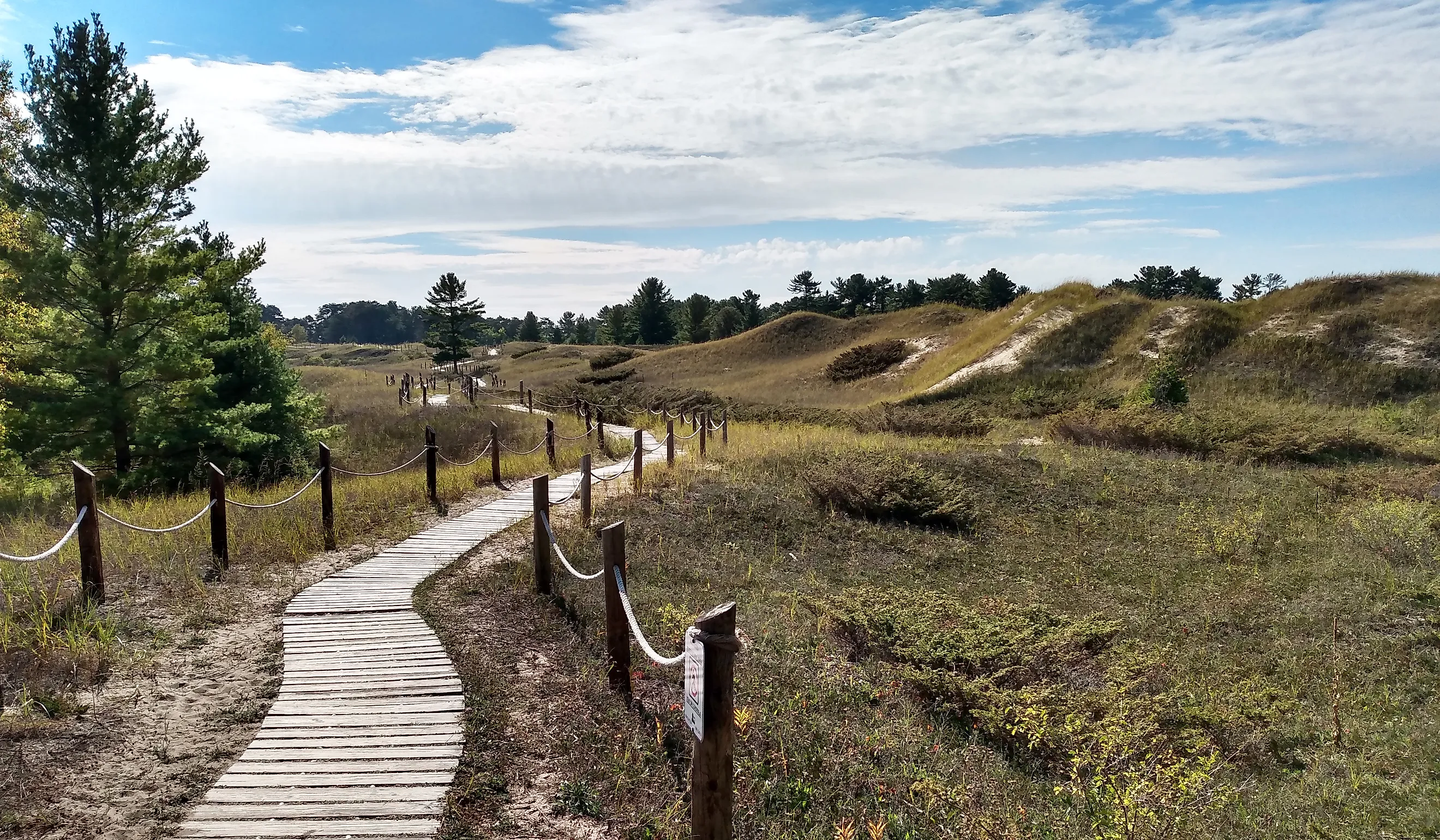
Not every attempt to hand over parkland succeeds, and Kohler-Andrae State Park on Lake Michigan is the clearest example of one that's been stopped repeatedly in court. In 2014, under Governor Scott Walker, Wisconsin's DNR approved swapping about 4.6 acres of state park land, plus an access easement, for 9.5 acres owned by Kohler Co. The company sought to build an 18-hole public golf course on its adjacent 247-acre parcel along the Lake Michigan shoreline. The parkland would have become a roadway, roundabout, and maintenance facility for the course. An administrative law judge overturned the project's wetland fill permit in 2019 for relying on "speculation and promises" instead of science, and the Wisconsin Court of Appeals upheld that reversal in December 2023, finding the permit application still missing key pollution data. As of this writing, the golf course remains blocked, and groups including the Sierra Club continue pushing Governor Tony Evers to undo the original land swap entirely, per PBS Wisconsin. For now, the park's dunes and beach along Lake Michigan remain public.
Liberty State Park, New Jersey

Liberty State Park, 1,212 acres across the water from the Statue of Liberty and Ellis Island, has fended off development proposals for decades without ever being sold, which makes it a useful study of what a sustained fight over parkland actually looks like. Opened in 1976 as New Jersey's bicentennial gift to the nation, the park has been the target of repeated commercial proposals over the years, including golf course expansions, a water park, hotels, and, most recently, a Suntex Marina proposal for a three-acre, 75-foot-tall luxury yacht storage warehouse. The warehouse proposal is six times larger than the half-acre limit set by the National Park Service's 1990 Record of Decision for the site, according to Jersey Vindicator. In response, state lawmakers have advanced the Liberty State Park Protection Act, which would block development incompatible with public recreation and require public input before the state's environmental agency approves changes. As of this writing, the bill had cleared a Senate committee in March 2026 but still needed budget committee approval, floor votes, and the governor's signature. The park's Liberty Science Center and Empty Sky memorial remain open to visitors in the meantime.
California's 2011 Budget Crisis

Sometimes the threat isn't a sale at all, but a state simply running out of money to keep a park open. California's 2011 budget crisis remains the largest-scale version of that on record. Facing a $33 million cut to the parks budget over two years, then-Governor Jerry Brown's administration announced in 2011 that 70 of the state's 278 state parks, roughly a quarter of the system, would close by July 2012. State Parks Director Ruth Coleman said at the time that "with the proposed budget reductions over the next two years, we can no longer afford to operate all parks." Rather than sell any of the land, though, the California Department of Parks and Recreation spent the following year signing operating and donor agreements with nonprofits, local governments, and concessionaires. By July 2012, 69 of the 70 parks had stayed open in some form; only Providence Mountains State Recreation Area closed, and that was for infrastructure repairs rather than the budget itself, according to the department's own announcement. It's the outcome most budget-driven park scares actually have: reduced hours and partnership deals, not a bill of sale.
Why This Keeps Happening, And What Protects A Park

Taken together, these five cases land in three different buckets. Oklahoma and Texas show what an outright loss looks like, whether through a direct sale or a lease that simply ran out from under the state. Wisconsin and New Jersey, on the other hand, warn that a proposed sale or swap isn't the same as a finished one, and that permits, courts, and organized opposition can delay a project for a decade or more. California shows a third pattern entirely: most park funding crises never reach a sale at all, because they end in reduced hours and partnership agreements instead. Closing a park, it turns out, is politically easier to walk back than selling the land under it.
So what actually separates the parks that stay public from the ones that don't? Mostly, it comes down to who owns the land in the first place, whether federal LWCF money is tied to it, and whether the state has built in any legal speed bump, like New York's constitutional amendment requirement, that a legislature can't undo on its own in a single session. For everyday travelers, the practical takeaway is simpler: state park land is not guaranteed to stay a state park. If there's a park on your list that's tangled up in one of these fights, it's worth visiting sooner rather than later, and checking the relevant state agency's current site for hours, fees, and access before you go, since all three can shift quickly around a park in this kind of limbo.