The Least Visited State Parks In America
You would think this would be an easy list to write. Just pull the visitor numbers, sort them smallest to largest, and hand out a trophy to the emptiest state park in America. Except here is the twist that makes this whole topic weirdly fun: that list basically cannot be made. Nobody actually knows which state park is the least visited, and the reasons why are a genuine statistical circus. So before we get to a few gloriously empty contenders, let us talk about why "America's least-visited state park" is less a fact than a ghost story.
There Is No Scoreboard

National parks are easy to rank. All 63 of them answer to a single agency, the National Park Service, which counts visitors with one shared system and publishes tidy numbers every year. That is why everyone knows Gates of the Arctic in Alaska is the loneliest one. State parks have no such referee. There are more than 10,000 of them, spread across 50 states, and each state runs its own park agency with its own budget, its own priorities, and its own way of counting heads, or not counting them at all. There is no master spreadsheet, no national ranking, no equivalent of the Park Service tallying it all up. Fifty scorekeepers, fifty rulebooks, and no league office.
Nobody Counts the Same Way

Even where parks do count, they count differently, and the methods are shakier than you would hope. A lot of visitor numbers come from a rubber tube stretched across an entrance road that clicks every time tires roll over it, then gets multiplied by a guessed number of people per car. Some parks tally only paid entries, some run infrared trail counters, some straight-up estimate. And these systems break constantly. At Crater Lake, an entrance counter failed in 2012 and logged zeros for the better part of a year before anyone fixed it. Worse, most of these tallies count "visits," not people, so one local who walks their dog in the same park every morning can rack up 300 "visits" a year single-handedly. If the pros struggle with all that, imagine 50 states doing it 50 ways.
Half of Them Do Not Even Have a Gate

Here is the real killer. A huge share of state parks are free, open around the clock, and completely unstaffed, with no booth, no gate, and nobody collecting anything. When there is literally no one at the entrance, there is literally no one counting, so a park can look "least visited" simply because it is uncounted, not unvisited. Pile on the fact that states cannot even agree on what a "state park" is, some lump in recreation areas, historic sites, natural areas, and undeveloped land they are just holding onto, and you are no longer comparing apples to apples. You are comparing apples to hand grenades. So treat every list like this one, including this one, with a healthy shrug. With that giant asterisk in place, here are some parks that genuinely almost nobody visits.
Big Bend Ranch State Park, Texas

Start with the rare case where we actually have a number, and a jaw-dropping one. Big Bend Ranch is the largest state park in Texas at over 300,000 acres, and in all of 2025 it logged around 12,451 visitors. For perspective, the famous national park next door can pull that many people in a single busy day. Texas literally nicknamed it "El Despoblado," The Uninhabited, and the interior ranger station sits 27 miles of dirt road from the nearest highway. It is one of the wildest parks in Texas, and its emptiness is not a data glitch. It is the genuine article.
Berlin-Ichthyosaur State Park, Nevada

If you set out to design a park almost nobody would stumble upon, it would look like this. Berlin-Ichthyosaur sits high in the Shoshone Mountains of central Nevada, at the end of a long haul from anywhere, and it combines two things you would never expect to share a parking lot: Berlin, a mining ghost town abandoned around 1911, and a shelter full of fossilized ichthyosaurs, 50-foot marine reptiles that swam here 217 million years ago when Nevada was underwater. It is one of the most fascinating parks in Nevada and one of the loneliest, which is exactly why the people who make the trek tend to have the whole strange place to themselves.
Anza-Borrego Desert State Park, California

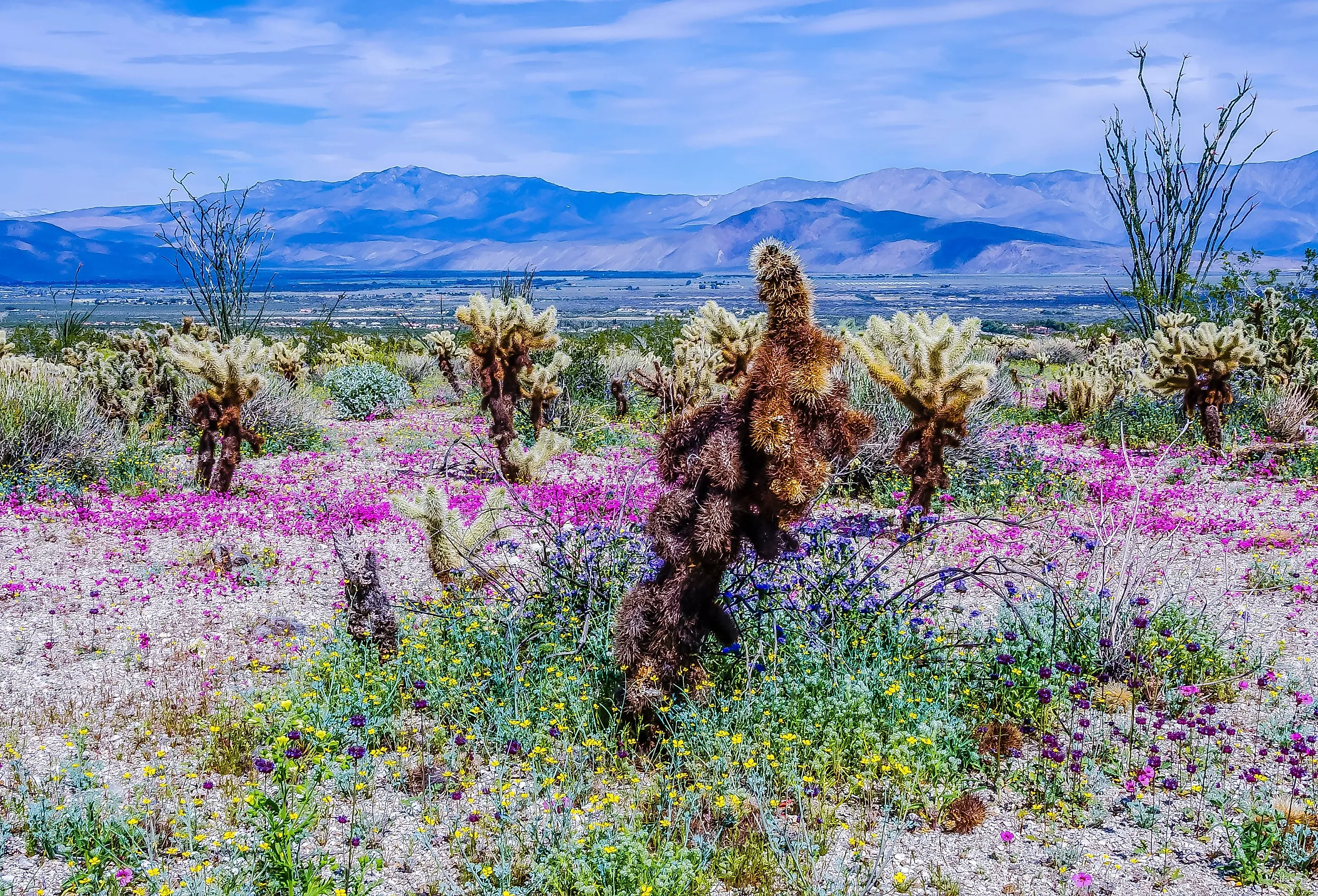
This one is a fascinating case, because as a whole Anza-Borrego is not obscure at all. It is California's largest state park, and its spring wildflower blooms draw real crowds to the town of Borrego Springs. But the park is 600,000 acres laced with some 500 miles of dirt road, and once you leave the few paved pockets, the visitor count effectively drops to zero. Drive an hour into the backcountry and you can genuinely go a full day without seeing another human. It is the perfect illustration of why counting is so hard: the same park can be busy and utterly empty at the same time, depending entirely on where you are standing.
Cathedral Gorge State Park, Nevada

Set deep in eastern Nevada's Lincoln County, a long way up a quiet highway, Cathedral Gorge is the kind of jaw-dropping park that would be mobbed if it were anywhere near a city. Instead, its soaring cathedral-like spires and narrow slot canyons, carved out of soft bentonite clay over millions of years, sit in near-total solitude. You can wander the slots and squeeze through the clay corridors for hours and cross paths with barely anyone. It even preserves 1930s picnic shelters from the earliest days of Nevada's park system, a reminder that this quiet spot has been quietly beautiful, and quietly overlooked, for a very long time.
Caddo Lake State Park, Texas

Way out in the far eastern corner of Texas, on the Louisiana line, Caddo Lake is a haunting maze of moss-draped cypress bayous where the nearest town is named, with total sincerity, Uncertain. It is remote, a little eerie, and gloriously underused. Paddle out into the tangle of black-water channels and the loudest sound is your own paddle dipping in and out of the water. Whether it is technically one of the "least visited" is anyone's guess, given everything we just covered, but it delivers the feeling those numbers are supposed to promise: the sense that you have slipped somewhere the crowds forgot.
So Go Get Lost

The honest takeaway is that "America's least-visited state park" will probably never be a settled fact. There is no single scoreboard, the counting is a patchwork of rubber tubes and educated guesses, and half the contenders have nobody at the gate to notice you at all. But flip that frustration around and it becomes an invitation. Out past the counters and the fee booths sit thousands of parks where the trails are empty, the campsites are open, and the odds of sharing your sunset with a stranger are close to nil. You may never know which one is truly the loneliest. The fun is in going out to find one and having it all to yourself.