This New York Scenic Byway Is The Road Trip Of A Lifetime
Many memorable road trips stretch for hundreds of miles, but New York's Mohawk Towpath National Scenic Byway packs its rewards into just over 26 miles. The route traces the original Erie Canal between Waterford and Schenectady, blending engineering feats, colonial history, waterfalls, and canal landmarks into a single short drive. Each stop marks a different chapter in how the canal turned New York into a commercial powerhouse and opened the country's interior to trade and settlement.
Discovering the Legacy of the Erie Canal

The byway traces the path of one of the most significant transportation routes in the United States. Before railroads dominated long-distance travel, the Erie Canal revolutionized commerce by connecting the Hudson River with the Great Lakes. Completed in 1825, the canal dramatically reduced shipping costs and travel time between the Atlantic Coast and America's inland communities. This was the catalyst that helped establish New York City as one of the world's leading ports.
The path follows a section of this historic passage along the Mohawk River, showing how engineers overcame steep elevations, rocky terrain, and powerful currents long before modern equipment existed. Although the canal system has been modernized, some remnants of the original route survive, a reminder of how ambitious the project was.
Begin at the Waterford Harbor Visitor Center

A natural starting point for the drive is the Waterford Harbor Visitor Center, where displays introduce both the old and present-day canal systems. The harbor sits where the Hudson and Mohawk rivers meet, and today the boats moving through it carry recreational travelers rather than the cargo that once crossed New York. From here it is a short step to one of the byway's most impressive attractions, the Waterford Flight of Locks.
The Marvel of the Waterford Flight of Locks

Few places along the Erie Canal show off early canal engineering better than the Waterford Flight of Locks. Five consecutive locks, numbered E-2 through E-6, raise or lower boats a total of 169 feet as they pass between the Hudson and Mohawk rivers.
That is the highest lift over the shortest distance of any canal lock system in the United States. Watching a boat rise or descend through the chambers drives home the complexity and precision of the whole project. Today's chambers are twentieth-century replacements built for the Barge Canal, but they still handle the same steep elevation change that once stopped boats cold. For many visitors, this becomes one of the most memorable moments of the drive.
Stand at the Edge of Cohoes Falls

A short distance down the path from Waterford Harbor lies one of the Mohawk River's most dramatic natural features, Cohoes Falls. From the overlook at Falls View Park, you can watch the Mohawk plunge nearly 90 feet into the gorge below. Depending on the season, the flow ranges from a trickle to a wall of rushing water that shows the full force of the river.
Long before the canals existed, Cohoes Falls stopped most boats from traveling farther upstream. Engineers designing the Erie Canal built an elaborate lock system to bypass it, which makes the waterfall one of the main reasons that ambitious design became necessary in the first place. Falls View Park is a good spot along the byway to take in both the landscape and the solutions it forced.
The Vischer Ferry Nature and Historic Preserve

Driving westward, you reach the Vischer Ferry Nature and Historic Preserve, which combines history with outdoor recreation. The roughly 700-acre preserve takes in a section of the original Erie Canal along with wetlands, forests, and wildlife habitat beside the Mohawk River.
Walking and cycling trails run past several notable canal features, including the original 1825 stone locks, portions of the old towpath, Clute's Dry Dock, and a restored Whipple Truss Bridge. These structures show how boats were repaired and moved during the 19th century. The calm setting makes it easy to picture travel nearly two centuries ago, when mule-drawn canal boats moved slowly through these same waterways.
Enjoy the Scenic Drive Along Riverview Road

Not every highlight along the towpath requires leaving the car. Riverview Road winds through stretches of mature trees beside the calm waters of the Mohawk River. Orchards, open farmland, and quiet river views make a peaceful contrast to the busy canal communities earlier in the drive.
In autumn, when the surrounding forests turn red, orange, and gold, this becomes one of the most photographed stretches of the byway. It is where the drive best shows the region's long connection to the river.
Exploring New York's Colonial Past

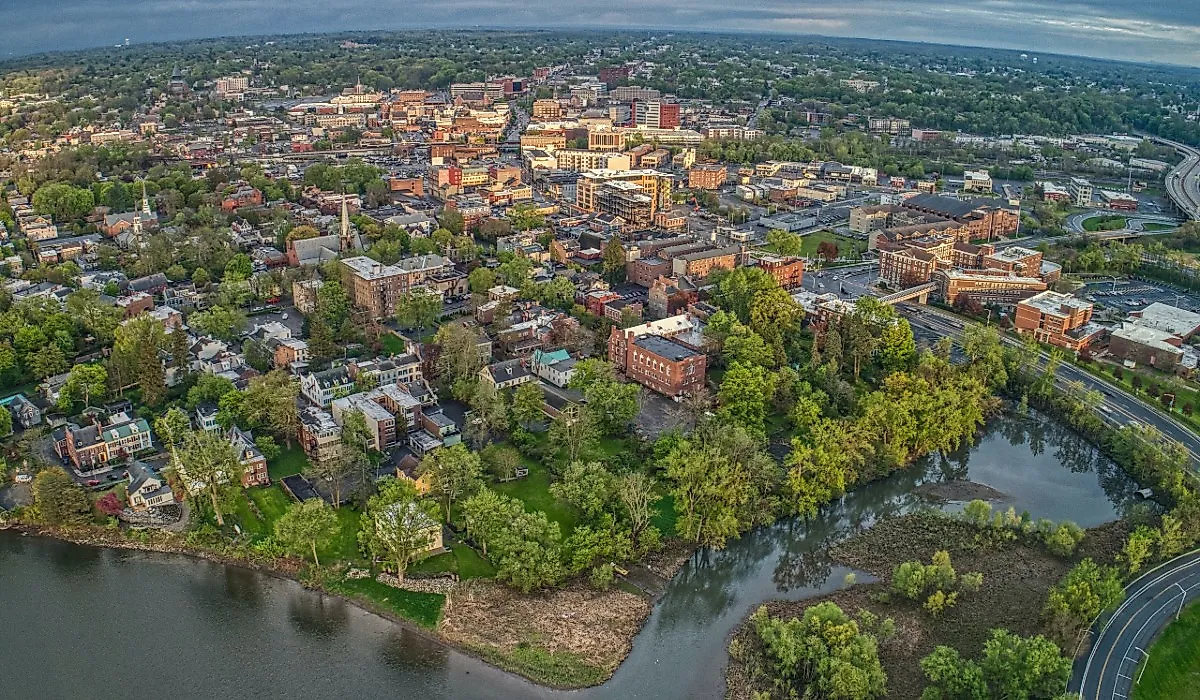
The drive ends at the western end of the byway in one of New York's oldest neighborhoods, the Schenectady Stockade Historic District. Europeans settled the area in the late 1600s, and the Stockade holds an extraordinary collection of Dutch Colonial, Georgian, and Federal-style buildings along quiet cobblestone streets. Homes such as the Yates House and the Hendrick Brouwer House date to the early 18th century, which makes this one of the state's most historic areas.
Walking the neighborhood offers a close look at life during the colonial period. It is a fitting end to the drive, tying together the region's history and the canal that helped shape its future.
More Than Just a Scenic Drive
The Mohawk Towpath Scenic Byway stands out for how tightly it packs historical landmarks and natural landscapes into a short distance. In just over 26 miles, visitors take in stone locks, a major waterfall, and Dutch colonial homes. Most scenic drives sell the landscape alone; this one lays out how geography, innovation, and transportation reshaped an entire state. Each stop makes the case for why the Erie Canal became such an influential project in American history.