The Oldest Mines You Can Tour In America
The oldest mine in the United States still offering public tours is the Old New-Gate Prison and Copper Mine in East Granby, Connecticut, where mining began in 1707. Its top spot is sometimes contested by the Sterling Hill Mine in Ogdensburg, New Jersey, which is often said to date to the 1630s, though its earliest documented mining is from 1739. When it comes to ranking something by a term such as "oldest" it can depend on a few variables. These mines are ranked by the earliest documented year in which they began mining, and to qualify for the list they also offer public entry into their underground workings, which cuts out any mine site that only offers open pits, closed attractions and surface museums.
Old New-Gate Prison & Copper Mine

Mining began here in 1707 after copper was reported on the west side of Talcott Mountain, then part of Simsbury, in 1705. It featured a vertical shaft, horizontal tunnels running off of it, and ventilation shafts. The first company to run the mine failed within four years, and it switched operators several times until the end of colonial mining. The site was listed as closed in 1745 in its National Historic Landmark listing, but the state museum says work continued until the 1750s and resumed briefly in the 1830s.
In 1773 the mine was turned into a prison, with an iron gate installed over the ventilation shaft and a lodging room carved underground. Prisoners were held in tunnels of complete darkness. The prison ran until 1827, and the site became a National Historic Landmark in 1972.
The tunnels toured today are part of the original workings. The site is run as a museum by the Connecticut Department of Economic and Community Development. Standard admission includes a guided mine tour of around 30 minutes, offered from May through September, and the site stays open through October.
Sterling Hill Mine

Mining began by the 1730s in Ogdensburg, Sussex County, New Jersey, despite claims of its opening in the 1630s. The site's 1991 National Register listing isn't based on the earlier date, and the 1630s claims often credit William Alexander, Lord Stirling, who wasn't born until the 1720s. Its oldest traceable and reputable date is 1730, when the "Copper Mine Tract" was divided among the heirs of Anthony Rutgers.
The mine was first worked for copper, but it became one of the richest zinc mines in the world and also produced iron and manganese. It was worked from open pits and cuts from 1818 until 1897, when the mines were consolidated by the New Jersey Zinc Company, which then focused on underground development. The new operations began producing ore in 1912, and the mine eventually reached 2,675 feet below the surface. It was the last working underground mine in New Jersey when it closed in 1986.
The tunnels toured today are twentieth-century workings rather than colonial ones. The property was bought by brothers Richard and Robert Hauck in 1989 and opened as a museum in 1990. The tour takes about two hours, with about half of that time spent underground. It includes the Rainbow Tunnel, which glows red and green when ultraviolet lamps light up the fluorescent minerals in the walls.
Reed Gold Mine

Mining first began in 1803 near Midland in Cabarrus County, North Carolina. It's the site of the first documented gold find in the US, made when 12-year-old Conrad Reed found a heavy yellow rock in Little Meadow Creek on his family's farm in 1799. It was used as a doorstop until it was identified as gold in 1802, and the following year his father, John Reed, helped start a small mining operation. It began with placer mining, washing gold out of the creek, and underground mining began in 1831. In 1835, a family dispute closed the mine for a decade, and after John Reed's death in 1845 the property was auctioned off and saw little mining until the Kelly family bought it in 1895. They ended underground work in 1912, and in 1971 their heirs sold most of the land to the state at a low price and donated the rest. It opened as Reed Gold Mine State Historic Site in 1977.
Its restored tunnels date back to the 1830s and were dug by hand, so they're narrow and low, about 450 feet of them running roughly 50 feet below the surface. Entry to the grounds is free, but the underground mine can only be seen on a guided tour, which costs a fee.
Bevans Lead Mine

The Bevans Lead Mine is located behind The Mining & Rollo Jamison Museums on East Main Street in Platteville, Wisconsin, in the Upper Mississippi Valley lead-zinc district. Lead had been mined around Platteville since the 1820s and was the region's main draw until the California Gold Rush pulled miners west. By the 1840s much of the easy surface ore had been taken, but in 1845 Lorenzo Bevans struck an untouched vein. A crew of about twenty raised around 2 million pounds (907 metric tons) of galena in the first year.
The mine's workings were rediscovered south of the museum in 1972, more than a century later, and opened to the public in 1976. The tour covers the region's shift from lead to zinc, which pushed miners further underground. Visitors descend 90 steps into the mine, which is stated as 45 feet (14 m) underground by the museum and 50 feet (15 m) by AAA. The above-ground tour includes the headframe building and hoist house, as well as ore car rides when weather permits. Tours run from May to October, Wednesday through Sunday. In the winter only special programs run.
Quincy Mine

The Quincy Mining Company was formed in 1846 when the Northwest and Portage mining companies merged. They worked copper in the hill above Hancock until 1945. It was one of the most profitable mines in the area, nicknamed "Old Reliable" for paying dividends every year from 1868 to 1920. It produced nearly one billion pounds (454,000 metric tons) of copper, with its No. 2 shaft reaching 92 levels down.
When the mine closed, groundwater filled it and now reaches the 7th level. The tour does not use the original shafts and can't go any deeper than the flooding. Instead, a cogwheel tram takes visitors down the hillside. At the bottom is the East Adit, a 2,000-foot drainage tunnel that leads into 1860s workings on the 7th level, about 350 feet underground. It was enlarged in the 1970s by Michigan Technological University for mining studies.
The surface portion of the tour includes the No. 2 hoist house, home to what is believed to be the largest steam-powered hoist in the world. The site is run by the Quincy Mine Hoist Association, a nonprofit that partners with Keweenaw National Historical Park. The tour takes around two and a quarter hours, and tours run year-round, though in winter visitors drive to the adit instead of taking the tram.
Delaware Mine

The Delaware Mine is about 12 miles south of Copper Harbor in Keweenaw County, Michigan, and was first worked in 1847 by the North West Mining Company. It contained five shafts, with the deepest reaching 1,400 feet (427 m) across ten levels. The mine passed through several companies but never turned a profit, and it closed in 1887. The state tourism agency says it produced 8 million pounds of copper, though other accounts say 7 million.
It has operated as a show mine since 1977, and the tour passes through its original workings. Visitors descend about 100 feet (30 m) of stairs through the No. 1 shaft to the first level. Roughly 1,700 feet (518 m) of passages are open, with copper still visible in the rock. The underground tour is self-guided. It's privately owned and is a heritage site of Keweenaw National Historical Park. It's open from mid-May to mid-October.
Adventure Mine

The Adventure Mine is at the base of the Keweenaw Peninsula near Greenland, in Ontonagon County, Michigan, and first began operations in 1850. Thomas Howe and C. G. Hussey formed the company, though ownership changed several times. Thomas Mason's Adventure Copper Company later took over, and in 1898 the mine was combined with the Hilton-Ohio and Knowlton mines. Low copper prices halted work in 1908, and after a brief restart during World War I, mining ended in 1917. The mine closed in 1920. Roughly 11 million pounds (4,990 metric tons) of copper was mined through its five shafts.
Tours have run on and off since 1973. It is currently owned by Matthew Portfleet, who is the director of mine safety and health at Michigan Technological University. Visitors explore the workings with only a hardhat lamp. Various tours are offered, from easy guided walking tours to rappelling, six-hour underground tours, and drilling and blasting workshops. It runs from mid-May to mid-October.
No. 9 Mine

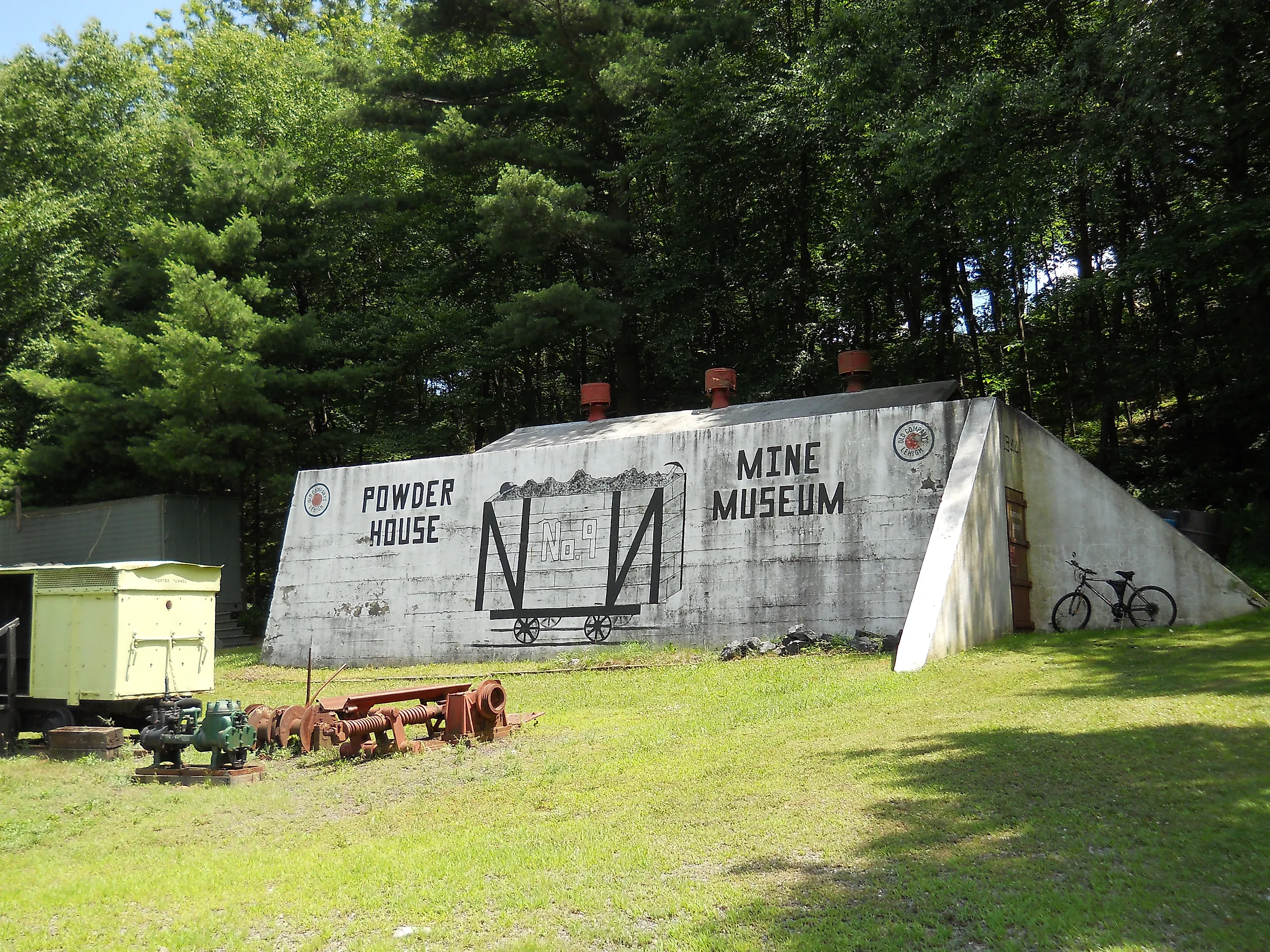
Located in Lansford, Pennsylvania, the No. 9 Mine opened in 1855, owned by the Lehigh Coal and Navigation Company, and reached coal in late 1857. It focused on the anthracite of the Panther Creek Valley's Mammoth Vein, running until 1972. It is the longest continuously operated deep anthracite coal mine in the world, and the museum states it is the oldest coal mine you can tour in the United States.
Volunteers with the Panther Creek Valley Foundation made the abandoned mine safe and opened it to public tours in 2002. A mine train runs about 1,600 feet (488 m) into the mountain before a guided walking tour of about 600 feet takes over. Stops include the original No. 9 hoisting shaft, the mule-way, and the miners' hospital. The shaft's depth ranges from 700 to 900 feet depending on the source. A museum next to it covers the anthracite industry, and the site is open from April to November, with weekend-only hours in April and November.
Old New-Gate leads the way by more than two decades when it comes to the oldest tourable mines in the United States, with Sterling Hill coming in second. If the definition of what constitutes oldest is changed, such as if the focus was on the age of walkable passages, Sterling Hill moves to the 20th century, and Reed moves from 1803 to the 1830s. Other well-known mines, like the Ruggles Mine in New Hampshire, didn't count because Ruggles is considered an open pit, and the Vinegar Hill Lead Mine no longer offers tours. For those hoping to see the most in one trip, the Keweenaw Peninsula in Michigan is the best stop, with three mines within a few hours' drive of each other.