The Gold Rush Towns Still On The Map
For every Gold Rush ghost town crumbling away out in the hills, a lucky few boomtowns beat the odds, banked their winnings, and stuck around for good. Some are small historic villages you can still wander through today; a surprising number ballooned into full-blown cities, and no fewer than four of them ended up as state capitals. Here are the Gold Rush towns still very much on the map.
Dahlonega, Georgia

Before anyone shouted "gold!" in California, they were shouting it in the hills of north Georgia. Dahlonega sat at the heart of America's first major gold rush, all the way back in 1829, a full 20 years before the famous Forty-Niners. So much gold came out of the ground here that the federal government built a mint in town in 1838 to stamp it into coins. When the local deposits finally thinned out, many Georgia miners simply packed up and reinvented themselves as California's Forty-Niners. Today Dahlonega is a lively little town known for its wineries, its fall color, and a gold museum sitting in its old brick courthouse.
Nevada City, California

Deep in California's Gold Country, Nevada City is roughly as well-preserved as a Gold Rush town can get while still being a real, functioning place. Founded in the 1849 frenzy, it grew into one of the richest and most important mining towns in the state, and its walkable downtown of gas-lit Victorian storefronts and brick buildings still looks the part. Unlike the ghost towns scattered nearby, though, it never emptied out. It is a busy little community of shops, theaters, and restaurants that simply happens to be wrapped in genuine 19th-century architecture.
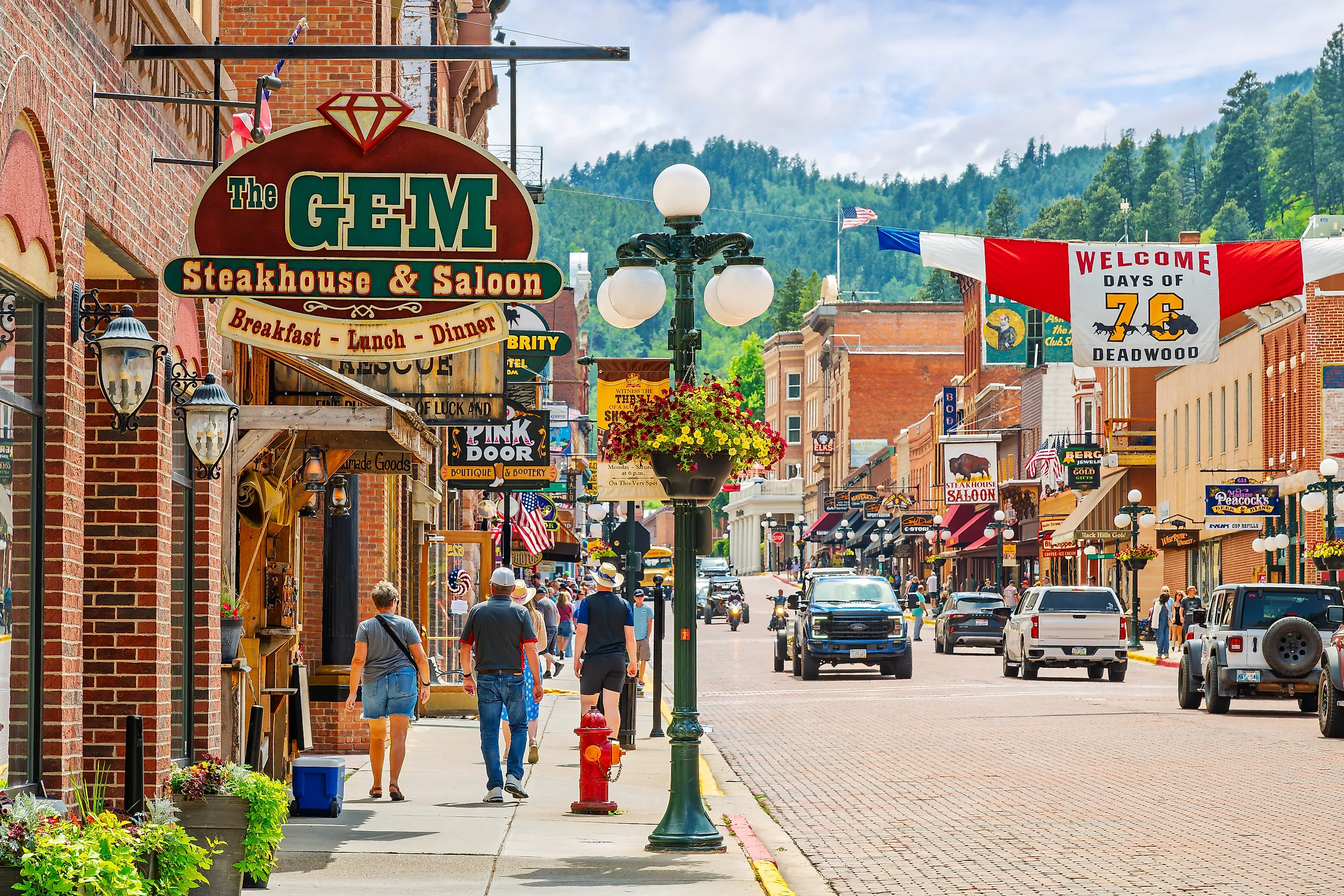
Deadwood, South Dakota

Few Gold Rush towns carry a reputation quite like Deadwood's. When gold was struck in the Black Hills in 1876, this lawless camp filled up almost overnight with prospectors, gamblers, and outsized characters of the Old West. Wild Bill Hickok was famously gunned down here holding his "dead man's hand" of aces and eights, and Calamity Jane is buried on the hill above town. Instead of fading into a ghost town when the gold ran low, Deadwood reinvented itself. The entire town is now a National Historic Landmark, and legalized gambling has kept its saloons and Main Street thoroughly alive.
Sacramento, California

Not every town struck it rich by digging. Sacramento struck it rich by selling shovels. Sitting close to where gold was first spotted at Sutter's Mill, it became the great supply and transport hub of the entire California Gold Rush, the place miners passed through to stock up on gear and cash in their nuggets. That role sent it booming, and it never looked back. Today Sacramento is the capital of California and the center of a metro area of more than two million people.
Denver, Colorado

Denver owes its very existence to gold. It sprang up as a scrappy mining camp in 1858 and 1859 during the "Pike's Peak or Bust" rush, when prospectors poured into the base of the Rockies chasing rumors of riches. The easy gold did not last long, but the settlement built to serve the miners dug in, grew into a railroad and commercial powerhouse, and eventually became the capital of Colorado. The Mile-High City now anchors a metro area of nearly three million.
Helena, Montana

Helena began as a long-shot gamble that happened to pay off spectacularly. In 1864, four discouraged prospectors decided to give a promising ravine one final try, struck gold, and touched off a stampede. The main street running through downtown is still literally named Last Chance Gulch in honor of that moment. The strike proved to be one of the richest in the country, minting a whole crop of instant millionaires, and the town it created did not merely survive the boom, it went on to become the capital of Montana.
Juneau, Alaska

Alaska's capital is a Gold Rush town through and through. Juneau was founded in 1880 after two prospectors, pointed in the right direction by a local Tlingit chief, found gold in the surrounding mountains and set off Alaska's first big stampede. It grew into a serious mining town and, in time, the capital of the entire state. Its wildest quirk still holds true today: hemmed in by mountains and ice, Juneau remains the only US state capital with no roads connecting it to the rest of the country. You can only get there by boat or plane, which is not bad going for a scrappy old mining camp.