The Largest Park In The Lower 48 Is Not A National Park
Yellowstone, Everglades, Glacier, and Grand Canyon could all fit inside the largest park in the Lower 48, with room to spare. It is not a national park. It is Adirondack Park, six million acres of northern New York where about 123,000 people live, a car drives in with no gate and no fee, and the rules for the public forest are written into the state constitution. Want a ski trail on Whiteface Mountain? New Yorkers voted yes in 1941. Nordic trails at the Olympic complex nearby? They voted again in 2025. Nobody turned it into a national park, and the 1967 plan to try fell apart fast.
It Is Nearly Twice The Size Of Death Valley National Park

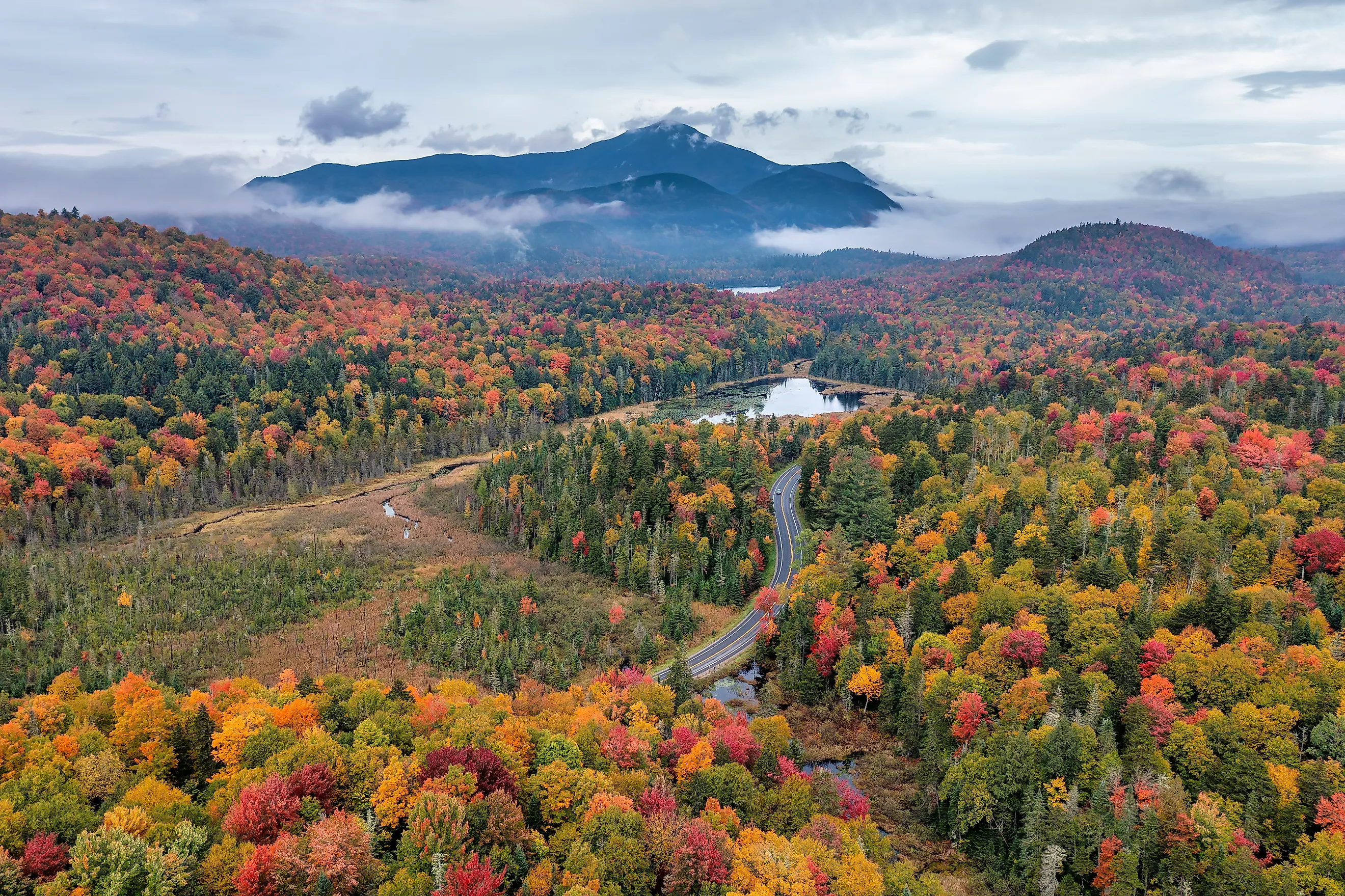
Adirondack Park spreads across northern New York and takes up about one-fifth of the state's land area. Its boundary encloses roughly six million acres, an area the Adirondack Park Agency compares to the entire state of Vermont. Death Valley, the biggest national park in the contiguous 48 states, covers about 3.4 million acres, so the Adirondacks hold nearly twice as much ground as any national park outside Alaska.
Alaska is the only state with national parks on that scale. Wrangell-St. Elias National Park and Preserve, the largest in the country, covers 13.2 million acres. The Adirondacks sit within a day's drive of more than 100 million people in the United States and Canada, and nearly 2,000 miles of trails run through the park.
About 123,000 People Live Inside The Park Year-Round

When New York created Adirondack Park on May 20, 1892, a blue line was drawn around the region, and the Blue Line is still shorthand for the park itself. In 1912 the legislature made clear that private land inside that line counted as part of the park. About half of the park is private today, holding towns, farms, timberland, businesses, homes, and camps, and about 123,000 people live there year-round in 101 towns and villages. There is no entrance gate and no admission fee.
Building on that private land is regulated. The Adirondack Park Agency, created by the state legislature in 1971, sorts private parcels into land-use classes that limit how many buildings can go up per square mile, and projects of regional significance usually need its permit. Homes are scarce for the people who live there. Reporting after the 2020 census found that only about 55 percent of the park's existing homes were occupied by Adirondack residents, with the rest serving as rentals or second homes.
New York Put "Forever Wild" In Its Constitution

The state owns roughly 2.6 million acres inside the Blue Line, and that public land falls under a clause added to the state constitution in 1894. In force since January 1, 1895, it says the Forest Preserve "shall be forever kept as wild forest lands." The land cannot be sold or leased, and the timber on it cannot be cut.
Changing the clause requires an amendment passed by two successive state legislatures and then approved by voters statewide. One went on the ballot in November 2025, when New Yorkers decided whether 323 acres of Forest Preserve at the Mount Van Hoevenberg Olympic Sports Complex near Lake Placid could hold Nordic skiing and biathlon trails. Bobsledding there goes back to the 1932 Winter Olympics. Proposal 1 passed with about 52 percent of the vote, and it will add 2,500 acres to the Forest Preserve.
Downhill skiing on Forest Preserve land needed the same kind of vote decades earlier. Voters approved ski trails on Whiteface Mountain in 1941, and the constitution caps the mountain at 25 miles of ski trails. Whiteface has 3,430 feet of vertical drop, the greatest of any ski area east of the Rockies, and it hosted the alpine events of the 1980 Winter Olympics.
A 1967 Plan To Make It A National Park Collapsed

Laurance Rockefeller, who chaired the state's parks council and whose older brother Nelson was governor, pushed for federal control. A proposal released from the governor's office on July 30, 1967, called for about 1.72 million acres, mostly in the High Peaks and central lakes, to become an Adirondack Mountains National Park. Forever wild made national park-style amenities all but impossible to build on Forest Preserve land, and Laurance's answer was to get rid of it. Opponents warned of losing more than one million acres of public hunting land, and New York's environmental activists disliked the idea as well. The proposal faded and never resurfaced. The fight did produce a state commission, and its work led to the Adirondack Park Agency.
New York's Highest Point Is A Hike Inside The Park

The High Peaks sat at the center of that 1967 plan, and the highest of them is Mount Marcy, at 5,344 feet the top of New York State. About 1,000 feet below the summit lies Lake Tear of the Clouds, the state's highest pond at 4,293 feet and often cited as the Hudson River's highest source. Its outflow runs down Feldspar Brook to the Opalescent River and on toward the Hudson. Winter hikes to the lake and the summit should only be attempted by experienced hikers.
One of the mountain's best-known hikes ended on September 13, 1901. Vice President Theodore Roosevelt was returning from a climb of Marcy when a messenger reached him with word that President William McKinley was dying. That night Roosevelt set out on a carriage ride of about 35 miles to the train station at North Creek, arriving just before dawn to learn that McKinley had died. The route is now the Roosevelt-Marcy Trail.
Motors Are Banned Across The St. Regis Canoe Area

A canoe trip through the St. Regis Canoe Area, northwest of the High Peaks between Tupper Lake and Paul Smiths, means carrying the boat between ponds. Its 58 ponds are linked by carries, the regional word for portages, and only two of them can be reached without one. The 18,400-acre tract is the only designated canoe area in New York State, one of seven classes the state assigns to its land inside the park, and motorboat use by the public is prohibited. Primitive canoe camping is allowed on many of the ponds, and the trail up Long Pond Mountain can only be reached by water.
Moose Returned After More Than A Century

Moose disappeared from New York in the 1860s, pushed out by unregulated hunting and habitat change. In 1986, state biologists documented a small resident population in the Adirondacks, animals that may have wandered in from Vermont, Massachusetts, or Quebec. That group of six to 11 moose had grown to as many as 400 by the early 2010s.
The state's most recent estimate, reported in 2024, puts about 716 moose inside the park, and many of them live on private industrial forest land in the northern and western Adirondacks. Hunting them is not allowed, yet growth has lagged behind neighboring New England states, and researchers point to milder winters that have filled the woods with more deer, which share parasites with moose. Biologists keep track of the population from helicopters, recording each moose they spot.
Changes to the park's forever wild land go to New York's voters, and the people who live inside the Blue Line cast ballots alongside everyone else in the state. When the Mount Van Hoevenberg amendment reached the ballot in 2025, voters in Essex County, home to Lake Placid and Mount Marcy, approved it by roughly two to one, and two neighboring North Country counties did the same. Statewide, the margin was much closer, about 52 to 48 percent. The result made the Olympic Nordic and biathlon trails on public forest legal, and it will add 2,500 acres to the Forest Preserve. Whiteface still has a little room under its own constitutional cap. A 2022 plan for the mountain proposed a quarter mile of new ski trail and left 2.65 miles before the limit.