The Oldest Ballparks Still In Use In America
As America's favorite pastime, there are a number of historic baseball diamonds, big and small, spread around the country that've been continuously maintained and used since the sport's inception. Some have hosted games for more than a century, remaining active venues where college, minor-league, and/or Major League teams still take the field. A lot are older than you may have guessed. Fuller Field in Massachusetts dates to the 1870s, while Rickwood Field in Alabama opened before WW1 and has hosted both Negro Leagues and Major League baseball. Furthermore, Fenway Park and Wrigley Field are easily the longest-running active MLB venues, while fields such as Sims-Galle Field and Goss Stadium continue their collegiate traditions. Read on to learn more about these legendary ballparks and how remarkably long the game has been tied to certain cities across the United States.
Fuller Field, Clinton, Massachusetts - Est. 1878
Fuller Field in Clinton, Massachusetts, has been around and kicking since 1878, making it a remarkable survivor from the very early days of organized baseball. That year, the Clinton Base Ball Club began playing on the grounds, and a June 15 game against the Stars of Marlborough drew about 500 spectators.
The longest-standing diamond in the world, let alone America, this field got its name after local lumber dealer William A. Fuller donated the property to the town. Its historical importance was confirmed decades later when local historian A.J. Bastarache found an oilcloth survey map, dated to none other than 1878, showing the "Clinton Base Ball Ground" in the exact location it is today. With that, Guinness World Records certified Fuller Field in 2007 as the oldest baseball diamond in continuous use.
Fuller's connection to professional baseball also runs deep, as Tim Keefe, who later became a Baseball Hall of Famer, is reported to have played for Clinton in the same year it opened. The site remains a public recreational facility, with a number of adjacent football fields included, too.
Sims-Galle Field, Mobile, Alabama - Est. 1889
Sims-Galle Field at Spring Hill College in Mobile, Alabama, traces its baseball history to 1889, when intercollegiate baseball was first played at the site. Spring Hill College considers it the oldest active collegiate baseball field in the United States, and the Badgers continue to play home games here.
It is part of a campus with a long relationship to the game of baseball in general. During the 1860s, foreign students at Spring Hill learned the sport and later helped introduce baseball to their home country of Cuba, contributing to its early development and continued popularity there.
The field itself was originally known as Stan Galle Field, named for longtime Spring Hill coach Stan Galle. In 2022, it was renamed Sims-Galle Field to honor both Galle and Frank Sims, another influential coach in the program's history.
Centennial Field, Burlington, Vermont - Est. 1906

Burlington, Vermont's Centennial Field began its story in 1906 and has served as a baseball venue for well over a century. Located on the University of Vermont campus, this ballpark originally hosted college athletics, later gaining a bit of a connection to professional baseball as well.
The Vermont Lake Monsters have played there since 1994, first as a minor-league affiliate and, since 2021, in the summer-collegiate Futures League. Although professional baseball ended there during a canceled 2020 season, Centennial Field is still an active diamond used by college and other local teams, with the University of Vermont Catamounts having played there until 2009 and the facility still used for other sports.
Centennial Field has had appearances by players who later reached the Major Leagues, while its location beside the university's other athletic facilities has helped maintain its overall sporting role across many generations. Because of that, the venue is also famous for hosting football, soccer, and track events, as well.
Goss Stadium at Coleman Field, Corvallis, Oregon - Est. 1907

Most West Coast parks are relatively new. However, Goss Stadium at Coleman Field dates to 1907, when Oregon State began playing varsity baseball on the same site it uses today. It is named for Ralph Coleman, who coached Oregon State for 35 seasons from 1923 through 1966.
The first recorded game there came on April 12, 1907, when Oregon State lost to Salem High School 4-0. The playing field has remained in place ever since, although the surrounding ballpark has been rebuilt and expanded several times. A permanent stadium was constructed in 1999, and the venue later received additional seating, lights, a video scoreboard, upgraded locker rooms, and other improvements.
Notably, the Oregon State Beavers won three NCAA championships in 2006, 2007, and 2018, with its championship-era teams playing their home games here. Goss Stadium also became the home of the Corvallis Knights in 2007, a collegiate summer team.
Rickwood Field, Birmingham, Alabama - Est. 1910
Birmingham's Rickwood Field opened in 1910 and remains the oldest purpose-built professional ballpark in the United States. Built for the Birmingham Barons by industrialist A.H. "Rick" Woodward, it was also the first minor-league ballpark constructed with concrete and steel, being modeled partly after Pittsburgh's Forbes Field. The opening game on August 18, 1910 had an impressive 10,000 spectators there to witness it.
Rickwood later became deeply connected to Negro Leagues history through the Birmingham Black Barons, who played their home games there from 1924 through 1960. In fact, Willie Mays began his professional career with the Black Barons here in 1948, while Satchel Paige and other future Hall of Famers also played the venue a number of times.
The ballpark was added to the National Register of Historic Places in 1993, and in 2024, it hosted its first Major League game when the San Francisco Giants faced the St. Louis Cardinals. The Birmingham Barons also continue to return for special games, keeping pro baseball active at this American sporting landmark.
Fenway Park, Boston, Massachusetts - Est. 1912

The famed Fenway Park opened its doors in 1912 and remains the oldest ballpark in Major League Baseball. 27,000 fans saw the Boston Red Sox play their first official game there on April 20, 1912, defeating the New York Highlanders 7-6 in an exciting 11-inning game. To add to its accolades, the venue also hosted World Series games during its first season, a rarity among MLB stadiums.
It was built on an irregularly shaped parcel, which helped create its distinctive field dimensions. However, the most recognizable feature here is probably the "Green Monster," the over 37-foot-high left-field wall that has stood as a part of the park since its early years. Fenway also has a connection to baseball's history beyond the Red Sox, as the Boston Braves briefly shared the park with the Red Sox in 1914 and 1915.
Despite extensive renovations, Fenway has retained its original location and remains among the most beloved ballparks in the Big Leagues more than a century after opening, continuing to host professional games and other events regularly today.
Wrigley Field, Chicago, Illinois - Est. 1914

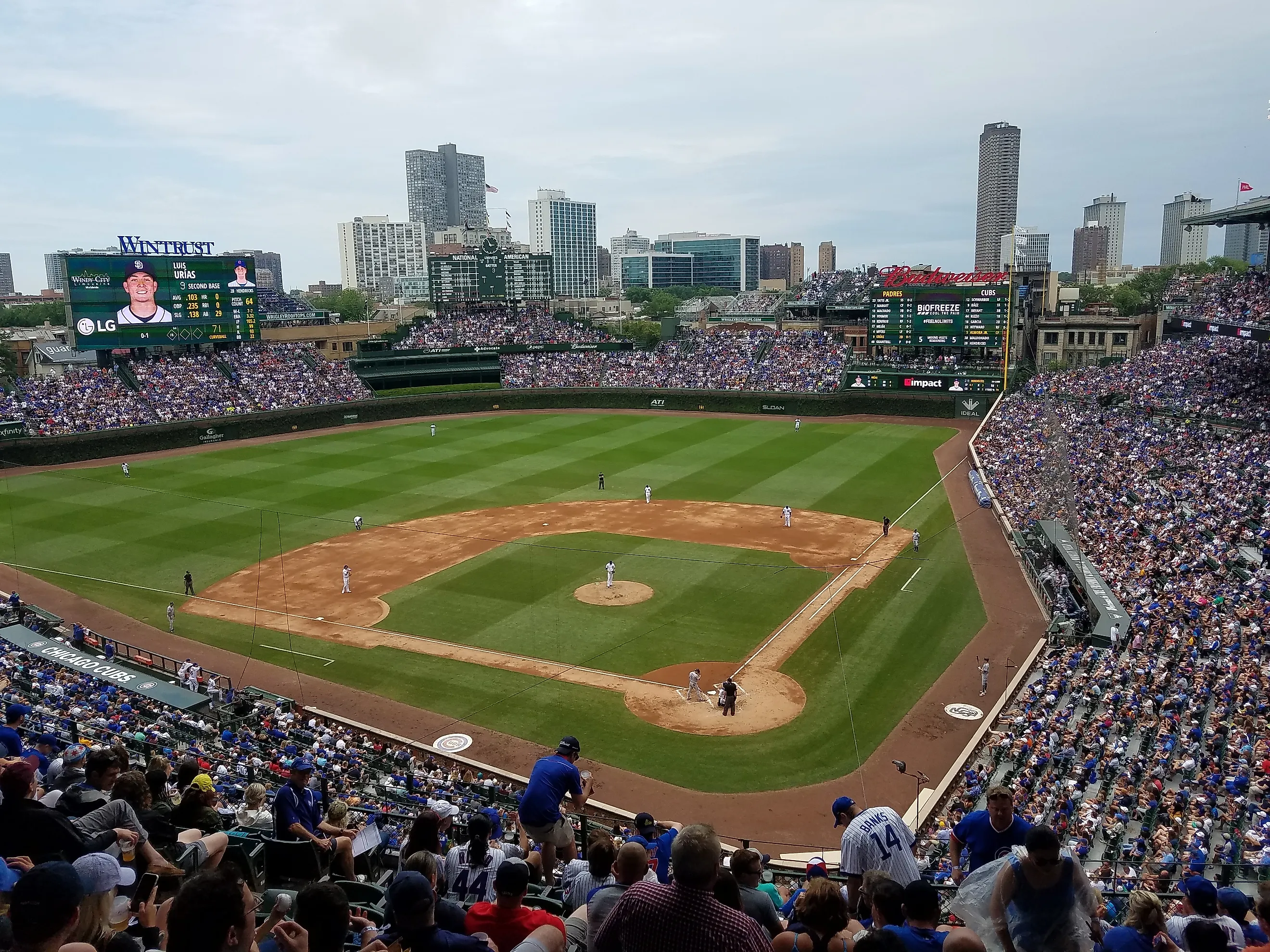
In 1914, Wrigley Field, originally called Weeghman Park, and then Cubs Park, started operating, making it the second-oldest ballpark currently used by a Major League Baseball team. The Chicago Federals of the Federal League played the first game there on April 23, 1914. The Cubs moved into the park in 1916, and it was given its current name in 1926 after Cubs owner William Wrigley Jr. It then went on to host its first World Series in 1929 and has since staged numerous postseason games. The NFL's Chicago Bears also played here from 1921 through 1970.
Its original ivy-covered outfield walls, hand-operated scoreboard, and rooftop seating across Waveland and Sheffield avenues have become defining features of the legendary stadium. The park underwent a major renovation beginning in 2014, but thankfully, much of its historic structure and distinctive features were retained. Moreover, Wrigley Field was designated an official Chicago Landmark in 2004, recognizing its long architectural and cultural history to both the city and the game.
Catch a Game Inside a Slice of American History at these Parks
To many, baseball is a truly romantic game, filled with both passion and history. These parks remain important because their pasts are still connected to present-day play. From Fuller Field's 19th-century origins to the century-plus traditions at Fenway Park, Wrigley Field, and a few smaller college venues, each site mentioned above showcases a different chapter of America's favorite pastime. Their continued use keeps their stories tangible to players and fans alike rather than reducing them to mere photographs in museums.