7 Quirkiest Victoria Towns You Didn't Know Existed
Regional Victoria runs on goldfields heritage and small towns with large personalities. Walhalla hides in a mountain gorge with a working narrow-gauge railway. Port Fairy has a lighthouse and a shearwater colony. Clunes has gone all-in on books since the 2000s. Beechworth pairs Ned Kelly history with a haunted asylum. Each of the seven towns ahead has built itself around something just off-centre.
Walhalla

Walhalla sits at the bottom of a steep Stringers Creek Gorge in Gippsland, a former gold rush town whose population peaked at 2,500 in the 1880s and now hovers in the low double digits. The Walhalla Goldfields Railway, a 762mm narrow-gauge tourist line, runs the original route from Walhalla Station to Thomson Station over six trestle bridges and the heritage-listed 92-metre Thomson River Bridge. The full return trip takes about an hour and is one of the more dramatic short rail journeys in the country.
Underground tours of the Long Tunnel Extended Gold Mine run daily, guided by local volunteers who explain the reef-mining techniques that pulled around 14 tonnes of gold from these hills. The Walhalla Cemetery climbs the cliffs above town with headstones tilted at the angle of the slope. The Walhalla Post Office Museum holds relics from the boom years. The Poverty Point walk follows the creek out to the Old Steel Bridge for an easy hour-long return.
Port Fairy

Port Fairy is small, around 3,400 residents, but the calendar is busy year-round. Griffiths Island, reachable by a causeway from town, holds the 1859 bluestone Port Fairy Lighthouse at its eastern tip and a colony of around 30,000 Short-tailed Shearwaters (mutton birds). The birds arrive each year within three days of 22 September from the Aleutian Islands near Alaska, a 15,000-kilometre flight, and breed on the island through to mid-April before heading north again. Dusk during shearwater season is the time to walk the island as the colony returns en masse.
The Port Fairy Farmers Market runs the first Saturday of each month with local produce, crafts, and live music. The Wishart Gallery in a historic bluestone building shows rotating contemporary work. The Port Fairy Folk Festival in March, running since 1977, is the country's longest-running folk festival and fills the town with stages, sessions, and instrument workshops over four days.
Clunes

Clunes was Victoria's first major gold strike town, with gold discovered in July 1851, and the gold rush built the bluestone-and-brick Main Street that still defines Fraser Street today. The town now runs on books. Clunes was designated an International Booktown in 2012, joining a global network anchored by Hay-on-Wye in Wales, and the annual Clunes Booktown Festival each May brings around 18,000 visitors to browse rare and second-hand titles in pop-up stalls inside the gold rush buildings. The Bookatorium by Huc & Gabet on Fraser Street is the year-round flagship, holding a curated rare-book collection viewable by appointment.
The Lee Medlyn Home of Bottles at 70 Bailey Street, housed in the decommissioned South Clunes State School, holds more than 6,000 bottles dating back to the 1500s, with the largest display of rare bottles in the Southern Hemisphere. Tinakori Animal Farm offers families a hands-on visit with alpacas and goats. Mount Beckworth Wines sits just outside town on a granite ridge with a tasting room and views back toward the Pyrenees ranges.
Yackandandah

Yackandandah, locally known as "Yack," sits in the Indigo Shire near the Victorian Alps and has held its entire High Street as a heritage precinct since the 1990s. The Yackandandah Historic Court House, built in 1864, anchors the precinct alongside restored shopfronts now holding cafés, galleries, and the Yack Station Arts Hub where working artists keep studios open to the public. The town also runs Totally Renewable Yackandandah, a community-led project formed in 2014 to power Yackandandah with 100 percent renewable electricity. Town-wide rooftop solar, community batteries, and the local Indigo Power retailer have built the project into one of the country's most ambitious community-energy efforts.
Karr's Reef Goldmine Tours runs 4WD trips out to the original 1852 alluvial gold finds along Commissioner's Creek. The Yackandandah Gorge Walk is a short loop through bushland. The Yackandandah Folk Festival in March turns the High Street into a multi-stage music festival drawing thousands across the long weekend, and the town's coffee culture punches well above its 2,000-person population.
Maldon

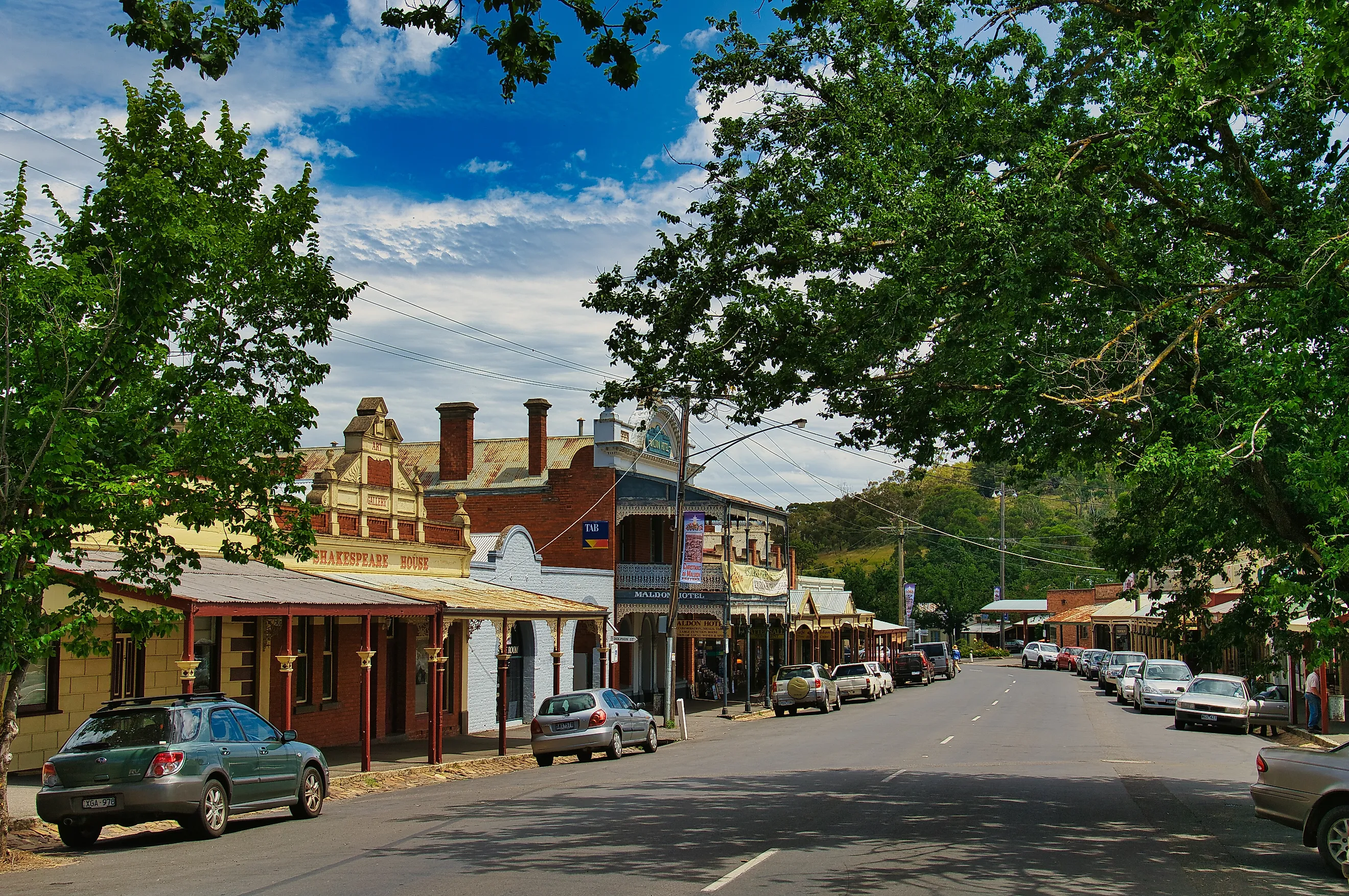
Maldon was named Australia's First Notable Town by the National Trust in 1966 and has held its 1850s gold rush footprint intact since. The Victorian Goldfields Railway runs heritage steam services between Maldon and Castlemaine, about 16 km south, on the restored 1880s line. The Maldon Historic Reserve covers the old diggings outside town with walking trails past stone huts and mine workings. The Maldon Vintage Machinery & Museum holds working steam engines and mining equipment.
The Maldon Lookout Tower at the summit of Mount Tarrengower, the highest point in the area at 565 metres, gives panoramic views back to town and across the surrounding box-ironbark forest. The Maldon Folk Festival in early November fills the town with acoustic and folk music across multiple venues. Penny School Gallery on Church Street operates from the town's original 1857 schoolhouse and shows local contemporary art.
Beechworth

The Beechworth Asylum operated from 1867 to 1995 on a 100-acre site at the edge of town and was one of the largest psychiatric institutions in Australia at its peak. Asylum Ghost Tours run nightly walks through the abandoned wards, focused on the building's history rather than easy theatrics. The Beechworth Historic Courthouse on Ford Street is where bushranger Ned Kelly was committed to stand trial in 1880, and the courtroom remains essentially unchanged.
The Beechworth Honey Experience runs free tastings and a working glass-fronted hive, and the Beechworth Gorge Scenic Drive loops through granite cliffs and waterfalls north of town. The annual Beechworth Heritage Festival (which replaced the Celtic Festival to broaden its scope) runs each November with Celtic, Chinese, and First Nations programming spread across the Old Gaol, Queen Victoria Park, and the Police Paddocks.
Meeniyan

Meeniyan, in South Gippsland with a population of around 600, has built itself into a disproportionately busy arts and food hub. Meeniyan Art Gallery on the main street, a former butcher's shop, shows rotating contemporary work from local and visiting artists. Mahob at Moos serves modern Cambodian cooking and runs as one of the most-talked-about regional restaurants in the state. The Meeniyan Garlic Festival in February celebrates the region's strong garlic-growing scene with cooking demonstrations and food stalls.
The Meeniyan Bird Hide a short walk from the centre overlooks wetlands where waterbirds gather year-round. The Outer Space, on the edge of town, runs pop-up performances and art installations in an old industrial building. The Winter Meeniyan Makers Market draws shoppers from across Gippsland for handmade clothing, jewellery, sculpture, and paintings. The Meeniyan Golf Club at the south end of town sits against rolling farmland and runs nine-hole rounds for casual visitors.
The Heartbeat of Victoria's Wild Side
Victoria's quirkiest small towns are not theme parks. They are working communities that built themselves around something specific: Walhalla's gorge railway, Clunes' books, Maldon's intact heritage streetscape, Beechworth's complicated asylum-and-Kelly history. Bookstores in former mining banks, ghost tours through abandoned wards, and a town committed to renewable energy by community vote all sit within a few hours of one another. Each one rewards a day or a weekend rather than a quick stop, and the seven above hand visitors something different from the postcard versions of regional travel.