The Longest Bridges In The World That Cross Open Water
Imagine driving for miles and miles with nothing but water on either side. On Louisiana's Lake Pontchartrain Causeway, one eight-mile stretch puts drivers out of sight of land in every direction. Some bridges stretch more than 30 miles across open water. Crossing a small river is one thing, but stretching a road for dozens of miles across a coastal waterway is something entirely different. Bridges over open water are a remarkable feat of engineering, combining enormous lengths with carefully designed supports, artificial islands, tunnels, and sophisticated construction techniques. These are five of the most impressive bridges in the world, running from the longest down.
Hong Kong-Zhuhai-Macau Bridge, China and Hong Kong

Completed in 2018, the Hong Kong-Zhuhai-Macau Bridge is far more than a typical bridge. It is closer to a corridor across the water. Spanning the Pearl River Estuary, this monumental transportation system connects Hong Kong, Zhuhai, and Macau through a combination of bridges, tunnels, and artificial islands. This intricate system measures about 34 miles (55 kilometers) and includes bridges, viaducts, artificial islands, and an underwater tunnel. All of these elements make it one of the most ambitious infrastructure projects in the world. The bridge opened to public traffic in 2018 and dramatically reduced travel times between the three areas. What once could be a lengthy journey around the Pearl River Delta became a more direct connection.
Constructing the bridge was no easy task. Engineers had to work around busy shipping routes, powerful currents, typhoons, and marine ecosystems, all in the middle of one of the world's most developed coastal areas. The underwater tunnel is a fascinating detail, with engineers creating an approximately 6.7-kilometer tunnel immersed beneath the estuary. This preserved a navigation route for large, important ships while allowing the crossing to continue uninterrupted. Additionally, artificial islands were built to connect the bridge sections to the tunnel and serve as essential transition points within the network.
Sheikh Jaber Al-Ahmad Al-Sabah Causeway, Kuwait
Kuwait's Sheikh Jaber Al-Ahmad Al-Sabah Causeway opened on May 1, 2019, and it crosses Kuwait Bay in two directions rather than one. The combined length reaches 30.1 miles (48.5 kilometers), divided between a Main Link running north from Kuwait City toward the Subiya region and a shorter Doha Link heading west. Nearly 80% of that length is offshore. The project was designed by the French engineering group Systra and cost around $3.6 billion. It was built by a consortium led by South Korea's Hyundai Engineering and Construction.
Reaching Subiya once meant a journey of roughly a 90-minute drive around the coast. The causeway cut that to about 30 minutes. There are two artificial islands out in the middle of the bay, with maintenance buildings, fuel stations, and marina facilities. The centerpiece is a cable-stayed span with a sail-shaped pylon rising nearly 500 feet above the water. Its navigation channel is wide and high enough for ships heading to port. Engineers even sank 1,000 rocks and reef blocks into the bay to replace habitat disturbed during construction.
Qingdao Jiaozhou Bay Bridge, Shandong Province, China
China is home to some of the world's most ambitious bridge projects, and the spectacular Qingdao Jiaozhou Bay Bridge, which opened in June 2011 after four years of construction, is no exception. Located in Shandong Province, the bridge itself runs 16.6 miles (26.7 kilometers), almost all of it over water. The wider connection project it belongs to, which folds in expressways and an undersea tunnel, reaches an astounding 25.84 miles (41.58 kilometers) in aggregated length. Aggregated length means Qingdao has different bridge and road sections added together, unlike the continuous bridge of the Lake Pontchartrain Causeway. On that aggregated figure, the Qingdao Jiaozhou Bay Bridge has held a Guinness World Record for the longest bridge over water, revealing that the title of longest bridge can depend on how length is measured.
It crosses Jiaozhou Bay and was designed to improve transportation around the rapidly developing Qingdao region. Before it was built, traveling around the bay would require a much longer road journey, so the connection created a convenient direct route between parts of the city and surrounding communities.
Lake Pontchartrain Causeway, Louisiana, United States

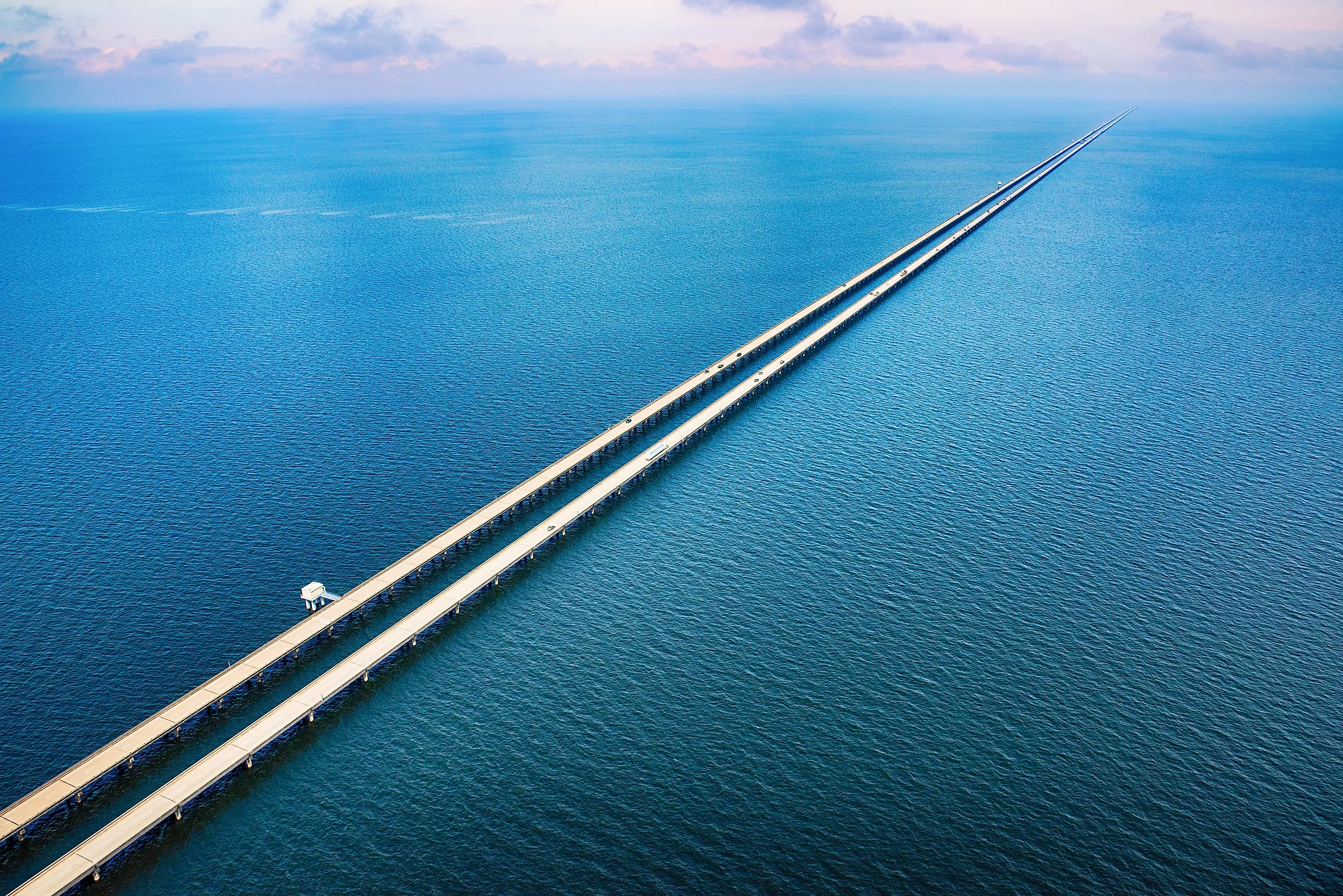
The extraordinary Lake Pontchartrain Causeway stretches 23.83 miles (38.35 kilometers) across Lake Pontchartrain in Louisiana and holds a Guinness World Record for the longest continuous bridge over water. The original causeway opened in 1956, and a second adjacent span was completed in 1969. It is made of two parallel concrete bridges running between the lake's north and south shores, providing a vital connection between busy New Orleans and many communities to the north.
For roughly eight miles, the causeway becomes so isolated that drivers can lose sight of land entirely. Looking in almost every direction, there is nothing but water and sky. The experience can feel like traveling out into the middle of the sea. The length makes maintenance a formidable undertaking however, because engineers must contend with unpredictable weather, wind, waves, corrosion, and constant vehicle movement. What looks like a simple straight line across the water is actually a massive piece of infrastructure requiring continual inspection and upkeep.
Chesapeake Bay Bridge-Tunnel, Virginia, United States

Opened in 1964, the Chesapeake Bay Bridge-Tunnel runs for approximately 17.6 miles (28.3 kilometers) across the mouth of the Chesapeake Bay in Virginia, connecting Virginia Beach with the Eastern Shore. It combines trestle bridges, artificial islands, and underwater tunnels instead of rising continuously above the water. The tunnel sections are necessary because the Chesapeake Bay is a busy shipping route, and building a bridge high enough for large ships to pass beneath would create major engineering and navigational challenges. Instead, the roadway descends below the water's surface, passes through a tunnel, and then emerges above again.
Between the tunnels are artificial islands that serve as transition points. From a driver's perspective, the experience can seem almost surreal. One moment the road runs above open water, then it drops below the surface and into a tunnel, only to emerge onto another bridge. Ultimately it represents a unique approach to overcoming the basic obstacles of getting people and vehicles across a huge expanse of water.
Bridging the Impossible
These bridges cross open water in very different ways. Lake Pontchartrain stretches continuously over water without touching land or entering a tunnel. Qingdao combines a long bridge with expressways and an undersea tunnel. The Chesapeake Bay Bridge-Tunnel is shorter, but part of its route drops below the surface.
Each structure solves a different engineering problem. Shipping lanes need to stay open, storms put huge forces on exposed spans, and salt water constantly wears at concrete and steel. Hong Kong-Zhuhai-Macau uses a tunnel beneath the estuary, and Kuwait built artificial islands to support its crossing. From above, they may look like simple lines across the water, but each one required years of planning and major engineering decisions to turn open water into a highway.