The Longest Beaches In The World
The longest continuous stretch of sand on Earth runs about 254 kilometres (158 miles) along the southern coast of Brazil. Praia do Cassino, recognised by Guinness World Records in 1994, extends from the breakwaters at the Rio Grande seaport south to the mouth of the Chuí Stream at the Uruguayan border, a single uninterrupted sandy shoreline longer than the entire coastline of New Jersey. The thirty beaches below cover the world's longest documented shorelines, ranked by peak measured length and verified against current sources. The list includes one major correction to most older rankings: Eighty Mile Beach in Western Australia, at 220 kilometres, is the world's second-longest continuous beach, ahead of Australia's better-known Ninety Mile Beach in Victoria.
The Coastline Paradox: Why "Longest" Is Tricky
Ranking the world's longest beaches is harder than it sounds. The coastline paradox, first articulated by Lewis Fry Richardson in the 1950s and developed mathematically by Benoit Mandelbrot in the 1960s, holds that the measured length of any natural coastline depends on the resolution of the measurement. A coastline measured with a one-kilometre ruler will appear shorter than the same coastline measured with a one-metre ruler, because finer-grained measurements pick up bays, inlets, and curves that coarser measurements smooth over. The smaller the ruler, the longer the coast.
This means the published "length" of a beach depends partly on the measurement standard. Beaches measured along their dune line, their high-tide mark, or their low-water mark can differ by 10 to 20 per cent. Beaches that are continuous in the sense of having no rock outcrop or river mouth interruption (Praia do Cassino, Eighty Mile Beach, Ninety Mile Beach) are usually compared with each other, but some lists include beaches with minor inlets or interruptions and others do not. The figures in the table below use the highest credibly published value for each beach.
1. Praia do Cassino, Brazil - 254 km (158 mi)
Praia do Cassino, in Rio Grande do Sul state, has been recognised by Guinness World Records since 1994 as the world's longest sea beach. Different measurement methods place the length between 212 and 254 kilometres (132 and 158 miles), with 254 km the most commonly cited maximum. The beach runs from the breakwaters (Molhes) at the entrance to the Rio Grande seaport south to the Chuí Stream on the Uruguayan border, with no significant river mouths or rocky interruptions along the way. The South Atlantic waters here are part of the Patos-Mirim Lagoon system's drainage and run cooler than most beachgoers expect for South America (the latitude is similar to Buenos Aires).
Praia do Cassino is named for the casinos that operated in the early 20th-century luxury hotels overlooking the beach near the resort town of Cassino. The beach hosts a substantial population of South American sea lions, and the wreck of the Greek freighter SS Altair (grounded in 1976) still partly protrudes from the sand at low tide. Surfing, fishing, and four-wheel-drive beach traffic are the primary uses. The beach has hosted scientific events including NASA atmospheric rocket launches during a 1966 total solar eclipse visible from the site.
2. Eighty Mile Beach, Australia - 220 km (140 mi)

Eighty Mile Beach (formerly Ninety Mile Beach, renamed in 1946 to avoid confusion with the Victoria beach of the same name) runs along the Indian Ocean coast of Western Australia roughly midway between Broome and Port Hedland. Despite its name, the beach is approximately 220 kilometres (140 miles) long, making it the world's second-longest continuous sandy shoreline and, by some methodologies, a contender for the longest. The beach forms the coastline where the Great Sandy Desert meets the Indian Ocean.
The beach is one of the most important migratory shorebird habitats in Australia and was designated a Ramsar Wetland of International Importance in 1990. Tides here reach up to 9 metres (28 feet), exposing vast intertidal flats that draw eastern curlews, oystercatchers, and a dozen other wader species. The Nyangumarta people hold native title over the southern section of the beach following a 2009 Federal Court determination, and the area's offshore waters lie within Eighty Mile Beach Marine Park. The beach is the source of wild pearl oysters (Pinctada maxima) that produce the largest pearl shells on Earth.
3. Ninety Mile Beach, Australia - 151 km (94 mi)

Ninety Mile Beach runs through the Gippsland region of Victoria, separating the Gippsland Lakes from the Bass Strait along the southeastern coast of mainland Australia. Despite the name, the beach is approximately 151 kilometres (94 miles) long. It is one of the few continuous beaches in the world that supports a designated 4WD road, though tidal conditions and shifting sand make any driving here a serious undertaking. Strong rip currents and limited surf-lifesaving coverage mean the beach is more popular with anglers, surfers seeking solitude, and dolphin and whale watchers than with general swimmers.
The Ninety Mile Beach Marine National Park, established in 2002, protects a 16-kilometre section of the beach including offshore reefs. Loch Sport, Seaspray, and Woodside are the three small townships providing access points, with most of the beach between them undeveloped.
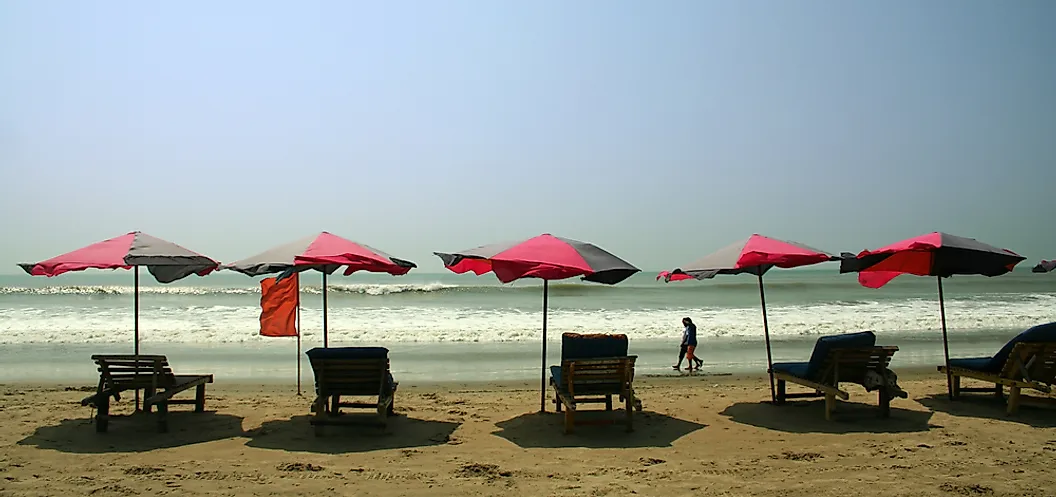
4. Cox's Bazar Beach, Bangladesh - 120 km (75 mi)

Cox's Bazar Beach is the longest natural sea beach in Asia and is widely marketed as the longest unbroken natural sandy beach in the world (a claim disputed by the older Brazilian and Australian beaches above, but legitimate within Asia). The beach runs 120 kilometres along the Bay of Bengal in southeastern Bangladesh's Chittagong Division. The main beach is divided into three named sections that visitors typically distinguish: Laboni Beach closest to Cox's Bazar town, Himchari Beach to the south with its inland waterfalls, and Inani Beach further south near Teknaf.
The beach is 200 metres wide at high tide and up to 400 metres wide at low tide, and the Bay of Bengal here is warm year-round. Quicksand during ebb tide is a documented hazard along several sections. The town of Cox's Bazar in Bangladesh is the country's top domestic tourist destination, drawing several million visitors a year. The beach is named after Captain Hiram Cox, a British East India Company officer who established a market town (bazar) here in the late 18th century to resettle Rohingya refugees from neighbouring Arakan.
5. Padre Island National Seashore, United States - 105 km (65.5 mi)

Padre Island National Seashore in south Texas protects 105 kilometres (65.5 miles) of the world's longest undeveloped barrier island. Padre Island itself runs 182 kilometres (113 miles) total, but most of the developed portions are at the north (Corpus Christi) and south (South Padre) ends; the National Seashore in the middle is preserved as a near-wild dune-and-grassland system with only one paved access road. The seashore was designated in 1962 and is administered by the National Park Service.
Most of the beach is accessible only by four-wheel-drive vehicle. The waters are part of the Gulf of Mexico, separated from the mainland by the hypersaline Laguna Madre (one of only six hypersaline lagoons in the world). The National Seashore is a major nesting ground for the critically endangered Kemp's ridley sea turtle, with a Park Service hatchery program releasing thousands of hatchlings each summer. Padre Island National Seashore is also a major migratory bird flyway stop, with over 380 bird species recorded.
6. Grand Strand, United States - 97 km (60 mi)

The Grand Strand is a 97-kilometre arc of continuous beach along the South Carolina coast, running from Little River at the North Carolina border south to Georgetown. Myrtle Beach is the largest of the dozen or so beach towns strung along the strand, and the beach is the densest concentration of vacation rentals, golf resorts, and live-music theatres on the US East Coast. Annual visitor counts exceed 17 million, making the Grand Strand one of the most-visited beaches in the United States despite its sand quality (mostly coarse, with shell fragments) being generally considered inferior to the Florida and Gulf Coast destinations.
The Strand is also the host of Myrtle Beach Bike Week and the Carolina Country Music Festival, both held annually. North Myrtle Beach, the northern third of the strand, is the origin point of the Carolina shag dance.
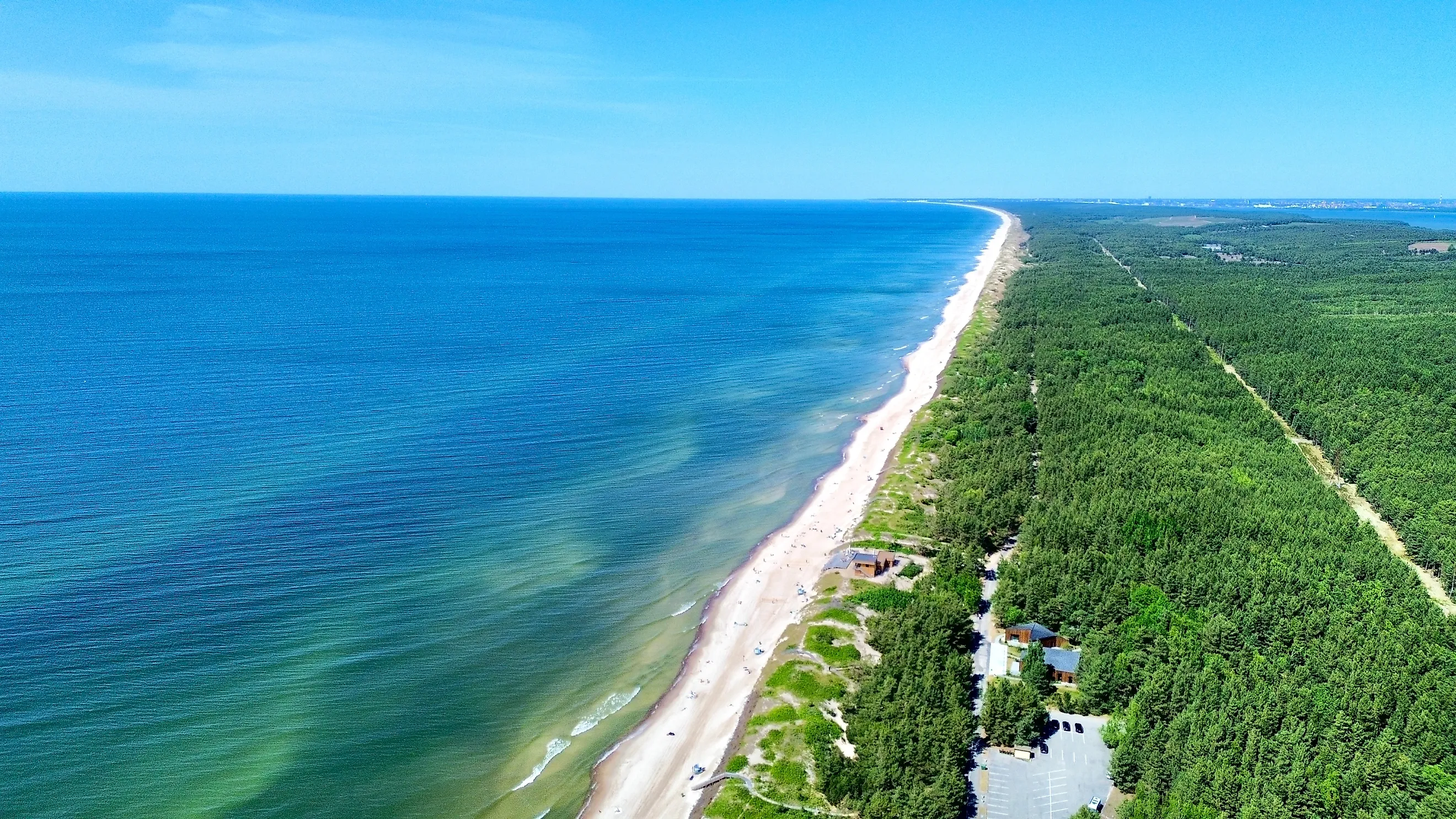
7. Curonian Spit Beach, Lithuania and Russia - 98 km (61 mi)

The Curonian Spit is a 98-kilometre sand-dune peninsula separating the Curonian Lagoon from the Baltic Sea. The Baltic-facing side is a continuous sandy beach running the spit's full length, split politically between Lithuania (the northern 52 km) and Russia's Kaliningrad Oblast (the southern 46 km). The dunes here are among the tallest drifting dunes in Europe, reaching 60 metres in places, and have shifted often enough through the centuries that several villages have been buried and abandoned. The Curonian Spit was jointly inscribed as a UNESCO World Heritage Site in 2000.
The Lithuanian side is mostly within Kuršių Nerija National Park; the Russian side is within Curonian Spit National Park. The resort town of Nida on the Lithuanian end and Zelenogradsk on the Russian end anchor either side, with the road running the full length when geopolitics permits (the Russia-Lithuania border crossing has been closed since 2022).
8. Ibeno Beach, Nigeria - 90 km (56 mi)
Ibeno Beach in Akwa Ibom State, Nigeria, runs about 90 kilometres along the Bight of Bonny in the Gulf of Guinea, making it West Africa's longest beach. The beach is wide and flat with fine white sand backed by coconut groves and mangrove wetlands inland. Ibeno is the headquarters of ExxonMobil's offshore Nigerian operations, and the town's commercial activity is built around both the oil industry and a developing tourism economy.
The Stubbs Creek Forest Reserve adjoins the beach inland and protects one of the few remaining populations of the Niger Delta red colobus monkey. The Qua Iboe River meets the Atlantic at the beach's eastern end, and beachfront fishing villages still operate the traditional dugout canoe and surf-net fisheries that long predated oil-industry development.
9. Ninety Mile Beach, New Zealand - 88 km (55 mi)

New Zealand's Ninety Mile Beach runs along the western coast of the Aupōuri Peninsula at the far north of the country's North Island, between Ahipara in the south and Scott Point near Cape Reinga in the north. Despite the name, the beach is approximately 88 kilometres (55 miles) long; the name probably originated from an early survey that miscalculated travel time across the sand. The beach is gazetted as a public highway in New Zealand, and tour buses regularly drive its full length at low tide.
The beach is a traditional resource of the Te Aupōuri and Ngāti Kurī iwi (Māori tribes) and is the route by which the spirits of the dead, in Māori cosmology, travel north to Cape Reinga to depart for the ancestral homeland of Hawaiki. The sand dunes inland reach up to 150 metres tall and are used for commercial sandboarding. The beach is also a substantial source of Tuatua shellfish (Paphies subtriangulata), harvested traditionally and commercially.
10. Playa Novillero, Mexico - 82 km (51 mi)
Playa Novillero in the Nayarit state of western Mexico is the longest beach in North America and runs 82 kilometres (51 miles) along the Pacific coast about 220 kilometres northwest of Puerto Vallarta. The beach is unusually flat (the slope between the dune line and the water is so gentle that visitors can walk a hundred metres into the surf before the water reaches their waist) and is mostly undeveloped, with the small fishing village of Novillero being the only significant settlement along its length.
The Pacific waters here are part of the Sea of Cortez ecosystem and host migratory humpback whales between December and March. The hinterland behind the beach is the Marismas Nacionales mangrove biosphere reserve, one of the largest mangrove systems on the Pacific coast of the Americas.
The Longest Beaches By Continent
Continental records (longest single beach on each continent) follow a different pattern than the global top 10. South America's leader is Praia do Cassino (254 km). Oceania has both Eighty Mile (220 km) and the two Ninety Mile Beaches, plus Cable Beach near Broome at 22 km. Asia's leader is Cox's Bazar (120 km), followed by Marina Beach in Chennai (13 km, the longest urban beach in Asia). North America has Padre Island (105 km) and Playa Novillero (82 km), with the Grand Strand at 97 km in third. Europe's leader is the Troia Peninsula in Portugal at 65 km, with Costa da Caparica (30 km) and Chesil Beach in the UK (29 km) following. Africa's leader is Ibeno (90 km) in Nigeria. Antarctica has no major sand beaches (the continental coast is almost entirely ice shelf, with limited gravel beaches like the one at Cape Royds on Ross Island).
The Thirty Longest Beaches in the World
| Rank | Beach | Length | Country | Continent |
|---|---|---|---|---|
| 1 | Praia do Cassino | 254 km (158 mi) | Brazil | South America |
| 2 | Eighty Mile Beach | 220 km (140 mi) | Australia | Oceania |
| 3 | Ninety Mile Beach (Victoria) | 151 km (94 mi) | Australia | Oceania |
| 4 | Cox's Bazar Beach | 120 km (75 mi) | Bangladesh | Asia |
| 5 | Padre Island National Seashore | 105 km (65.5 mi) | United States | North America |
| 6 | Curonian Spit (Baltic side) | 98 km (61 mi) | Lithuania / Russia | Europe |
| 7 | Grand Strand | 97 km (60 mi) | United States | North America |
| 8 | Ibeno Beach | 90 km (56 mi) | Nigeria | Africa |
| 9 | Ninety Mile Beach (NZ) | 88 km (55 mi) | New Zealand | Oceania |
| 10 | Playa Novillero | 82 km (51 mi) | Mexico | North America |
| 11 | Troia Peninsula | 65 km (40 mi) | Portugal | Europe |
| 12 | Santa Rosa Island / Pensacola Beach | 64 km (40 mi) | United States | North America |
| 13 | Virginia Beach | 56 km (35 mi) | United States | North America |
| 14 | Long Beach Peninsula | 45 km (28 mi) | United States (Washington) | North America |
| 15 | Daytona Beach | 37 km (23 mi) | United States | North America |
| 16 | Hel Peninsula Beach | 35 km (22 mi) | Poland | Europe |
| 17 | Stockton Beach | 32 km (20 mi) | Australia | Oceania |
| 18 | Costa da Caparica | 30 km (19 mi) | Portugal | Europe |
| 19 | Chesil Beach | 29 km (18 mi) | United Kingdom | Europe |
| 20 | Seventeen Mile Beach | 27 km (17 mi) | Barbuda | Caribbean |
| 21 | Muizenberg Beach | 25 km (15.5 mi) | South Africa | Africa |
| 22 | Maspalomas Beach (with dunes) | 23 km (14 mi) | Spain (Gran Canaria) | Europe |
| 23 | Cable Beach | 22 km (14 mi) | Australia | Oceania |
| 24 | Monolithi Beach | 22 km (14 mi) | Greece | Europe |
| 25 | Skagen / Grenen | 20 km (12 mi) | Denmark | Europe |
| 26 | Hutt's Beach / Geraldton | 18 km (11 mi) | Australia | Oceania |
| 27 | Patong / Karon stretch | 15 km (9.3 mi) | Thailand (Phuket) | Asia |
| 28 | Marina Beach | 13 km (8 mi) | India (Chennai) | Asia |
| 29 | Anjuna-Calangute stretch | 12 km (7.5 mi) | India (Goa) | Asia |
| 30 | Saint-Tropez / Pampelonne | 4.5 km (2.8 mi) | France | Europe |