The Largest Dams In North America
Some of North America's largest dams rise hundreds of feet from their foundations, holding back reservoirs that supply cities, generate electricity, and regulate major rivers. The dams below are ranked by their maximum structural height from foundation to crest. That puts several less familiar structures ahead of famous landmarks such as Hoover Dam.
The ranking also covers the full North American continent, including Mexico and Central America. Mexico's Chicoasén Dam takes the top spot, followed by enormous projects in Canada, the United States, and Honduras. Fort Peck Dam, once at the top of this article, is exceptionally large by the volume of earth used to build it, but at about 250 feet high it does not belong near the top of a height-based ranking.
Chicoasén Dam, Mexico

Chicoasén Dam rises 261 meters, or about 856 feet, above its foundation on the Grijalva River in Chiapas, Mexico. Officially named the Manuel Moreno Torres Dam, it is the tallest major dam in North America. Its rockfill embankment sits near the northern end of Sumidero Canyon, where steep limestone walls give engineers the vertical relief needed for a high-head hydroelectric project. Construction was completed in 1980.
The dam's scale is closely tied to electricity production. Its hydroelectric station has an effective capacity of about 2,400 megawatts, making it one of the most important plants in Mexico's Grijalva River system. The reservoir can store roughly 1.63 billion cubic meters of water. Chicoasén works alongside La Angostura, Malpaso, and Peñitas as part of a chain of hydroelectric projects on the Grijalva. The river system remains a major source of hydropower for southern Mexico, and a separate Chicoasén II project is being developed downstream.
Mica Dam, British Columbia

Mica Dam reaches about 243 meters, or roughly 797 feet, across the Columbia River in southeastern British Columbia. That makes it Canada's tallest dam and second on this North American ranking. The earthfill structure stands about 135 kilometers north of Revelstoke and impounds Kinbasket Reservoir, a long body of water running through the Rocky and Monashee mountain region.
Kinbasket has about 12 million acre-feet of licensed storage and plays an important role in regulating the upper Columbia River. Its stored water supports generation at Mica and at hydroelectric stations farther downstream. Mica was originally designed with room for six generating units, though only four were installed during the project's initial development in the 1970s. BC Hydro added the final two units during a project completed in 2016. The expansion added about 1,000 megawatts of generating capacity, bringing the station to roughly 2,805 megawatts.
Oroville Dam, California

At 770 feet (235 meters), Oroville Dam on California's Feather River is the tallest dam in the United States. The zoned earthfill structure has a crest 6,920 feet long and contains tens of millions of cubic yards of earth and rock. Work at the site began in 1961, and crews topped out the embankment in 1967. The dam became a central component of the California State Water Project.
Behind it sits Lake Oroville, with a total storage capacity of approximately 3.5 million acre-feet. Water stored there feeds California's water-supply system, generates hydroelectricity, and provides space for flood management. Oroville's height became particularly visible during the February 2017 spillway emergency. Severe erosion damaged the main spillway, and water later passed over the emergency spillway for the first time. Authorities ordered roughly 188,000 downstream residents to evacuate when erosion near the emergency structure raised concern about a possible failure.
Francisco Morazán Dam, Honduras

The Francisco Morazán Dam in Honduras, commonly called El Cajón, reaches 226 meters (741 feet). Its inclusion changes any ranking that treats North America as the continent rather than simply Canada, the United States, and Mexico. Completed in 1985, El Cajón is a double-curvature concrete arch dam built in a narrow canyon. Its shape transfers much of the force of the reservoir into the rock on either side of the structure.
El Cajón's power station has 300 megawatts of installed capacity and remains Honduras' most important hydroelectric facility. The project faced a serious engineering problem after its reservoir filled. Water found paths through limestone beneath and around the structure, and by 1993 leakage had climbed to about 1,600 liters per second. Engineers eventually stabilized the site through an extensive grouting program that involved drilling deep into the foundation and sealing water pathways. The dam remains in operation under Honduras' national electricity utility, ENEE.
Hoover Dam, Arizona-Nevada
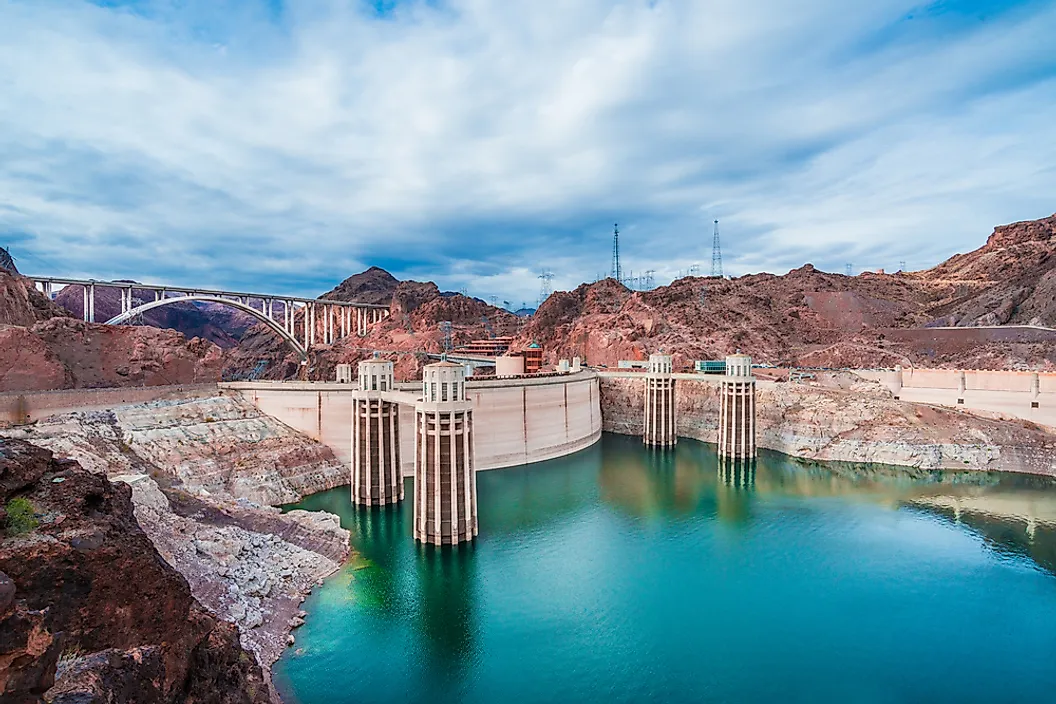
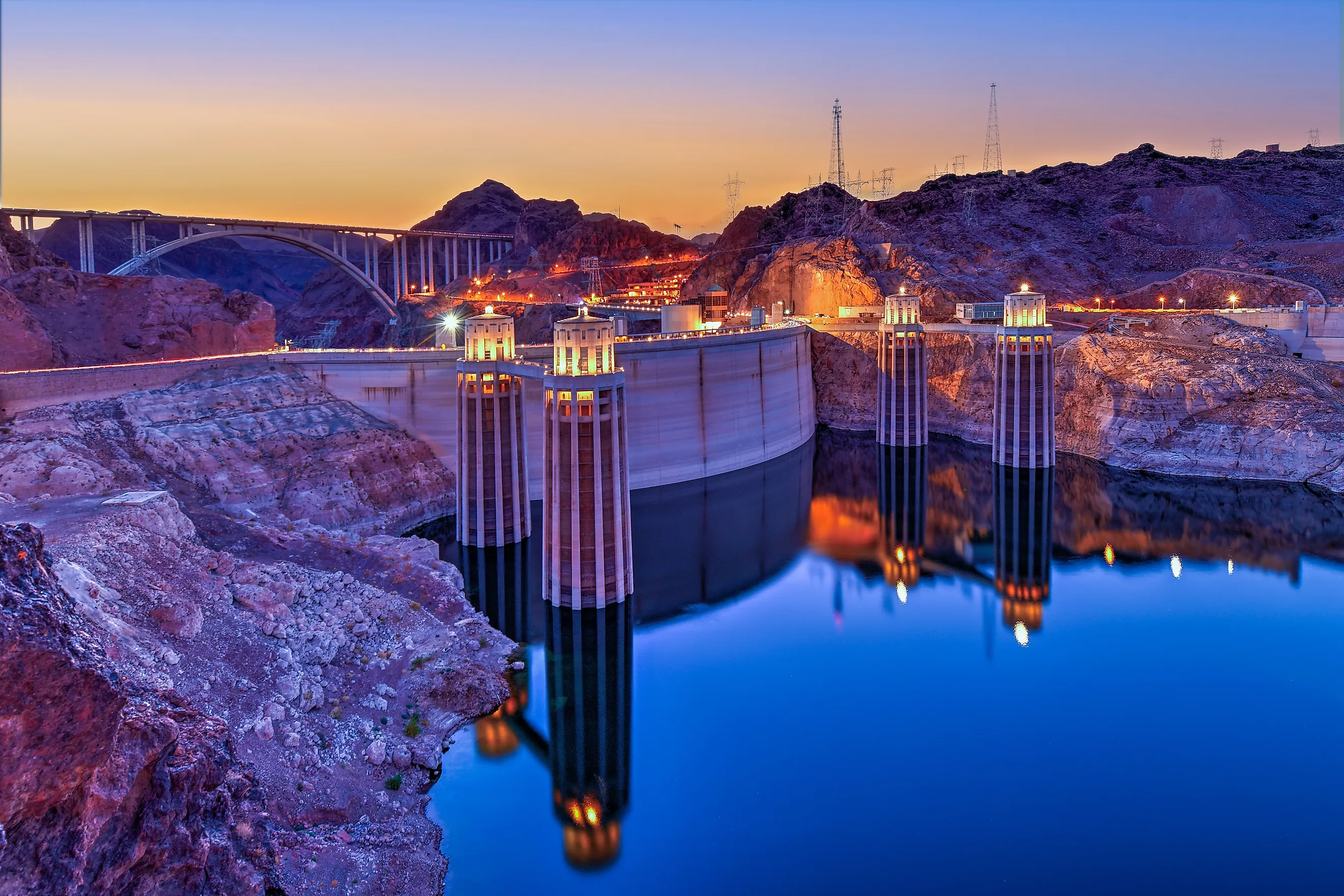
Hoover Dam stands 726.4 feet (221 meters) from its foundation in Black Canyon on the Colorado River. Its place fifth on this list may seem low for one of the world's most recognizable dams, but its importance has never depended on holding the height record. The concrete arch-gravity structure is 1,244 feet long at the crest and contains about 3.25 million cubic yards of concrete in the dam itself.
Construction took place during the Great Depression, with the final concrete placed in 1935 and the project dedicated that September. Hoover created Lake Mead, which has a full storage capacity measured in tens of millions of acre-feet. Water released through the dam also drives 17 main generating units. The power plant has a total capacity of about 2,079 megawatts. Hoover's combination of water storage, electricity generation, river regulation, and sheer visibility has given it a public profile much larger than its fifth-place height ranking suggests.
Dworshak Dam, Idaho

Dworshak Dam rises 717 feet (219 meters) above its foundation on the North Fork Clearwater River in northern Idaho. The U.S. Army Corps of Engineers identifies it as the third-tallest dam in the United States and the tallest straight-axis concrete dam in the Western Hemisphere. Its crest stretches 3,287 feet across the valley near Orofino.
The project began operating for flood control in 1972, with hydropower production following in 1973. Three turbines provide 400 megawatts of generating capacity. One of them is a 220-megawatt unit, the largest individual hydroelectric generator in the Army Corps inventory. Dworshak Reservoir reaches roughly 54 miles into the Clearwater National Forest and provides more than two million acre-feet of storage used for flood management. Summer releases also serve another purpose downstream. Cooler water from the reservoir is released to help reduce river temperatures and support migrating salmon and steelhead in the lower Snake River system.
Glen Canyon Dam, Arizona

Glen Canyon Dam rises 710 feet (216 meters) from bedrock on the Colorado River near Page, Arizona. The concrete arch structure is only about 16 feet shorter than Hoover Dam. Its crest spans 1,560 feet, and construction required roughly 5.37 million cubic yards of concrete when the dam and power plant are counted together. Crews worked from 1957 through the early 1960s, placing the final bucket of concrete in September 1963.
The closing of the diversion tunnels allowed Lake Powell to begin filling in March 1963. At its historical full-pool dimensions, the reservoir has a total capacity of about 25.16 million acre-feet and stretches 186 miles upstream. It took until June 1980 for Lake Powell to reach its full elevation for the first time. The dam remains a major storage point within the Colorado River system and sends water through eight hydroelectric generating units.
Daniel-Johnson Dam, Quebec

Daniel-Johnson Dam reaches 214 meters, or about 702 feet, above the Manicouagan River in Quebec. Its height puts it just behind Glen Canyon, but the dam looks unlike anything else in the top eight. Thirteen concrete arches curve between 14 massive buttresses across a crest 1.3 kilometers long. Hydro-Québec identifies it as the largest multiple-arch-and-buttress dam in the world.
The structure is part of the Manic-5 hydroelectric development in Quebec's Côte-Nord region. Its reservoir covers roughly 1,942 square kilometers and stores about 138.8 billion cubic meters of water. The adjacent Manic-5 station has 1,596 megawatts of installed capacity, and the later Manic-5-PA station adds another 1,064 megawatts. Construction of the dam dominated the project during the 1960s, when thousands of workers operated at the remote site. The distinctive series of arches eventually became one of the most recognizable pieces of Quebec's hydroelectric infrastructure.
A height-based ranking produces a list that better matches the physical scale implied by the title. It also explains why some famous mega-dams are absent. Grand Coulee is North America's largest hydroelectric facility by generating capacity, but its dam is about 550 feet high. Fort Peck contains far more construction material than most structures here, yet reaches only about 250 feet. Those records are genuine, but they measure different things. By structural height, Chicoasén, Mica, Oroville, Francisco Morazán, Hoover, Dworshak, Glen Canyon, and Daniel-Johnson lead the continent.