The First Traffic Light In The United States
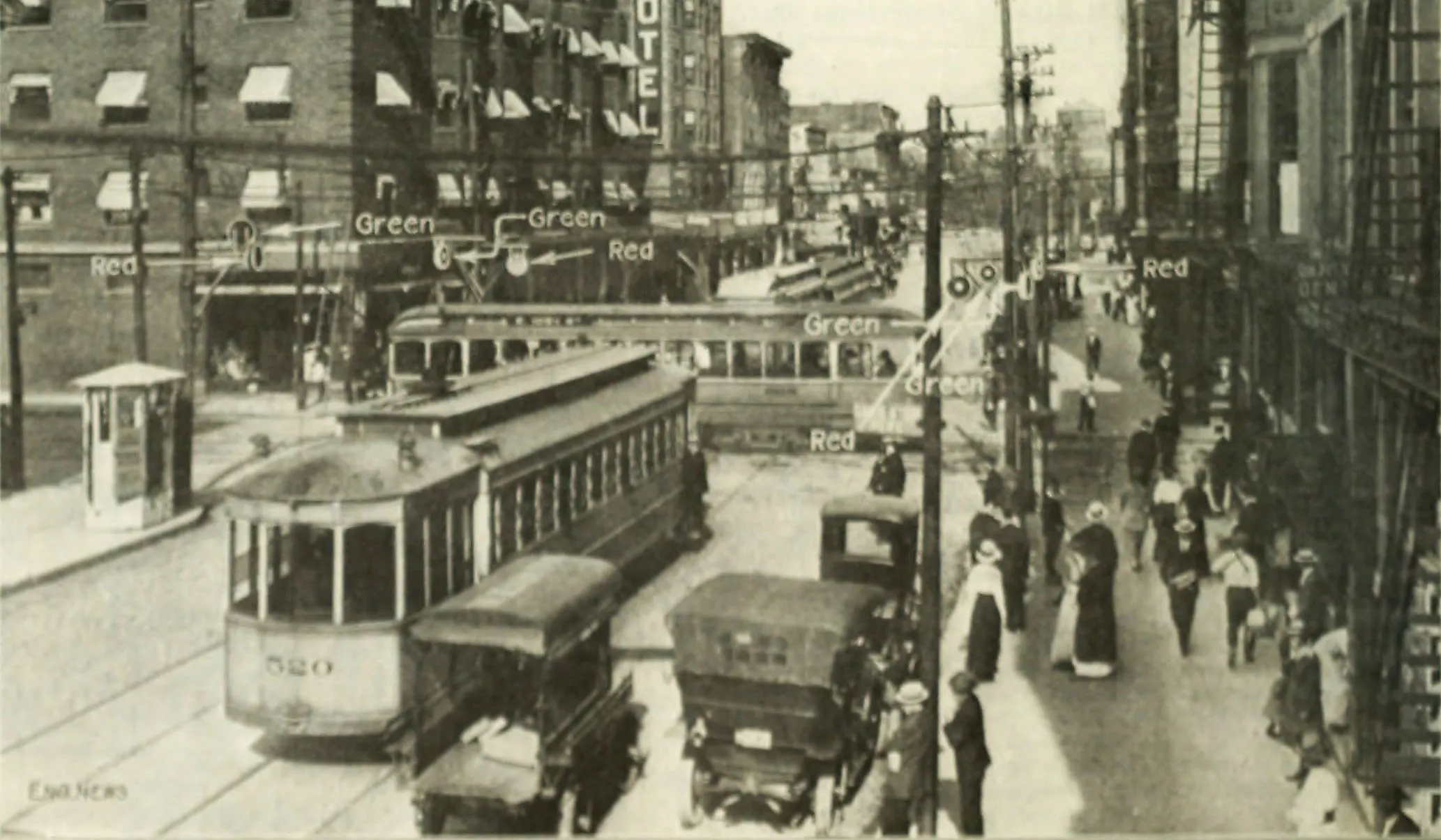
On August 5, 1914, the corner of Euclid Avenue and East 105th Street in Cleveland, Ohio, made history by being the first place in America to receive an electric traffic light. The light was designed by inventor James Hoge and made by the American Traffic Signal Company. It was operated manually and contained red and green light bulbs attached to four corner posts. These bulbs helped direct a steady flow of automobiles, streetcars, and pedestrians.
Why the Cleveland Light Takes First Prize

The criteria for this article focus on the first traffic light that worked with electricity and was installed at a public intersection. It also means the first light linked to the local municipality that used illuminated indicators to direct different types of traffic. Under different criteria, other candidates fit the bill too. For instance, when looking at a prototype that was not patented at the time, the wooden electric light box installed by Lester Wire in Salt Lake City in 1912 can be listed as the first. Or, if the criteria require the inclusion of an amber warning light, William Potts’ 1920 Detroit design can take the top spot. If the metric is a three-position mechanical signal, Garrett Morgan moves ahead with his 1923 invention in Cleveland.
The History of Hoge’s Traffic Light Installation
Euclid Avenue was an extremely busy road in 1913. Everyone, from automobile drivers to carriage riders, pedestrians, and trolleys used it. But, without a traffic system, it was always chaos. Every person using the road believed they could move off first. When oil magnate George Harbaugh turned on Euclid Avenue in March 1913, the chaos culminated in a streetcar crashing into his roadster. Fortunately, no lives were lost. This in itself seemed miraculous, considering more than 4,000 people died in car accidents in the U.S. that year.
Engineer and soon-to-be-inventor James Hoge had a bright idea to curb the chaos. Using the red and green railroad signal system, he created the first municipal traffic control system. He believed that the system could work using the electricity that powered the trolleys, and he was right. Before his own patent was issued, Hoge’s light was installed on Euclid Avenue at 105th Street. A policeman was instructed to sit in a booth on the sidewalk and control the signals by flipping a switch. The system was also integrated with municipal emergency services. Being wired to the Cleveland Fire Department station house and police precinct, the system had a master switch that could be thrown in case of an emergency. The switch would activate the red lights, bringing traffic to a standstill, and allowing emergency vehicles to pass.
Other people used Hoge’s idea to improve the system, which resulted in the invention of the yellow light and traffic lights as we know them today. By 1930, all the major American cities and hundreds of small towns boasted at least one traffic light. This invention was more than just another innovation. It saved countless lives.
What Visitors Can Expect Today

Unsurprisingly, the original signal hardware and control booth no longer exist at Euclid and East 105th. There has been extensive redevelopment in the area throughout the mid-to-late twentieth century. This expanded into the campus of the Cleveland Clinic and the surrounding University Circle district. Today, visitors will find only a historical marker commemorating the occasion of the first traffic light installed in America. Around the marker is a modern urban intersection that looks like all the other intersections in the state. This in itself shows just how revolutionary that first traffic light invention was. While the 110-volt lamps and manual switchboxes have disappeared, the fact that a four-way traffic system is in its place demonstrates one of the most important moments in American history.
Other Traffic Signal Designs
Several other traffic signal inventions also have a bearing on history. For instance, traffic patrolman Lester Wire was at his wits' end trying to dodge automobiles in the rain, without any kind of system to bring order to the traffic. He came up with an experimental electric traffic box that was installed at the intersection of 200 South and Main Street in Salt Lake City, Utah. Wire’s device was essentially a wooden box covered in yellow reflective paint. The box contained two cutouts fitted with red and green electric bulbs. The signal box was mounted on a post in the intersection. It was operated by an officer on the side of the road using a manual double-throw switch. Wire’s invention was an incredible feat, but it never received a patent and was never mass-produced. Because it relied on custom wiring without overrides or audible warning indicators, it was considered a pioneer experiment and was removed after a trial period.
William L. Potts, a superintendent of signals for the Detroit Police Department, invented the first four-way, three-color electric traffic signal in 1920. The system was installed at Woodward Avenue and Fort Street in downtown Detroit, Michigan. Potts’s system was the first to introduce the yellow light between the red and green cycles. By the mid-1930s, this new traffic signal could be found just about everywhere. Visitors can still see the original traffic signal at the Henry Ford Museum in Dearborn, Michigan.
Garrett Morgan also invented his own version of the traffic light in 1923, after witnessing an accident between an automobile and a horse-drawn carriage. His design used a T-shaped post with movable mechanical arms that displayed the words ‘stop’ and ‘go.’ The signal also featured an intermediate position that halted traffic in all directions at the same time, allowing pedestrians to cross. Morgan’s invention was not purely an electric light system, but also a mechanical semaphore. Its main innovation was the inclusion of the all-way stop setting. Morgan sold the rights to his patent to the General Electric Corporation for $40,000, and elements of his design were used for mechanical and electrical traffic control hardware across America.
The Legacy of the 1914 Traffic Light Installation Lives On

When the traffic light switched on at East 105th Street and Euclid Avenue in 1914, it changed how cities managed traffic forever. Before this, police officers had to stand in the middle of chaotic streets, blowing their whistles and frantically waving their arms to keep horses, cars, and pedestrians from being involved in collisions. James Hoge’s system proved that lights combined with timing and emergency overrides could handle city traffic far better than any police officer ever could. His invention was such a clear success that within fifteen years, updated three-color traffic lights were installed on street corners in nearly every major city not only in the U.S., but also in Western Europe.
Give That Red Light a Second Look
Most of us do not give a red light a second thought beyond stopping when it is illuminated. But that red light, along with the yellow and green ones, marked the turning point when cities began relying on new technologies to keep people safe while allowing traffic to flow. The experimental boxes and makeshift experiments are long gone, but every time you stop at a modern red light today, you are using a system born on a busy street in Cleveland more than a hundred years ago.