The 7 Wonders Of India
India's seven wonders were chosen by public vote in 2007. The Times of India ran a six-week SMS poll that pitted twenty candidate sites against one another and let readers narrow the field down to seven. The result is a list that spans roughly fifteen centuries and four religious traditions (Buddhist, Hindu, Jain, and Sikh) drawn from seven different Indian states.
The Taj Mahal in Agra appeared on every shortlist for obvious reasons. The Statue of Gomateshwara in Karnataka attracted close to half of all votes in some tallies, more than any other entry. The remaining five came in close behind: Hampi, Khajuraho, the Konark Sun Temple, Nalanda University, and the Golden Temple. Four of the seven are UNESCO World Heritage Sites; a fifth, Nalanda, was added to the UNESCO list in 2016 after extensive archaeological excavation and restoration.
What follows is an overview of all seven, arranged in chronological order from the oldest to the youngest. Two are still living religious sites of supreme importance to their communities. Two are in active ruins. The remaining three sit somewhere between, drawing daily worshippers in some areas and walking tourists in others.
Nalanda University In Bihar (Fifth Century CE)

Nalanda was a Buddhist monastic university founded under the Gupta emperor Kumaragupta I around 427 CE, in what is now Bihar's Nalanda district, about 90 kilometers southeast of Patna. It operated continuously for roughly 750 years and is widely regarded as the world's first residential university. At its peak under the Pala dynasty in the eighth and ninth centuries, the campus housed more than 10,000 students and 2,000 teachers drawn from China, Korea, Tibet, Mongolia, Sri Lanka, Java, and the Central Asian steppes. Subjects on the curriculum included theology, logic, philosophy, medicine, astronomy, grammar, mathematics, and metaphysics. The Chinese pilgrim-monks Xuanzang and Yijing both studied there in the seventh century and left detailed accounts of campus life.
The end came in the 1190s, when Bakhtiyar Khalji, a Turkic general serving Muhammad of Ghor, sacked the monastery, burned the library, and killed many of the monks. Estimates of when the library finally finished burning range anywhere between several days and several months. The site was abandoned and largely forgotten for several centuries until Francis Buchanan-Hamilton identified the ruins in 1812 and Alexander Cunningham confirmed them as Nalanda in 1861. The Archaeological Site of Nalanda Mahavihara was inscribed as a UNESCO World Heritage Site in 2016. A separate modern Nalanda University, founded as a deliberate revival of the ancient institution, opened in 2014 in nearby Rajgir; its permanent campus was inaugurated by Prime Minister Narendra Modi in June 2024.
Khajuraho Group Of Monuments In Madhya Pradesh (950 To 1050 CE)

The Khajuraho temples are a group of Hindu and Jain sandstone shrines in the Chhatarpur district of Madhya Pradesh, about 175 kilometers southeast of Jhansi. They were built between roughly 950 and 1050 CE by the Chandela dynasty, who at the time controlled the Bundelkhand region and called their capital Kharjuravahaka. Historical records list 85 temples standing on the site by the twelfth century; about 25 survive today, distributed across an area of around six square kilometers in three main groups (Western, Eastern, and Southern).
The temples are best known internationally for their erotic carvings, which occupy perhaps a tenth of the total sculptural program and have drawn most of the attention since the British army officer T. S. Burt rediscovered the site in 1838. The architectural framework around those carvings is more important. Khajuraho's temples are the most complete surviving expression of the nagara style of north Indian temple architecture, with tall curvilinear shikhara towers, intricately layered exteriors, and a clear progression from outer porch to inner sanctum. The Kandariya Mahadeva Temple, dedicated to Shiva, is the largest and most ornate of the Western Group. The site was inscribed as a UNESCO World Heritage Site in 1986.
The Gomateshwara Statue In Karnataka (Circa 981 CE)

The Gomateshwara, also known as Bahubali, is a 57-foot (17.4-meter) monolithic statue standing on top of Vindhyagiri Hill in Shravanabelagola, in southern Karnataka. It was commissioned around 981 CE by Chavundaraya, a minister and military commander of the Western Ganga dynasty, and carved from a single block of granite in situ. The statue depicts Bahubali, the son of Rishabhanatha (the first of the twenty-four Jain tirthankaras). In Jain tradition, Bahubali achieved kevala jnana (omniscient enlightenment) by meditating standing motionless for a year, long enough for climbing vines and anthills to grow up around his legs. The carvers represented this by adding plant tendrils and small creatures climbing the statue's calves and thighs.
Every twelve years, the statue is the focus of the Mahamastakabhisheka festival, in which it is bathed with milk, sugarcane juice, saffron paste, sandalwood, turmeric, vermilion, and gold and silver coins poured from scaffolding erected around the head. The most recent celebration was in 2018; the next is scheduled for 2030. Shravanabelagola has been a major Digambara Jain pilgrimage center for more than a thousand years, and Gomateshwara remains one of the tallest free-standing monolithic statues in the world.
The Konark Sun Temple In Odisha (Circa 1250 CE)
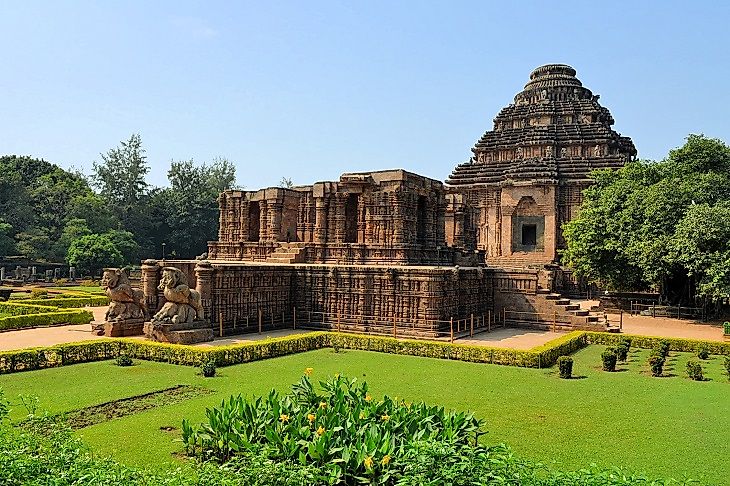
Konark stands on the Bay of Bengal coast in the state of Odisha (called Orissa until the state was renamed in 2011), about 35 kilometers northeast of Puri and 65 kilometers from Bhubaneswar. The temple was built around 1250 CE under King Narasimhadeva I of the Eastern Ganga dynasty, who dedicated it to the sun god Surya. The entire structure is conceived as a giant stone chariot: twenty-four elaborately carved wheels line the base, each about three meters in diameter, and seven life-sized horses pull the chariot eastward. According to local tradition, the temple was designed so that the first rays of the rising sun would strike the deity in the sanctum.
The main shrine collapsed at some point between the sixteenth and nineteenth centuries; the exact date and cause are disputed. What remains is the jagamohana (audience hall) along with significant portions of the temple base and chariot wheels, all carved from Khondalite stone in the Kalinga style. European sailors approaching the coast used the dark mass of the temple as a landmark and called it the Black Pagoda, in contrast to the white-walled Jagannath Temple at Puri. The Sun Temple was inscribed as a UNESCO World Heritage Site in 1984.
Hampi And The Vijayanagara Ruins In Karnataka (1336 To 1565 CE)
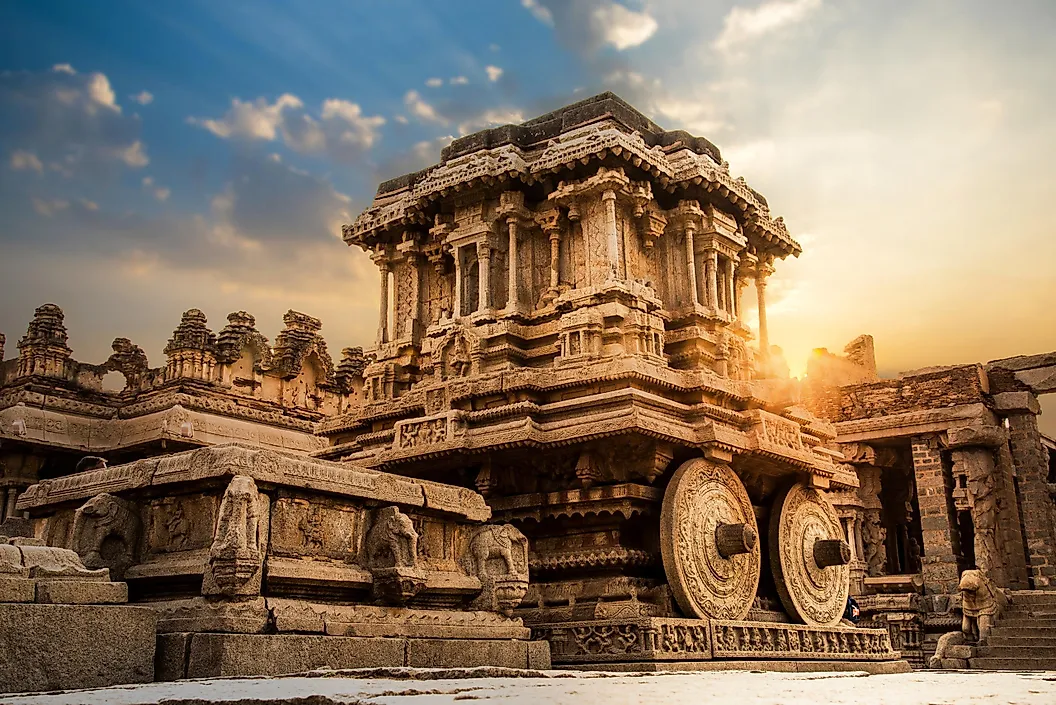
Hampi is the surviving core of Vijayanagara, the capital of the empire of the same name that dominated southern India for more than two centuries. Founded in 1336 by the brothers Harihara I and Bukka Raya I on the south bank of the Tungabhadra River in present-day Karnataka, Vijayanagara grew rapidly into one of the largest cities in the world. By the early sixteenth century, under Krishnadevaraya, the population is estimated to have reached around 500,000, making it second only to Beijing in size. Foreign visitors, including the Portuguese horse-trader Domingo Paes, left vivid descriptions of broad bazaars, irrigation channels, palaces, and a court with elephants and trained cheetahs.
The empire collapsed catastrophically after the Battle of Talikota in January 1565, when a coalition of Deccan sultanates defeated the Vijayanagara army and sacked the capital over the following six months. The Group of Monuments at Hampi, inscribed as a UNESCO World Heritage Site in 1986, covers 4,187 hectares and contains more than 1,600 surviving structures: forts, royal pavilions, water tanks, the Lotus Mahal, the Elephant Stables, and dozens of temples. The Virupaksha Temple, dedicated to Shiva, predates the empire (its earliest shrines go back to the seventh century) and remains an active place of worship. The Vittala Temple complex contains the celebrated stone chariot, which is depicted on the reverse of the current Indian fifty-rupee note, and the Maha Mantapa with its so-called musical pillars, which produce different tones when struck.
The Golden Temple In Punjab (Completed 1604; Gilded 1830)

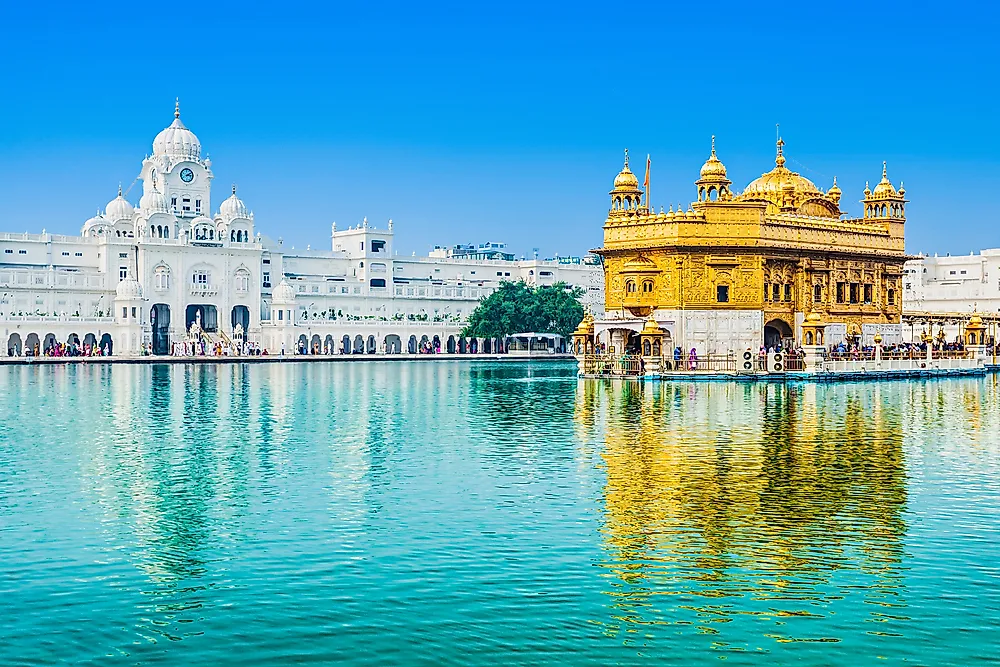
The Harmandir Sahib (also called the Darbar Sahib, and known worldwide as the Golden Temple) is the holiest gurdwara in Sikhism. The city of Amritsar around it was founded by the fourth Sikh guru, Guru Ram Das, in 1577. His successor, Guru Arjan, designed the central shrine and laid its foundation in 1581; construction was completed in 1604. On August 16 of that year, Guru Arjan installed the Adi Granth inside the temple. This was the first compilation of Sikh scripture and would later become the Guru Granth Sahib. The Akal Takht ("throne of the Timeless One"), the highest seat of Sikh temporal authority, was built across the sacred pool by the sixth guru, Guru Hargobind, in 1606. The two buildings face each other and represent the two complementary domains of Sikh authority: spiritual (miri) and temporal (piri).
The upper floors of the Harmandir Sahib were covered in gilt copper plates in 1830 under Maharaja Ranjit Singh, the Sikh sovereign who unified Punjab in the early nineteenth century. The temple has four entrances, one on each side, intended to signal that the gurdwara is open to people of all castes, faiths, and origins. The community kitchen (langar) serves free vegetarian meals around the clock to anyone who walks in: on an average day this works out to roughly 100,000 meals, with the figure rising past 150,000 on weekends and high holidays. The Golden Temple is not on the UNESCO list, though it has been on India's tentative list since 2004.
The Taj Mahal In Uttar Pradesh (1631 To 1648 CE)

The Taj Mahal was commissioned by the Mughal emperor Shah Jahan as a mausoleum for his second wife, Arjumand Banu Begum, better known by her title Mumtaz Mahal. She died on June 17, 1631, from complications after giving birth to their fourteenth child. Construction of the main mausoleum began later that year on a 17-hectare site on the south bank of the Yamuna River in Agra. The chief architect was Ustad Ahmad Lahori. The main building was largely complete by 1648, and the surrounding complex (gardens, mosque, guest house, gateway, and outer courtyards) was finished by 1653. Some 20,000 craftsmen and laborers worked on it across two decades.
The mausoleum itself is built of Makrana white marble inlaid with semi-precious stones (carnelian, jasper, lapis lazuli, amethyst, onyx, and others) in a technique called pietra dura. The central dome reaches 73 meters at its peak and is flanked by four free-standing minarets. Shah Jahan was deposed by his son Aurangzeb in 1658 and spent the last eight years of his life imprisoned in Agra Fort with a partial view of the Taj across the river. He was buried beside Mumtaz Mahal inside the mausoleum in 1666. The site has been a UNESCO World Heritage Site since 1983 and was named one of the New Seven Wonders of the World in a separate global poll in 2007, the same year as the Times of India poll for the seven wonders of India. The Taj draws around five million visitors annually.
What The Seven Have In Common
Spread across seven states and built across roughly fifteen centuries, the seven wonders of India have less in common than the label might suggest. Three were built by Hindu dynasties (Konark, Hampi, Khajuraho's majority Hindu temples). Two are religious sites in continuous active use (Golden Temple, Gomateshwara). One is an Islamic mausoleum in a Mughal idiom (Taj Mahal). One is a Buddhist monastic ruin (Nalanda). Khajuraho's complex includes both Jain and Hindu temples on the same site, and Hampi includes both temple architecture and substantial secular structures with Indo-Islamic stylistic elements.
What ties them together is durability. Each has survived political collapse, religious persecution, or simple abandonment, and in every case the structure that remains is sufficient evidence of what was there before. Five of the seven are on the UNESCO World Heritage list (the Taj Mahal 1983, Konark 1984, Hampi and Khajuraho 1986, Nalanda 2016). The Golden Temple sits on India's tentative list. Gomateshwara is protected as a Monument of National Importance under the Ancient Monuments and Archaeological Sites and Remains Act of 1958. All seven remain in good condition and open to the public.