9 Ideal Washington Destinations for a 3-Day Weekend in 2026
Three days is the sweet spot. It's long enough to reach the far corners of a state that runs west to the Pacific and east to the Idaho line, and short enough to make it back home with energy to spare. Towns like Forks and La Push on the Olympic Peninsula feature rainforest and sea stacks. East over the Cascades, the weather flips, and the country opens into orchards and wine benches. The San Juans sit a ferry ride north. Read on to discover nine top towns across Washington for a long weekend, each with a few days' worth of reasons and somewhere decent to sleep.
Leavenworth

The Bavarian facades are the hook, and they are genuinely committed. Every storefront on Front Street carries the same architecture and typeface, the result of a 1960s decision to rebrand a dying railroad town rather than let it disappear. It worked. Give the street an afternoon, then keep moving. Waterfront Park starts a few blocks from downtown and crosses a bridge to Blackbird Island, a wooded strip in the middle of the Wenatchee River with a couple of miles of flat trail. Salmon run through in the fall.
Up Icicle Road, the Icicle Gorge Nature Loop is a four-mile family walk along the creek with wildflowers in early summer and canyon views most of the way around. Serious hikers use the same road to reach Colchuck Lake and the Enchantments permit zone. In summer, the town floats. Outfitters rent tubes for the Wenatchee River run toward Cashmere, which takes three to four hours depending on water level, and most include a shuttle back. Icicle Village Resort makes the easiest base for any of it, a walk from downtown. It has a pool, an on-site spa, and enough room types to accommodate families or couples.
Port Townsend

Port Townsend got rich betting it would become the biggest city on Puget Sound, then lost the bet when the railroad went to Tacoma instead. The result is a downtown of 1890s brick that, fortunately, nobody had the money to tear down. Fort Worden State Park takes a full day all on its own. Two miles of shoreline run below gun batteries built into the bluffs. A parade ground sits ringed by officers' quarters, with Point Wilson Lighthouse at the tip. From the point, Vancouver Island shows to the north and Mount Rainier to the southeast, and orcas and humpbacks feed in the strait offshore.
Inside the park, the Port Townsend Marine Science Center has been running since 1982. The aquarium that stood out on the historic pier closed in December 2024, and the center's rebuilt exhibits opened in the beachfront building in August 2026, with live kelp-forest tanks and a fully articulated orca skeleton. Docents lead low-tide walks when the timing works. A second location downtown at Flagship Landing hosts the store and gallery, and a 42-foot gray whale skeleton stands at Union Wharf, a block away.
The Puget Sound Coast Artillery Museum occupies an original 1904 barracks across the parade ground and explains why the fortifications exist. For the water, book a two-hour sail on Port Townsend Bay or a three-hour wildlife cruise out toward Protection Island, where the puffins and sea lions are. Downtown, The Palace Hotel occupies an 1889 building on Water Street with 26 individually laid out rooms. Most are Victorian, a few are loft style, and several have kitchens.
Friday Harbor

Those in the know plan around the ferry. Reservations fill weeks out in summer, and once the boat lands, a car becomes optional. Twelve miles west of town on Westside Road, Lime Kiln Point State Park carries the nickname Whale Watch Park honestly. It is the only park in the country set aside specifically for whale watching from shore, and the bathymetry brings whales close enough that visitors on the rocks can be within about thirty feet of a breach. The J, K, and L pods are most frequent from May through September. A 1919 lighthouse still works as a navigational beacon, and its hydrophone streams underwater audio around the clock. An interpretive center and lighthouse tours run through the summer months, with a self-guided trail and signage the rest of the calendar. Bring a Discover Pass.
Downtown, skeletons of a juvenile orca and a humpback hang in the Whale Museum alongside hydrophone recordings and genealogy charts that track individual Southern Resident whales by family. The section on how the Samish and Lummi peoples regard orcas as kin is the part most visitors remember. Roche Harbor on the north end covers the third day, with a marina, cobblestone streets, and the Hotel de Haro alongside remnants of the lime quarrying operation that built the place. Along the way, The Farm at Krystal Acres sits in the middle of the island with more than 50 alpacas and a farm store. Back in town, Earthbox Inn & Spa is a short walk from the ferry landing and has the island's only indoor pool.
La Conner

Fewer than a thousand people live here, and the town carries more museums per capita than places fifty times its size. The La Conner Boardwalk runs the Swinomish Channel with working tugboats passing at eye level, and the path leads south under Rainbow Bridge, the 1957 steel arch connecting town to Fidalgo Island and the Swinomish Reservation. April is the reason most people come. The Skagit Valley Tulip Festival showcases gardens and bulb fields a short drive from town, and La Conner makes a far better base than the highway motels. Go on a weekday morning if you can.
The town's three museums do a lot of heavy lifting. The Museum of Northwest Art anchors the arts scene with rotating exhibitions and free admission, compact enough for an hour but worth two. The Pacific Northwest Quilt & Fiber Arts Museum fills the 1891 Gaches Mansion, and the house alone justifies the ticket. Up the hill, the Skagit County Historical Museum invites visitors to explore valley farming and tribal history with a view over the fields. For recreation, Pioneer Park offers three-quarters of a mile of wooded trail and stairs down to the waterfront. La Conner Channel Lodge sits on the water downtown, with fireplaces in the rooms and the boardwalk out the door.
Winthrop

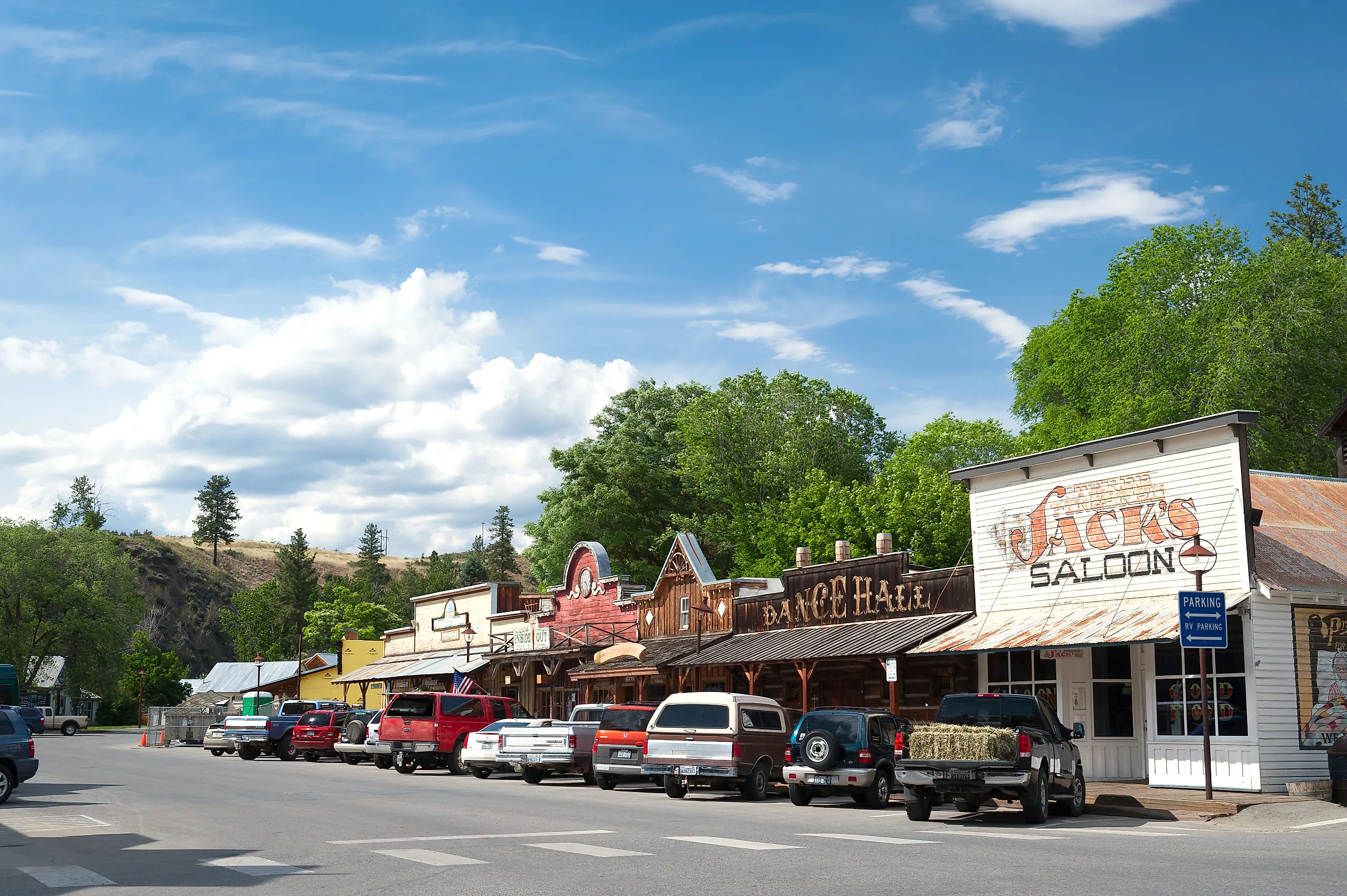
Winthrop's population sits somewhere under 500, and the visitor count runs to roughly 200,000 a year. In 1971, with the North Cascades Highway about to open and bring traffic through for the first time, local businesses funded a remodel of two downtown blocks in 1890s Old West style. Twenty-two buildings were done by the time the road opened in September 1972, and a design review board has held the theme ever since. The boardwalks and hitching rails are the result. The Shafer Historical Museum occupies the hill above town in the log house Guy Waring built in the 1890s, known locally as the Castle, surrounded by relocated mining and homesteading structures. Admission is by donation and the indoor portion closes in winter.
For a summer afternoon, Pearrygin Lake State Park is four miles north, a warm-water lake in ponderosa pine with day use available without reservations. Hotel Rio Vista is the downtown pick, with balconies over the Methow and Chewuch confluence. In winter, Methow Trails maintains around 120 miles of groomed track, the largest cross-country network on the continent, split into four areas linked by a community trail. The same corridors carry mountain bikes and trail runners once the snow melts. On that note, timing matters more here than anywhere else on this list. Highway 20 closes west of Mazama between roughly mid-November and late April, which turns a two-hour drive from Burlington into a five-hour detour. Check WSDOT before committing.
Long Beach

Twenty-eight miles of uninterrupted sand, and the drive from I-5 is long enough that it filters the crowds even in July. The Long Beach Boardwalk runs half a mile above the dunes between the Bolstad and Sid Snyder approaches, wheelchair accessible, with picnic tables and the sunset that everyone stops for. Underneath it, the Discovery Trail continues 8.5 miles south through Beard's Hollow into Ilwaco, tracing the last stretch of the Lewis and Clark route to the Pacific. Rent a bike in town and ride the whole thing.
Cape Disappointment State Park covers 1,882 acres at the mouth of the Columbia. Inside are two lighthouses, forest trails, freshwater lakes, and saltwater marsh. The Lewis and Clark Interpretive Center stands 200 feet above the surf with a glassed observation deck and exhibits on the Corps of Discovery. The Cape Disappointment light, first lit in October 1856, was the first in the Pacific Northwest and still operates. Swimming in the ocean here is not advised.
In town, the World Kite Museum holds what is regarded as the most complete collection of traditional Japanese kites outside Japan, and it runs the Washington State International Kite Festival during the third full week of August. Book lodging months ahead for that week. Speaking of which, the Adrift Hotel sits right on the beach with a saline pool, barrel saunas, free beach cruisers, and Pickled Fish on the top floor.
Walla Walla

Walla Walla sits five hours from Seattle in the southeast corner, at the foot of the Blue Mountains, which makes it a Friday-departure trip. The wine is why most people go, and the town is why they extend the stay. More than 30 tasting rooms operate in the walkable downtown alone, with over 130 wineries across the surrounding valley. A full day works without moving the car, which is the sensible approach. Also downtown, the Gesa Power House Theatre stages concerts and theater in a 120-year-old former gas plant, its interior modeled on the Blackfriars in London. The Marcus Whitman Hotel, the 1928 brick tower that anchors downtown, is within walking distance of most of the tasting rooms.
Seven miles west, Whitman Mission National Historic Site interprets the Whitman mission to the Cayuse Nation, the measles epidemic that followed, and the killings of 1847. Trails run through the mission grounds and a section of the reconstructed Oregon Trail. The current interpretation centers Cayuse perspective rather than the older monument framing. For its part, Fort Walla Walla Museum holds a 17-building pioneer village, five exhibit halls, and gardens on the grounds of the 19th-century fort. Allow half a day.
Chelan

The lake spans more than 50 fjord-shaped miles, and at 1,486 feet, it is the third deepest in the country. It sits wedged into the eastern Cascades, where the weather is reliably better than on the west side. The trip that separates a good weekend from a great one is the Lady of the Lake. The ferry runs the full 55 miles up to Stehekin, a community of roughly 75 year-round residents at the head of the lake with no road connection to anywhere. It takes about four hours each way in summer. A day trip is tight but doable; an overnight does it justice.
Slidewaters boasts eleven slides, a lazy river, and landscaped grounds above the lake. The Chelan Riverwalk Park near downtown offers a flat loop with big views, extending onto the Reach 1 Trail for another mile. The Lake Chelan AVA has more than 30 wineries in the benchlands above the water and around Manson, ten miles northwest, most of them small enough that the pour comes from whoever made it. Downtown, Campbell's Resort has welcomed guests on eight acres of waterfront since 1901.
Forks and La Push

Not one town but a base and a coastline, and the pairing is the point. Forks is a working timber town with a grocery store and a hospital, which matters when everything else out here is an hour away. Fourteen miles west, the La Push beaches deliver the images people come for. First Beach sits in La Push village on the Quileute Reservation, with sea stacks offshore and surfable waves. Second and Third Beach lie just south inside Olympic National Park, reached by trails through old growth. All three are open to the public. The Quileute Tribe asks visitors to ask before photographing people, and to leave driftwood and shells where they are.
Rialto Beach is the other essential stop, fourteen miles northwest via Mora Road. It is a pebble beach stacked with enormous driftwood and open views out to the Quillayute Needles. Check a tide table before walking north toward Hole-in-the-Wall, an arch a mile and a half up the sand. Inland, the Hoh Rain Forest is 31 miles south and takes three to four hours round trip with the Hall of Mosses. It receives more rain than almost anywhere in the lower 48. If a rainy afternoon needs filling, the Forks Timber Museum and the visitor center cover the town's logging history and, inevitably, the Twilight experience. Quillayute River Resort has cabins between Forks and the beaches, with kitchens and a river out the back.
Distance Does the Filtering
What keeps most of these places uncrowded is simply distance from I-5. Walla Walla, Long Beach, Winthrop, and the Forks coast all take real commitment, and all four repay it with room to move on a summer weekend. The nearer options trade that space for timing instead, which is why La Conner works for an April weekday and Chelan is best reserved for the week the weather turns east of the Cascades. In both cases, the binding constraint is not the drive but the booking, since the ferry berth and the rooms fill up long before the beaches and boardwalk.