8 Most Alligator Filled Places In Louisiana
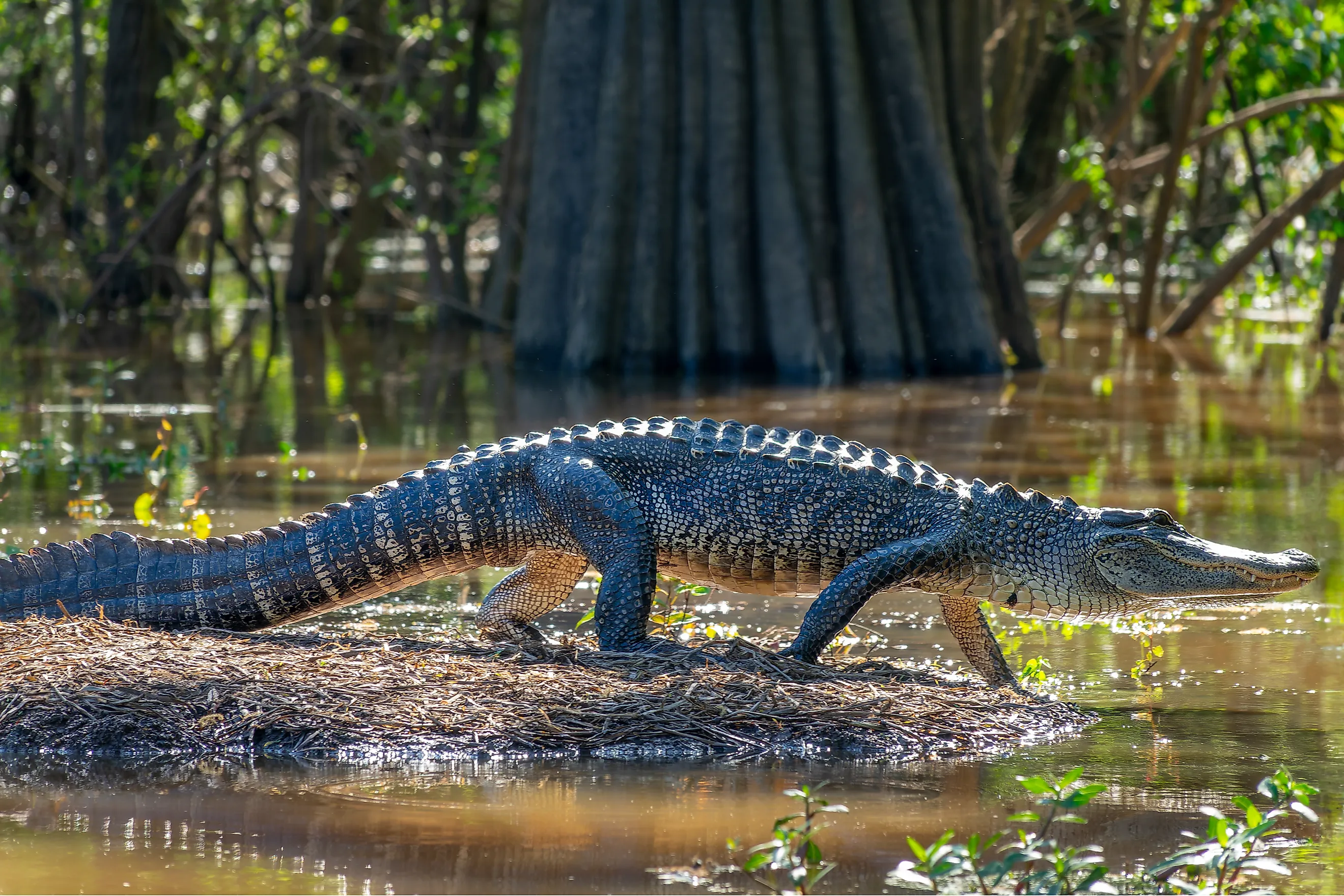
Louisiana’s urban bayous and remote swamps hold one of the largest American alligator populations in the country. Roughly 2 million wild gators call Louisiana home. The following eight places have, based on sightings and studies, a greater number of gators than other Louisiana locales. Interestingly, though alligators thrive in these places, sometimes with humans as their immediate neighbours, like in the New Orleans City Park, human-gator conflicts are hardly known. With proper precautions, these places make ideal destinations for a day spent outdoors.
Maurepas Swamp Wildlife Management Area

One of numerous gator hotspots on the banks of Lake Pontchartrain, the Maurepas Swamp Wildlife Management Area is tucked between Pontchartrain and namesake Lake Maurepas. Its thousands of acres of intermediate swampland shelter countless gators, which feast on other swampland creatures like herons, egrets, and rabbits. Gators occasionally prey on animals as large as deer. Fatal alligator attacks in Louisiana are extraordinarily rare, and the only recent reported attack in Lake Maurepas was on a 6-year-old boy who suffered a minor foot wound. Still, if you would rather not tempt fate by wading in murky water, view gators from a safe place via Cajun Pride Swamp Tours. Their boats operate in a privately owned wildlife refuge adjacent to Maurepas.
Atchafalaya National Wildlife Refuge

Spanning more than 1 million acres, the Atchafalaya Basin is considered the largest river swamp in the United States. This alleged Everglades-topper has several preserves, including the Atchafalaya National Wildlife Refuge, which protects over 15,000 acres of gatory habitat along the Atchafalaya River west of Baton Rouge. Other Atchafalaya gator hubs include the Sherburne Wildlife Management Area, which covers nearly 12,000 acres next to the refuge, and the Atchafalaya Basin Landing, where Airboat Swamp Tours take customers to wild but friendly alligators like Hercules, with whom the airboat captain has enjoyed a relationship since rescuing it from a fish hook many years ago. Gator attacks on humans are virtually unheard of in Atchafalaya. A dog was attacked near the terminus of the Atchafalaya River in 2021, but it recovered after surgery.
Jungle Gardens

Jungle Gardens is known for five things: birds, botany, Buddha, alligators, and Tabasco sauce. This 170ish-acre paradise was built on Avery Island by Edward Avery McIlhenny, who manufactured Tabasco sauce with salt from the island's salt dome. As much a conservationist as he was a mogul, McIlhenny brought together botanical and avian wonders, allowed other native species to take refuge among their splendor, opened the oasis to humans in 1935, and added an allegedly several-hundred-year-old Buddha statue in 1936. But there is another supersized relic enshrined at Jungle Gardens. Called "Monsurat," it is a taxidermied alligator said to be the largest individual taken on Avery Island and the only one feared by McIlhenny and associates. That 18-foot, 3-inch monster aside, alligators are permitted to live in peace around Jungle Gardens alongside other formidable predators like black bears and wild cats.
Pearl River Wildlife Management Area

The Pearl River Wildlife Management Area is a 35,000ish-acre preserve along the namesake river in eastern Louisiana. It covers much of the Honey Island Swamp, which, at an estimated 70,000 acres, is considered one of the most pristine swamplands in America. Naturally, it shelters myriad gators. Multiple tour companies, particularly Dr. Wagner's Honey Island Swamp Tours and Cajun Encounters, bring boatloads of passengers to bankloads of alligators. Still, like all other gator hubs, the Pearl River WMA and Honey Island Swamp experience scant human-gator conflicts. Yet their neighboring city, Slidell, saw one of Louisiana's only fatal alligator attacks. In the wake of Hurricane Ida in 2021, a 71-year-old was attacked outside his marshy home and his body disappeared. A couple of weeks later, his remains were found in the stomach of a 12-foot, 504-pound gator.
Rockefeller Wildlife Refuge

The brainchild of saucy conservationist Edward Avery McIlhenny and New York's opulent Rockefeller family, the Rockefeller Wildlife Refuge covers roughly 70,000 acres of coastal marshes that contain thousands of alligators and, during nesting season, thousands of alligator eggs. Rockefeller is said to have the highest alligator nesting densities in the United States. But, being part of "Louisiana’s Outback," the wild western region of the state, Rockefeller is one of many gator hotspots in a 200-mile radius. You can drive from the Rockefeller Wildlife Refuge to the Cameron Prairie National Wildlife Refuge to the Lacassine National Wildlife Refuge on the 180-mile gator-gawking Creole Nature Trail.
New Orleans City Park

Not all gator hubs are way out in the wilderness. Some are smack-dab in suburbia, like the City Park of New Orleans. This 1,300-acre urban park connects to Lake Pontchartrain via Bayou St. John and greater New Orleans via bustling neighborhoods. As such, New Orleans City Park is annually visited by millions of people and countless alligators. Despite such interspecies overabundance, hominid and reptilian parkgoers co-exist peacefully—most of the time. In June 2025, a woman was injured while saving her dog from an alligator attack. And, though it did not happen in the park, a 12-year-old boy was recently found deceased from gator-caused trauma in a nearby lagoon. Parental neglect was a contributing factor.
Lake Martin

A quasi-urban gator hotspot, Lake Martin sports a considerable nesting population of alligators despite sitting just seven miles from Lafayette and spanning only a few hundred acres. But more nesting habitat is provided outside the lake by the 9,500ish-acre Cypress Island Preserve, which is itself part of the massive Atchafalaya Basin. Gators can often be seen from Rookery Road, a gravel route that encircles the lake. Of course, if you so choose, you can get up close and personal with gators via kayaks, canoes, or tour companies. Cajun Country Swamp Tours and Champagne's Swamp Tours both operate on Lake Martin.
Jean Lafitte National Historical Park and Preserve

Yet another gatory site near Lake Pontchartrain and New Orleans, the Jean Lafitte National Historical Park and Preserve protects not just natural wonders along the Mississippi River Delta, but cultural wonders like the Chalmette Battlefield and the French Quarter Visitor Center. As for natural wonders, however, gators reign supreme. They can be found throughout the 26,000ish-acre Barataria Preserve, Jean Lafitte's in-preserve wildlife preserve, particularly near trails and walkways but sometimes on roads. Visitors are advised not to approach, harass, feed, or kneel in front of alligators. A kneeling human looks much more like prey than one who is standing.
Be aware, but not paranoid, of these alligator-filled places in Louisiana. Most gators are too small to be predators, and humans are too big to be prey. In fact, humans are the number one predators of alligators. Such preserves protect them from you rather than you from them.