8 Best Natural Wonders To Visit In Florida's Emerald Coast This Year
Florida's Emerald Coast is famous for its brilliant white sand and emerald-green Gulf waters, but its natural character extends far past the shoreline. Across the Northwest Florida coast are towering sand dunes at Henderson Beach State Park, lofty pine forests at Big Lagoon State Park in Escambia County, and wide wetlands at Tarkiln Bayou Preserve State Park.
The tannin-stained Blackwater River runs through longleaf pine country inland, and coastal dune lakes sit behind the beaches at places like Deer Lake State Park in Santa Rosa Beach, an ecosystem found in only a handful of regions worldwide. Eight destinations along this coast show what the Emerald Coast holds away from its well-known beaches.
Perdido Key State Park

On the western edge of Florida's Emerald Coast, Perdido Key State Park protects a stretch of white-sand beach backed by rolling dunes covered in sea oats. The dunes are more than a scenic backdrop. They form an important barrier-island ecosystem and a habitat for threatened and endangered species, including the Perdido Key beach mouse, nesting shorebirds, and sea turtles. Turtle nesting runs from late spring into summer under posted protection rules.
Boardwalks cross the dunes without damage to the fragile vegetation on the way to the Gulf shoreline. Swimming, shelling, fishing, hiking, and wildlife watching are all possible inside the park.
Big Lagoon State Park

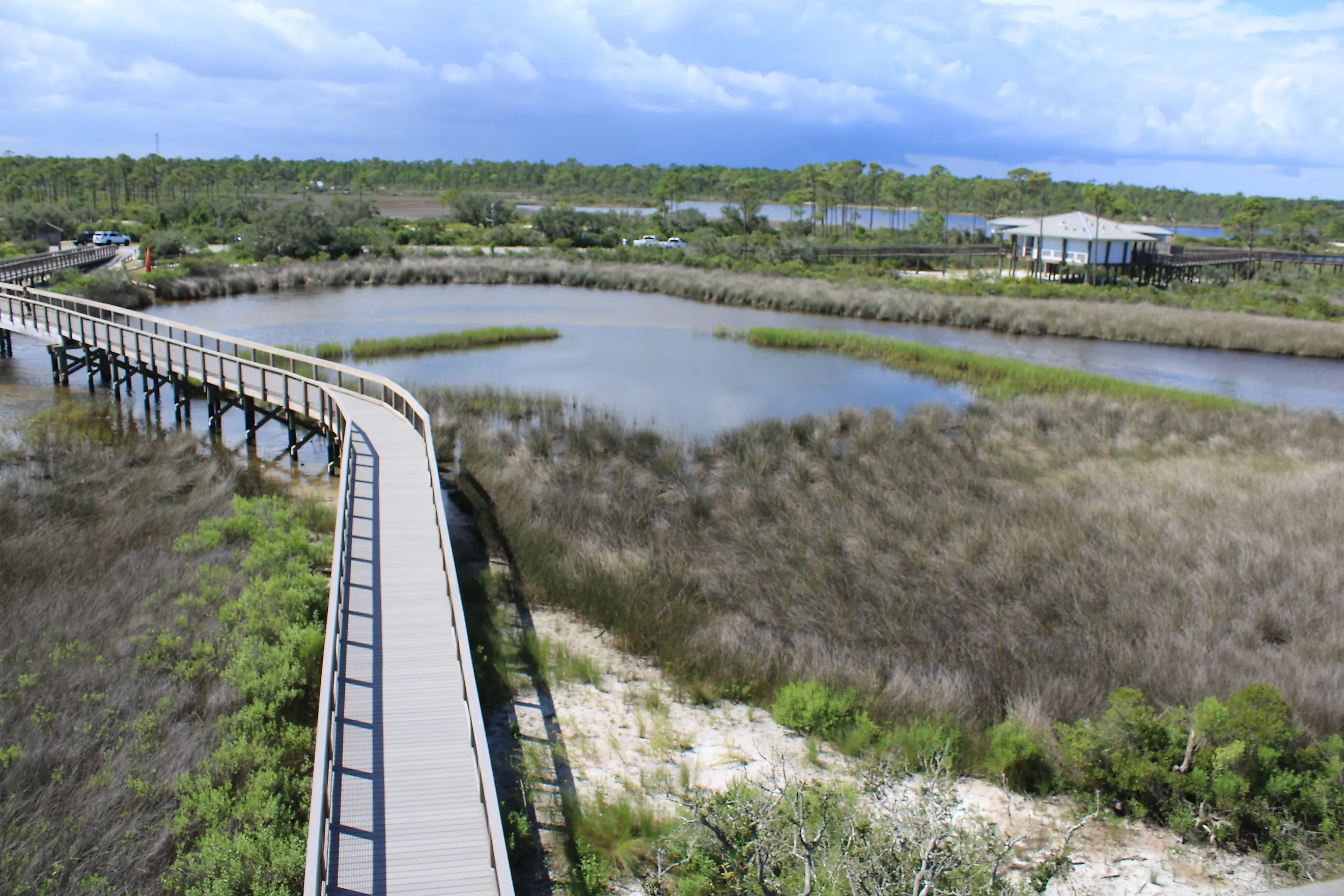
Big Lagoon State Park protects 704 acres between the mainland and Perdido Key, a landscape of saltwater tidal marshes, pine flatwoods, coastal forests, and shoreline habitat. The park's namesake lagoon forms part of the larger coastal water system separating the mainland from Perdido Key and the Gulf.
Birdwatchers have the strongest claim on the place. Florida State Parks notes that the area attracts numerous migratory species during spring and fall, including more than 23 species of wood-warblers. Hiking, kayaking, swimming, and fishing fill out the rest, and the park's three-story observation tower opens up a wider view of the surrounding landscape.
Tarkiln Bayou Preserve State Park

Tarkiln Bayou Preserve State Park shows a very different side of the Emerald Coast. More than 4,000 acres of wet prairie, pine and cypress forests, bayou, and coastal habitat shelter nearly 100 uncommon plants and animals.
The preserve is best known for its carnivorous pitcher plants. The white-topped pitcher plant is native to the Gulf Coast and grows only between the Apalachicola and Mississippi rivers. A half-mile accessible trail and elevated boardwalk lead through the wet prairie and forests to an overlook of Tarkiln Bayou.
The rugged Perdido Bay Trail extends 6.5 miles toward the bayshore for anyone after a longer walk.
Blackwater River

The Blackwater River is one of the Emerald Coast region's most distinctive waterways. Unlike the bright blue-green Gulf, the river is stained a golden-brown by tannins released from leaves and roots along its banks. Its sandy bottom and broad white sandbars create a striking contrast with the dark water.
The river runs through undeveloped stretches of Blackwater State Forest and Blackwater River State Park, home to one of the largest remaining contiguous longleaf pine and wiregrass ecosystems in the world. The river is undammed as well, and much of its natural character survives as a result.
Canoeing, kayaking, tubing, swimming, and picnicking are all available, along with trails through the surrounding forest.
Henderson Beach State Park

Henderson Beach State Park preserves one of the last remaining coastal scrub areas in Destin, where 30-foot white-sand dunes rise above the Gulf shoreline. The park protects more than a mile of natural scenic beach along with dune and scrub habitat.
A three-quarter-mile nature trail winds through the dunes, opening up the tough vegetation that survives in this harsh coastal environment. The shoreline is a good place to spot dolphins, sea turtles, shorebirds, and other marine wildlife.
Destin ranks among the Emerald Coast's busiest destinations, and Henderson Beach keeps a protected stretch of dune and coastal ecosystem in the middle of it.
Grayton Beach State Park and Western Lake

Grayton Beach State Park pairs one of the Emerald Coast's signature white-sand beaches with a much scarcer natural feature, a coastal dune lake. Western Lake covers approximately 100 acres inside the park, set among dunes and coastal forest.
Coastal dune lakes are freshwater bodies close to the Gulf that periodically exchange water with the sea. Walton County has 15 named coastal dune lakes, one of the world's most notable concentrations of these ecosystems.
The park contains nearly 2,000 acres of protected landscape, with hiking trails passing through coastal forest, dunes, and the ground around Western Lake.
Topsail Hill Preserve State Park

Topsail Hill Preserve State Park in Santa Rosa Beach takes its name from a towering dune that rises about 25 feet above sea level and resembles the sail of a ship. The dune is within a larger landscape of white quartz beaches, coastal dunes, wetlands, pine forest, and freshwater dune lakes.
The park contains approximately 1,600 acres of protected habitat and more than 10 miles of trails. Walking routes cross dunes and forest, Campbell Lake takes paddleboards, and three miles of undeveloped beach run along the Gulf.
The park's coastal dune lakes stand out because these shallow freshwater bodies occur in only a few regions of the world.
Deer Lake State Park

Deer Lake State Park in Walton County protects another of the Emerald Coast's coastal dune lakes, along with dunes, coastal scrub, forest, wetlands, and an undeveloped stretch of white-sand beach.
The park's namesake lake shares ground with the surrounding coastal dune ecosystem. A quarter-mile boardwalk crosses the dunes to the beach, opening up a close look at the vegetation and shifting landscape. Two nature trails give views of Deer Lake and the surrounding forest.
Several uncommon plants grow here, including Gulf Coast lupine, pitcher plants, spoonflower, and Curtiss' sandgrass.
A Coastline Beyond The Sand
Florida's Emerald Coast amounts to much more than a run of white-sand beaches. Its natural character comes from the interaction of sand, freshwater, saltwater, forests, wetlands, and Gulf ecosystems. Coastal dune lakes at Grayton Beach State Park and the dark water of the Blackwater River both belong to a side of the region that is easy to miss when the shoreline takes all the attention.
Spring and fall hold the steadiest conditions for hiking, paddling, and wildlife watching across the region. Anyone planning a late-summer or early-fall trip should track tropical weather forecasts, since the Atlantic hurricane season runs through November.