8 Best Natural Wonders To Visit In Australia This Year
Australia is an enormous landmass, and its natural wonders span an equally enormous range of environments, from tropical coastlines and ancient rainforests to deserts and other remote landscapes. What makes these places worth visiting this year is not simply their scenery, but the chance to experience a variety of ecosystems and landforms that are difficult to find anywhere else on Earth. Some are easy to reach from major cities, while others require long drives, flights, or guided excursions into little-devolped regions. Wherever you choose to go, the natural sites we will be highlighting should stand out to you for either their scale, geological significance, diverse wildlife, distinct character, or all of the above, with practical considerations such as seasonal access also worth keeping in mind when planning a visit.
Great Barrier Reef

The Great Barrier Reef is Australia's most extensive natural wonder, stretching for more than 1,400 mi (2,300 km) along Queensland's coast. It contains thousands of individual reefs and hundreds of islands, with coral gardens hosting anything from sea turtles to reef sharks, rays, and an enormous variety of tropical fish.
The best way to experience it is, of course, from the water, whether snorkelling in shallow reef areas or joining a guided diving trip to reach deeper sites. Cairns and Port Douglas are major gateways to reef excursions, while the Whitsunday Islands provide access farther south.
Conditions vary throughout the year, but the dry season generally brings clearer water and more comfortable weather. However, with coral bleaching and other pressures affecting local and global reef ecosystems alike, choosing responsible tour operators is increasingly important to best explore this spot.
Uluru

Uluru (widely known in previous times as "Ayers Rock") juts up 1,141 ft (348 m) above the surrounding Central Australian plain and is among the country's most recognisable natural landmarks. This massive, eye-catching sandstone formation sits within Uluṟu-Kata Tjuṯa National Park in the Northern Territory, where its appearance changes dramatically with the angle of the sun against its deeply rust-coloured faces. Sunrise and sunset are especially notable, with the rock shifting from muted reds to vivid orange and purple tones, a clear draw for landscape photographers.
The approximately 6.6-mi (10.6-km) Base Walk circles Uluru and passes various caves, waterholes, ancient rock art, and culturally significant sites. Here, you can also explore the nearby Kata Tjuṯa domes, another major geological feature within the park.
Note that Uluru has deep cultural significance to the Aṉangu, its traditional owners, and climbing the rock has been permanently prohibited since 2019.
Daintree Rainforest

In northern Queensland, the Daintree Rainforest is part of the Wet Tropics World Heritage Area, estimated to be an astounding 180 million years old, making it much older than the Amazon. This aged forestland more specifically stretches between the Great Dividing Range and the Coral Sea, creating an unusual combination of lush rainforest, mountains, beaches, and mangrove wetlands.
Visitors can wander the area along the Jindalba and Dubuji boardwalks, take guided walks focused on wildlife and Indigenous culture, or cruise the Daintree River, where saltwater crocodiles are commonly spotted. Cape Tribulation is another major destination to see within the region, with trails leading directly toward yet more beaches and other scenic locales.
In terms of interesting wildlife, the area further supports cassowaries, tree kangaroos, and hundreds of bird species, while its ancient flora communities include some of Australia's most primitive flowering plants.
Twelve Apostles

The Twelve Apostles are a collection of limestone sea stacks rising from the Southern Ocean along Victoria's Great Ocean Road. Despite the name, fewer than twelve formations have ever stood here, and ongoing erosion unfortunately continues to reshape and ultimately flatten the coastline. With that, get out and see it while you can, although it'll likely be quite some time until they're gone altogether.
The stacks were originally formed as waves gradually carved caves into the cliffs, eventually forming arches that collapsed and left isolated pillars offshore. To get a glimpse, the main viewing platforms at the Twelve Apostles Visitor Centre give broad views of the "Apostles," and beyond to the rugged coastline. Nearby, the Gibson Steps lead down toward the beach beneath the towering cliffs.
Furthermore, several other formations, including Loch Ard Gorge and London Bridge, lie farther along the coast and show the same geological forces at work. Sunsets and sunrises can often bring brilliantly changing light conditions to the pillars, but the site is impressive year-round regardless of when you go.
Kakadu National Park

Kakadu National Park covers nearly 7,700 mi² (20,000 km²) in Australia's Northern Territory, combining a number of wetlands, escarpments, savannas, and ancient rock formations. Each of these spaces changes dramatically with the seasons.
During the tropical wet season, local rivers and billabongs swell, and floodplains fill with water, while the dry season concentrates wildlife around shrinking wetlands. Knowing that, Yellow Water Billabong is a prime place to see saltwater crocodiles, magpie geese, and other wetland species on guided cruises. On the other hand, the sandstone cliffs at Ubirr and Burrungkuy provide awe-inspiring views across the surrounding floodplains, alongside thousands of years of Aboriginal rock art, too. Jim Jim Falls and Twin Falls are also worthwhile scenes to check out when seasonal access allows.
Blue Mountains

Just west of Sydney, the Blue Mountains are known for their steep sandstone cliffs, eucalyptus forests, lofty valleys, and impressive waterfalls spread across a very sizable region. The blue haze that gives the area its name comes from fine oil droplets released by its abundant eucalyptus trees.
Echo Point has perhaps the most classic view in the mountains across to the Three Sisters and Jamison Valley, whereas trails such as the Grand Canyon Track descend into the surrounding gorge country. Wentworth Falls is another must-see while in the area, with several lookouts and more walking routes around the falls and valley. Scenic World in Katoomba then offers aerial and rail rides into the Jamison Valley, giving you a much different perspective on the mountains' cliffs and forests in all directions.
This fairly easy-to-access natural wonder is also home to a rich diversity of flora and fauna, making it an important habitat for Australian wildlife and a top choice for any nature lover.
Bungle Bungle Range

The Bungle Bungle Range in Western Australia is renowned for its huge orange-and-black sandstone domes, some rising more than 820 ft (250 m) above the surrounding plains. Formed from ancient sandstone and shaped by erosion over millions of years, the distinctive beehive-like patterns here are among the country's most unusual geological features.
Located within the greater Purnululu National Park, it is best explored on foot along trails such as the Cathedral Gorge and Piccaninny Creek walks. Cathedral Gorge leads into a massive natural amphitheatre enclosed by towering rock walls, while Piccaninny Creek cuts deep into the domes. Moreover, scenic flights from nearby areas provide a broader view of the range and its isolated setting if you get a chance to do so. However, access is seasonal, with the park generally open during the dry months when roads are safer to travel.
Lake Hillier

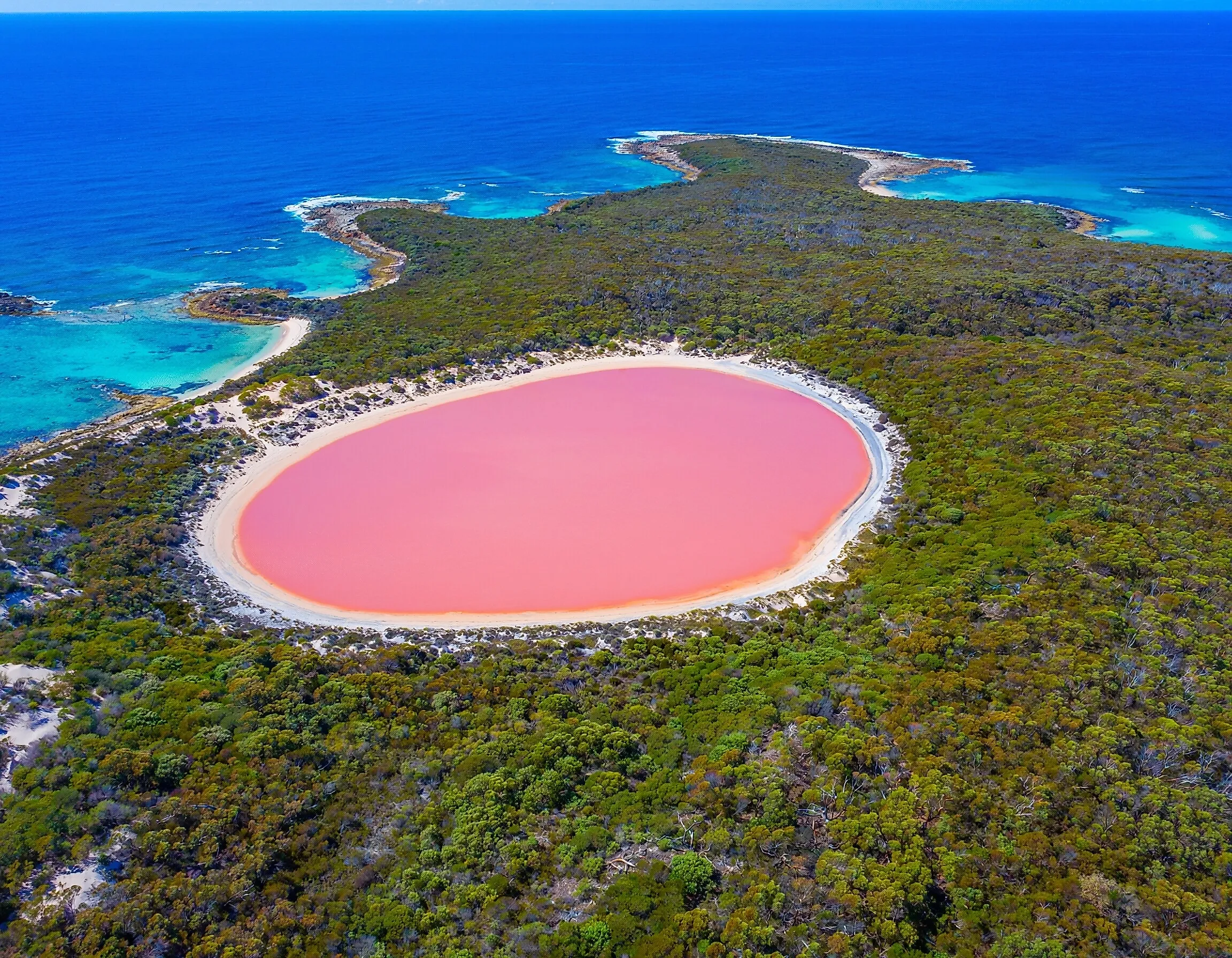
Lake Hillier can only be described as striking, as it's a deeply pink-hued lake on the otherwise verdant island in Western Australia's Recherche Archipelago. Its unmistakable, vivid colour contrasts sharply with the dark green vegetation and blue waters of the Southern Ocean surrounding the island.
The lake is about 1,969 ft (600 m) long and separated from the ocean by a narrow strip of dunes and forest. Its pink appearance is linked to microorganisms that thrive in the lake's extremely salty water, including certain algae and bacteria.
Lake Hillier is within the protected Recherche Archipelago Nature Reserve, and access to Middle Island is restricted, so visitors cannot simply arrive and walk to the shoreline. The most practical way to see the lake is from above on a scenic flight. An aerial tour also reveals Middle Island's forests, beaches, and remote position off Western Australia's southern coast.
See the Beauty of Australia for Yourself at these Essential Attractions
These incredible locales across Australia are spread across a continent where immense distance, variations in climate, and geology have created remarkably different environments. That variety makes planning matter, as some sites are seasonal, some remote, and others require guided access. But above all, all can be described as wonderful. Checking conditions before departure helps avoid wasted travel and makes it easier to experience these places at their best.