7 Best Natural Wonders To Visit In North Carolina This Year
Trade fireworks for waterfalls, caves, and mountains in 2026 and discover a fresh way to celebrate America’s 250th in North Carolina. As the country marks the 250th anniversary of the United States Declaration of Independence, this is the perfect year to make the trip to see landscapes that embrace superlatives and symbolize freedom, from the most-visited national park in the country, Great Smoky Mountains National Park, to the one of the deepest gorges, Linville Gorge, and the tallest waterfall east of the Rockies, Whitewater Falls. Here are seven of the best natural wonders to visit in North Carolina this year.
Great Smoky Mountains National Park

Great Smoky Mountains National Park is a bucket-list destination for outdoor enthusiasts who want to explore the mountain range, considered among the oldest on Earth, dating back 200 to 300 million years. The “Smokies” got their name from the Cherokee, who called the sacred place “Shaconage,” meaning “land of the blue smoke.” In reality, the smoky haze surrounding the mountains is produced by vegetation in the area, which releases organic compounds into the air. The Smokies became a national park in 1934 and were designated a UNESCO World Heritage Site in 1983.

Covering over 522,400 acres split between Tennessee and North Carolina, and more than 800 miles of trails to discover, hikers travel from all over the world to discover the out-and-back trails in the remote wilderness. With so many miles to choose from, it may seem daunting for hikers to decide which trails to take. A few of the not-to-be-missed hikes that take you to iconic destinations in the park include the Hike to Charlies Bunion, an 8-mile round-trip hike on a section of the famed Appalachian Trail; the Hike to Alum Cave Bluffs, a 4.60-mile round-trip hike through Arch Rock and old-growth forest; and the undisputed star of the park, Hike to Kuwohi (formerly Clingmans Dome), a one-mile round-trip up a steep path to the observation tower at the highest point in the Smokies, 6,643 feet.
Linville Gorge

In the heart of the Blue Ridge Mountains, Linville Gorge is one of the deepest gorges in the eastern U.S., set amidst the 12,000-acre Linville Gorge Wilderness Area. The gorge gets its name from the Linville River, which was named for explorers John and William Linville, who were killed in a clash with Shawnee warriors near the falls in 1766. With the passage of the Wilderness Act by the U.S. Congress in 1964, it was one of the first areas to be included in the National Wilderness System.

In 2026, the gorge is a favorite among climbers, backpackers, and hikers who want to head off-grid to explore its cliffs, roaring rivers, and discover awe-inspiring overlooks for 360-degree views of the gorge and the broader Pisgah National Forest. The gorge’s rim rises as high as 3,400 feet, high above the river, which flows 2,000 feet below. Along the rim, several iconic rock formations include Sitting Bear, Table Rock, and Hawksbill. Trails are mostly difficult, and the terrain is challenging and remote. The 2.1-mile Hawksbill Mountain Trail takes hikers to the top of the 4,009-foot mountain, rewarding their efforts with panoramic views of the Linville Gorge and the Charlotte skyline on a clear day. Primitive campsites near the mountaintop offer backpackers the chance to catch an unreal sunrise in the morning.
Whitewater Falls

Whitewater Falls is the tallest waterfall east of the Rocky Mountains, coming in at 811 feet. Located in one of North Carolina's four national forests, the Nantahala National Forest, the waterfalls are actually two sets: Upper Whitewater Falls, plunging 411 feet in North Carolina, and Lower Whitewater Falls, in the Sumter National Forest just across the border in South Carolina, dropping 400 feet. The terrain around Whitewater Falls is rugged, steep, and largely undeveloped, making it an ideal retreat into quiet, untouched wilderness. Access the Upper Whitewater Falls after a short, family-friendly half-mile walk through the forest, with glimpses of South Carolina’s Lake Jocassee along the way. Closer to the falls, there’s an observation deck, perfect for photographs, and a picnic area for a post-hike lunch.
Jockey’s Ridge State Park

Jockey’s Ridge State Park, in Nags Head, is home to the tallest natural dune system on the Atlantic Coast, estimated to be a remnant from the last Ice Age, dating back 7,000 to 12,000 years, with geologists suggesting that hurricanes and storms pushed shoals of sand ashore, creating the famous landmark. During the 1970s, the then-privately held land was destined to become a condominium complex until a local environmentalist, Carolista Baum, famously stood in front of a bulldozer, halting the project altogether. The developer was ultimately persuaded to donate or sell the land to the “People to Preserve Jockey’s Ridge,” an organization founded by Baum. In 1975, the land became a state park thanks to her activism.
In 2026, the 100-foot-tall dunes are an awe-inspiring natural wonder, comprising three main ecosystems that are home to more than 160 bird species, 38 reptiles and amphibians, along with otters, foxes, coyotes, and rabbits. The park doubles as a top tourist destination, where visitors can hike, hang-glide, sandboard, fly kites, and watch spectacular sunrises and sunsets over the Outer Banks.
Looking Glass Rock

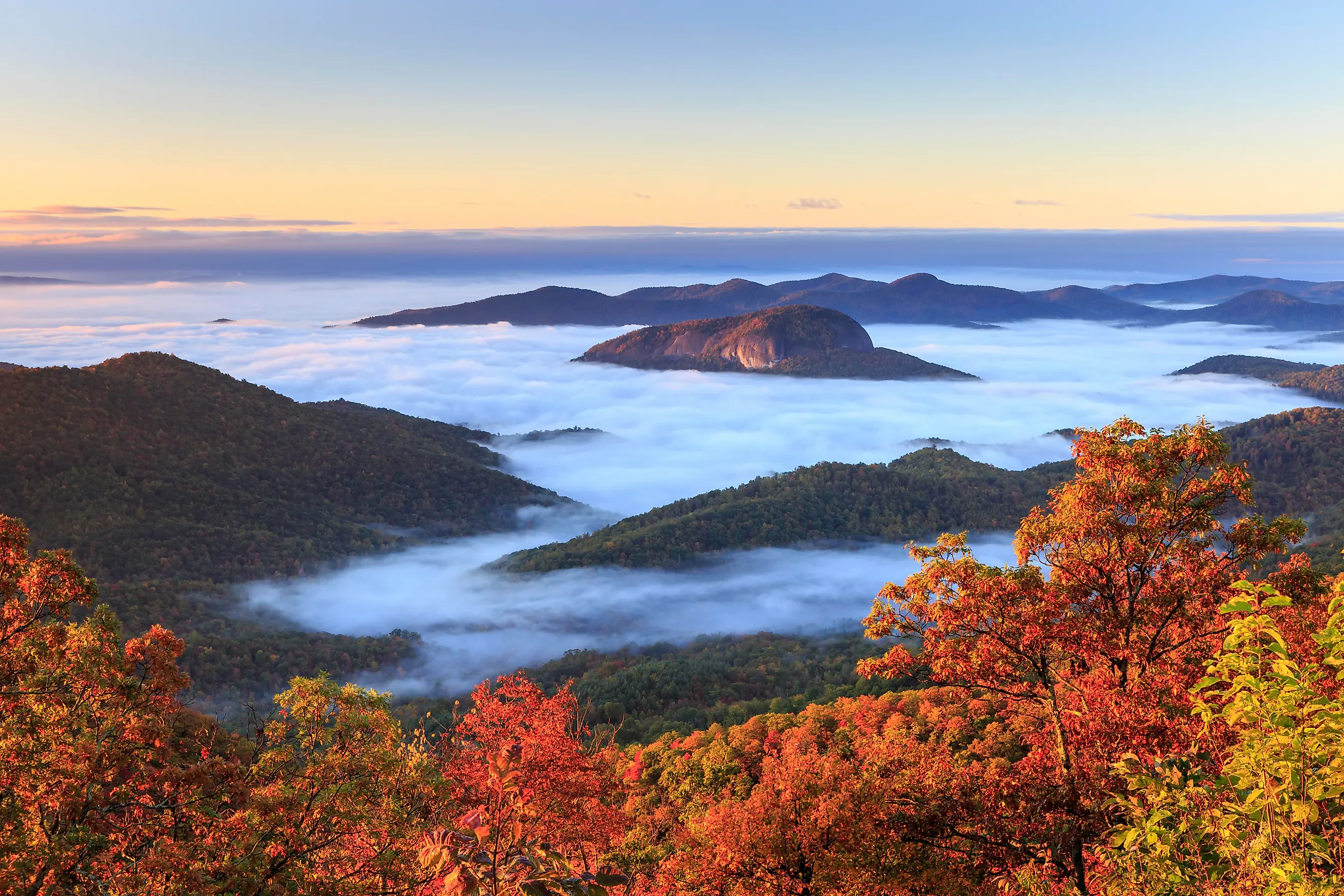
Looking Glass Rock is a massive granite dome, formed deep underground when molten rock slowly cooled and hardened. Over millions of years, erosion exposed the rock, leaving the dramatic, steep-sided formation you see today. Its name comes from the mirror-like reflection that happens when the sun hits the rock at a certain angle, especially after it rains. What sets Looking Glass Rock apart in the surrounding landscape is its sudden rise out of the ground, making it an obvious magnet for rock climbers.
2026 marks the 60th anniversary of the first ascent of Looking Glass Rock when Bob Watts, Steve Longenecker, and Robert John Gillespie climbed up the now-famous route known as The Nose in December 1966 after two unsuccessful attempts; today, there are about 200 established climbing routes up the landmark. The best place to see the monolith is from the Looking Glass Rock Overlook on the Blue Ridge Parkway, at milepost 417, near Brevard. To learn more about climbing in North Carolina in general, visit the Carolina Climbing Museum in Black Dome Mountain Sports in Asheville.
Linville Falls

Despite being part of Linville Gorge, Linville Falls is a natural wonder all its own. In the early 1900s, John D. Rockefeller owned large tracts of land around Linville Falls, helping preserve the rugged landscape that visitors enjoy in 2026. It is one of the most photographed waterfalls in the Blue Ridge Mountains. While the falls are usually accessible from the Linville Falls Visitor Center at Milepost 316.4, a hurricane damaged part of the road in 2025, closing parts of it. Nature lovers should check the recovery progress before planning a visit to the visitor center.
Visitors can still access the falls from Kistler Memorial Highway/Old NC-105, with rugged routes such as the Plunge Basin Trail depending on conditions. An alternate, easier trail is the Chimney View Trail on the opposite rim, which offers a quieter perspective of the Linville Falls after a short walk from the lot off the parkway.
Hanging Rock State Park

Nicknamed the “mountains away from the mountains” to distinguish the range from the nearby Blue Ridge Mountains, the Sauratown Mountains are home to Hanging Rock State Park, established in 1936 after a donation of 3,096 acres of land to the state for the purpose of creating a park. The park’s namesake is a jagged quartzite cliff that seems to hang over the surrounding forest, offering dramatic views of the Piedmont valleys and the Blue Ridge peaks in the distance. Much of the park’s early infrastructure was built by members of the Civilian Conservation Corps as part of President Franklin D. Roosevelt’s Depression‑era work relief program.
In 2026, the park spans more than 9,000 acres, including 48 miles of hiking trails, some of which lead to the 5 named waterfalls in the park. Starting at the Visitor Center, waterfall chasers can easily trek to Hidden Falls, Window Falls, and Upper Cascade Falls. Other activities to enjoy in the park include horseback riding, swimming, boating, and biking.
Exploring North Carolina’s Natural Wonders in 2026
This year, North Carolina offers travelers a chance to trade city crowds for landscapes that capture the spirit of adventure, freedom, and natural beauty of the Tar Heel State. From the Great Smoky Mountains to the dramatic cliffs of Linville Gorge, the stunning Whitewater Falls, and the otherworldly dunes at Jockey’s Ridge, each site is a unique natural wonder. Whether it’s the granite monolith of Looking Glass Rock, the iconic waterfalls at Linville Falls, or the rugged Sauratown Mountains, make 2026 the year to discover the seven best natural wonders in North Carolina’s awe-inspiring wilderness.