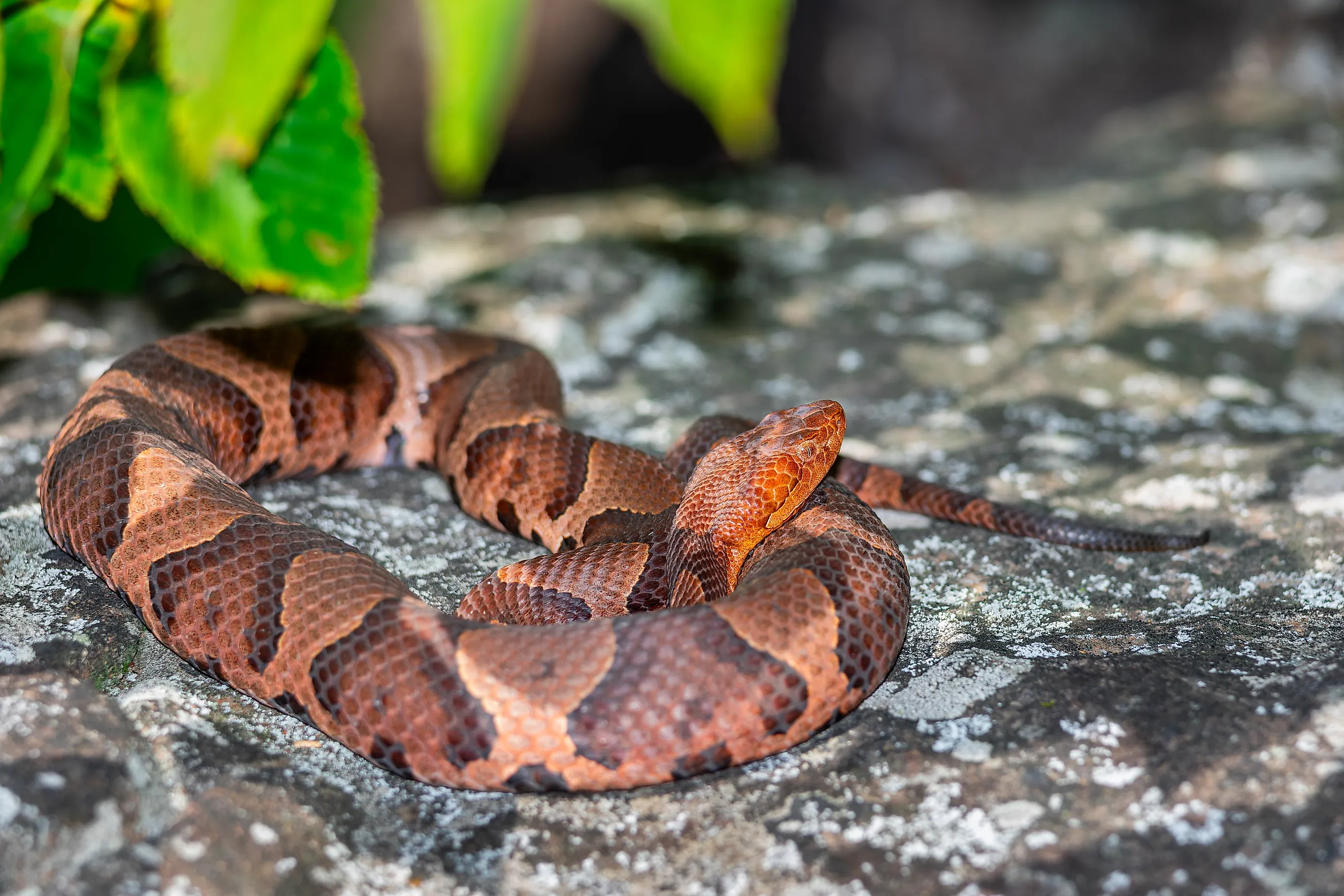
5 Copperhead Snake Hotspots In Maryland
Maryland is home to roughly 27 serpentine species. Of those dozens of diverse snakes, the eastern copperhead (Agkistrodon contortrix) stands out as one of the only two venomous snake species in the state (the other being the timber rattlesnake). The copperhead can be found across much of the state, with the exception of several counties on the Eastern Shore. The five locations below are known for frequent copperhead sightings in Maryland. If you head out to explore them, stay on marked paths, watch where you place hands and feet (especially around rocks, logs, and leaf litter), and give any snake plenty of space.
Gunpowder Falls State Park

Gunpowder Falls State Park covers more than 18,000 acres along the Gunpowder River and the Big and Little Gunpowder Falls in Central Maryland. Copperheads love its riverside and fallside foliage, under which they hide from predators like raptors (the bird-kind) and hunt prey like mice. They are especially common in the Hereford Area, the park's farthest-flung parcel.

Despite its name, Gunpowder Falls prohibits copperhead-shooting. In fact, per the Nongame and Endangered Species Conservation Act, the entire state is a no-snake-killing zone, with all species, venomous or otherwise, protected from slaughter. Harming or capturing a snake without a permit in Maryland is punishable by up to $1,000 in fines and/or one year of imprisonment. In 2015, four men from Glen Burnie were each fined $200 for killing and grilling Maryland's other venomous snake species, the timber rattlesnake. Such punishments make sense when you know that a single timber rattlesnake can annually remove 4,500 potentially Lyme-bearing ticks by eating tick-carrying mammals, or that no one in Maryland has died from a native snake in modern times. Maryland's only recent snakebite fatalities were from exotic species. In 2022, a Pomfret man was killed by one or more of the 124 snakes he kept in captivity. In 1992, an Emmitsburg man was killed by his pet Indian cobra. Though seldom fatal, copperhead bites are medically significant and do occur in Maryland, including in the following park.
Rock Creek Regional Park

Located in the Washington, DC, metropolitan area, Rock Creek Regional Park is an urban preserve with plenty of foot traffic and plenty of foot biters. Of course, so long as you watch your step while traversing its 1,800ish acres and 13 miles of trails, you will have nothing to worry about, especially since most snakes—in the park and in general—are non-venomous. Still, envenomations happen, like in 2018 when a parkgoer, after bringing his canoe ashore at Rock Creek's Lake Needwood, was bitten on the foot by a copperhead he had accidentally surprised. He recovered in hospital thanks to several vials of antivenin.

That Rock Creek visitor was one of roughly 75 Marylanders bitten by venomous snakes in 2018. A similar number is reported annually to the Maryland Poison Center, though not all are venomous bites. Copperheads cause the largest percentage of reported bites. Timber rattlesnakes, though not as bitey, are more potent. They co-exist with copperheads in one section of Maryland.
Cunningham Falls State Park

Though rattlers have been recorded in Central Maryland, Western Maryland is the primary mingling grounds of rattlesnakes and copperheads. They are extra chummy in Cunningham Falls State Park. They do not cross-breed, but they do share forested habitat and overwinter together in mountainside crevices. They act similarly in Catoctin Mountain Park, which borders Cunningham Falls to the north. Bites are rare in both parks, but they have occurred relatively recently. In 2014, a Cunningham Falls rock climber was bitten multiple times by a copperhead he had stepped on. The first strike penetrated his shoe and the second hit his ankle. He recovered in hospital. A few years earlier, a Catoctin parkgoer was bitten by a copperhead they had picked up. They ostensibly recovered as well. As is always the case, those bites happened due to unintentional and intentional provocation. Keeping one's distance from snakes is the best defense against snakebites.
Chesapeake And Ohio Canal National Historical Park

It is easy to avoid snakes in the supremely snaky Chesapeake and Ohio Canal National Historical Park. That is because much of this park, which stretches more than 184 miles along the Potomac River, is a resurfaced towpath. As such, whether you walk, jog, bike, or ride a horse on the path, you should be able to see a basking snake long before it can strike. This is particularly important if the snake is a copperhead, which can be found almost anywhere along the path but in greater numbers around Washington.

No known venomous snakebites have afflicted human parkgoers, but a black lab, who was walking about 10 feet ahead of his owners, was struck by a copperhead in 2022. He recovered with antivenom. Copperheads access the cowpath via thousands of acres of pathside wilderness, which also serve as a springboard for several non-venomous serpents. They include the common water snake, common garter snake, rough green snake, North American racer, and Eastern milk snake.
Calvert Cliffs State Park

Differing from the previous copperhead hotspots, which occupy central and western Maryland, Calvert Cliffs State Park is a copperheady preserve in Southern Maryland along Chesapeake Bay. Its namesake cliffs make excellent habitat, especially where they fan out inland as marshes and forests. Copperheads, due to their earth tones, are content camouflaging amid rotting logs and various other detritus—not just in the park, but throughout the region.

Per the Maryland Biodiversity Project, Calvert Cliffs State Park's surrounding quadrangle, called Cove Point, has more copperheads on record than any other quadrangle in Maryland. Further, Calvert County, to which Cove Point belongs, is arguably the state's copperheadiest county. Most, if not all, of the quadrangles in Calvert County contain copperheads, a percentage that seems to be unrivaled.
As the most widespread venomous snake in Maryland, the eastern copperhead slithers and causes shivers in various locales. But you should not be afraid to visit those hotspots. In reality, they are more like tepid spots, where copperheads are sometimes found but rarely bite and never unprovoked. If you refrain from harassing or surprising copperheads and all other snakes, human and serpent can co-exist peacefully in Gunpowder Falls State Park, Rock Creek Regional Park, Cunningham Falls State Park, the Chesapeake and Ohio Canal National Historical Park, and Calvert Cliffs State Park.