12 Amazing South Dakota Day Trips That Are Worth The Drive
South Dakota offers two very different kinds of day trips depending on where you begin. From Sioux Falls you can explore the eastern side of the state, including the waterfall where the city was founded and the trail of the Lewis and Clark Expedition. From Rapid City you can reach some of the grandest monuments in the country, both carved by hand and shaped by the geology of the Badlands. One base leans cultural and historical while the other leans monumental. Starting with Sioux Falls, here are twelve South Dakota day trips worth the drive.
Starting City: Sioux Falls
Old Courthouse Museum (Within the City)

The Old Courthouse Museum is worth stopping by just for the architecture alone. It was built between 1889 and 1893 by architect Wallace L. Dow, who was noteworthy for several other state buildings in South Dakota. Designed in the Richardsonian Romanesque style, it is three stories tall with a clock tower at the front and Roman-style archways. It was made out of Sioux Quartzite stone. The building is known as the old courthouse, as it was eventually deemed too small and set for demolition. Citizens advocated on its behalf, and it was converted into a museum in 1974.
The museum's exhibits cover far more than just the courthouse's history. They also cover pioneer history, indigenous history, the evolution of kitchens and cookbooks, law, and even the history of American clocks.
Washington Pavilion of Arts and Sciences (Within the City)

The Washington Pavilion of Arts and Sciences is an all-inclusive attraction in Sioux Falls for science, Broadway performances, art galleries, and educational programs. For example, the pavilion features music from Neil Diamond and plays such as "Waitress," while on the scientific side, it encourages scientific awareness from young families with its Space Explorers: Mission Infinity exhibit, and Grow It!, which enables children to play at running a farm. The science exhibits are designed to be interactive to help children learn via hands-on fun, such as Health Quest, where children can learn about human anatomy.
The Pavilion's Visual Arts Center regularly changes out its exhibitions. Recently, the center has displayed art inspired by the Midwest via the Becoming Midwest: Life Between exhibit, along with the artwork of Yankton Sioux artist Jerry Fogg via his Native Soul exhibit.
Falls Park (Within the City)

Falls Park is the most important landmark in the city, as it marks the spot of the origin of the city. Sioux Falls was built around and named after the Sioux Falls from the Big Sioux River. This natural landscape was formed around 14,000 years ago by a glacial ice sheet that changed the course of the river.
Today, Falls Park is a central community center and a place to enjoy the waterfalls. There are several viewing platforms to view the falls, which drop a total of about 100 feet across a series of cascades, with an average of 7,400 gallons of water pouring down every second. One of the best spots to get a picture of the falls is from up the five-story observation tower. Around Falls Park is the Big Sioux River Recreation Trail and Greenway and the Falls Overlook Cafe for snacks.
Palisades State Park (26-Minute Drive)

Palisades State Park is one of the most unique places to visit within a half-hour drive from Sioux Falls. Split Rock Creek cut deep gorges through Sioux quartzite spires over a period of millions of years, eventually creating the series of separated spires of varying sizes and shapes. Some are only a few feet above the water, whereas others are 50 feet tall.
Climbers typically climb up the taller rocks by scaling or rappelling, as bolting is not allowed on the rocks to protect them. These rocks are believed to be 1.2 billion years old. There are also four hiking trails that go around these formations. Other fun activities include canoeing, fishing, or biking. Discerning hikers will notice that many of the historic buildings in South Dakota are made out of the same materials as these cliffs.
Spirit Mound State Historic Prairie (56-Minute Drive)

The Spirit Mound State Historic Prairie has drawn travelers for generations, including Meriwether Lewis and William Clark. When Thomas Jefferson made the Louisiana Purchase, he commissioned these two men to lead an expedition to explore the territory and reach the Pacific Ocean. On August 25, 1804, the Lewis and Clark Expedition arrived on top of Spirit Mound and called it a "most beautiful landscape."
The land was filled with mystery, as Lewis and Clark had heard it was inhabited by spirits or little people with big heads. Today, the Spirit Mound is a place of quiet contemplation, standing 1,309 feet above sea level, offering a panoramic view of the prairie and town of Vermillion. For those with extra time, the town of Vermillion is worth seeing, for its many museums, including the National Music Museum.
Mitchell (1 Hour, 7-Minute Drive)

For those who like roadside attractions, the town of Mitchell, to the west of Sioux Falls, is worth the slightly over an hour drive. It is home to the World's Only Corn Palace, a structure designed with onion domes in the shape of corn stalks and is decorated with 7 murals made out of 12 colors of corn. The murals are changed out annually. Inside the palace, one can attend the Corn Palace Farmers Market along with a variety of events.
Another must-visit spot in Mitchell is the Mitchell Prehistoric Indigenous Archaeological Site & Museum. This is an active archeological site slowly uncovering a Middle Missouri site dating back to 1,000 AD. Visitors can see the shelter, tools, and artifacts used by this culture.
Starting City: Rapid City
The Journey Museum (Within the City)

The Journey Museum is aptly named, as it takes visitors on a wide-spanning adventure through prehistory to the modern day. It contains exhibits covering the distant prehistory of the Dakotas, such as an exhibit on paleontology on the many dinosaurs that used to wander South Dakota, including the Tyrannosaurus Rex.
Continuing on the journey, one can learn about how the Black Hills were formed over 65 million years ago in 25 rocky layers, and see rock art made by the Clovis people, the first humans to arrive in the Black Hills 12,000 years ago. Moving into modern times, the Journey Museum has a Sioux Indian Collection and a pioneer boardwalk featuring a recreated general store. One of the museum's current exhibitions is focused on American monuments and their many forms and purposes.
Storybook Island (Within the City)

First opened in 1959, Storybook Island has been a beloved place for children and young families ever since, remaining free for guests. This 8.5-acre park is designed to invoke various fairy tales through sculptures, playgrounds, and scenery. It prides itself on having scenes from more than 100 fairy tales and nursery rhymes, such as The Wizard of Oz and Humpty Dumpty.
For a small price, young families can ride a train through the island or get on the carousel. The Storybook Island is open from Memorial Day through Labor Day and has events throughout the year, such as its Books & Blankets storytime every Monday in June and July and the Safe N Sweet Fall Festival in October.
Mount Rushmore National Memorial (30 Minutes)

Rapid City is the closest city to the Mount Rushmore National Memorial, at just a 30-minute drive away. The park brings in more than two million visitors annually to see the Presidential faces carved into the monument.
Each of the Presidents was chosen by Gutzon Borglum to represent developments in American history. George Washington was chosen to represent the nation's birth, Thomas Jefferson for the growth of the nation, Theodore Roosevelt for its development, and Abraham Lincoln for its preservation. It is worth noting that this monument has been controversial due to the sacredness of the Black Hills to the Lakota Sioux and the history of the U.S. government removing Natives from the Black Hills.
Custer State Park (32 Minutes)

Custer State Park sits near the town of Custer, which is named after a controversial American figure, George Armstrong Custer. He was a Civil War cavalry commander who fought against various Native American tribes for control of the Black Hills. He would lose his life at the Battle of the Little Bighorn in 1876. Custer State Park, thankfully, is a more peaceful place, with 71,000 acres of land to explore in the Black Hills.
One can view bison, burros, mountain goats, and elk while hiking up granite spires, through pine forests, or to the clear waters of Sylvan Lake. Drivers can take the Wildlife Loop Scenic Byway, which passes through red canyons and along several wildlife viewing zones.
Crazy Horse Memorial (45 Minutes)

The Crazy Horse Memorial is a work in progress that aims to celebrate the story of the man Tasunke Witco, known more commonly as Crazy Horse, a Lakota war leader who would lead a confederacy of Lakota, Cheyenne, and Arapaho against the U.S. Army during the Great Sioux War. He famously defeated George Custer at the Battle of the Little Bighorn. This monument's construction began when Henry Standing Bear wrote to sculptor Korczak Ziolkowski, stating that his fellow chiefs wished to draw attention to Native American heroes.
The memorial is built for all indigenous people in North America and includes two museums, the Indian Museum of North America and the Ziolkowski Family Life Collection, in addition to the monument itself.
Badlands National Park (55 Minutes)

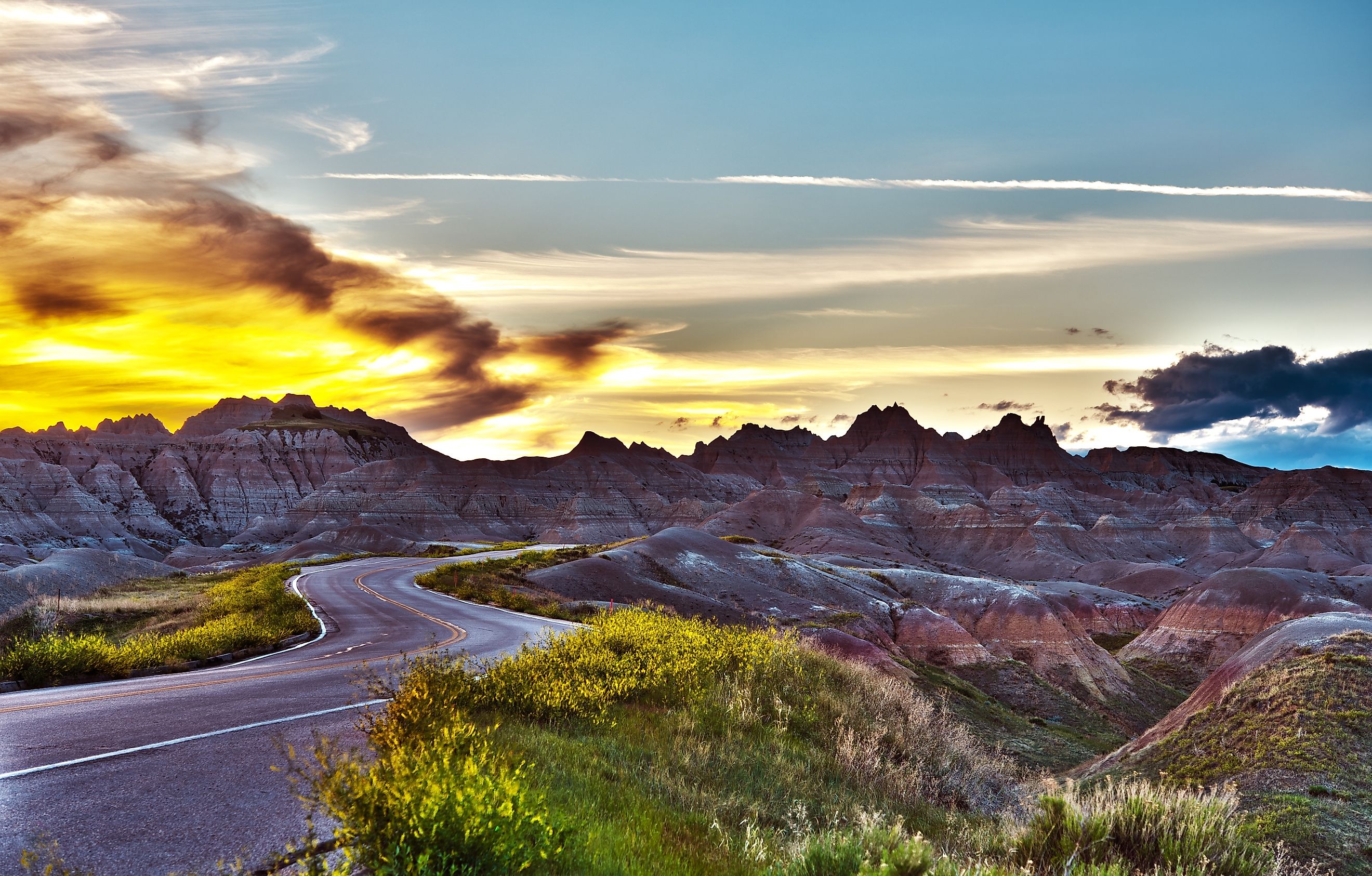
The Badlands National Park is the place to go to see the Dakotas' most intriguing landmarks, and it is less than an hour drive away from Rapid City. These rocks were formed first by a deposition from inland seas, rivers, and wind, and then were eroded by the Cheyenne and White Rivers.
Today in the Badlands, one can drive or hike through these rock formations. One of the best times to arrive or leave is at sunrise and sunset, when the sunlight creates vivid displays of color in the shadows of the rocks. Staying into the night will give one the opportunity to view dark skies at the Cedar Pass Amphitheater. In addition, visitors can see fossils from the Badlands and speak with paleontologists at The Fossil Preparation Lab in the park.
What's in a Monument?
Generally speaking, a monument is established in memory of someone or some event. These monuments can inspire awe, but also controversy, such as the case with Mount Rushmore. Other monuments are formed by nature, cataloging the geological changes over time, such as the eroded cliffs of the Badlands National Park or the Palisades State Park. By following one of these day trips, one can pick the monument that inspires them the most in the geologically and historically rich state of South Dakota.