12 Amazing Idaho Day Trips That Are Worth The Drive
Idaho is a beautiful place, where you can explore a network of tiny volcanoes, hike up the largest dune in America, or even explore one of the only territorial jails left in the country. Spend a day learning about Basque culture before hitting the road to visit the largest nesting grounds of birds of prey in the United States. Or explore an urban waterfall, then learn about the history of potatoes at a quirky museum. Read on to learn more about these amazing Idaho road trips that are worth the drive.
Boise
Old Idaho Penitentiary Site (within the city)

As you check in from your flight, you might be surprised to find out that one of Boise's most intriguing attractions is its old jail. The Old Idaho Penitentiary State Historic Site was built in 1870 when Idaho was still a territory. It wouldn't become a state until 1890. The site is one of only four territorial prisons in the United States open to the public.
Throughout the history of this Romanesque Revival building, it would see many daring escapes ranging from its earliest days to its closing in the 1970s, along with many infamous inmates such as Harry Orchard, who assassinated former Governor Frank Steunenberg in 1905. It's not all sad stories here, as a beloved kitten named Dennis was buried here by inmates in 1968. The site has self-guided tours and guided tours for a small fee.
Idaho Botanical Garden (within the city)

On the grounds of the penitentiary is a different sort of gated community: the Idaho Botanical Garden. It was originally the farm and nursery of the jail until it closed in 1973, and it was renovated in 1984 as a 15-acre garden.
There are multiple ecosystems contained within the botanical garden, such as the English Garden. The walls of the penitentiary are the backdrop of this garden, with its more than 1,300 perennial flowers and fountain. The other areas in the garden include the Rose Garden, with older rose blooms first introduced prior to the 1920s, and the Children's Adventure Garden with hollow logs for play and a carnivorous plant display. The garden hosts multiple events throughout the year, such as wine tasting with Sip the Unexpected in June.
Boise River Greenbelt (within the city)

The Boise River runs throughout the entirety of Boise, and one of the best ways to see it is through the Boise River Greenbelt. This riverside trail starts in downtown Boise and winds for about 25 miles on a paved trail past multiple parks in Boise and beyond.
Throughout the trail, you will have plenty of places to pull your bike off to go off for further exploration. For example, there are multiple wildlife refuges open to foot traffic, and a sculpture honoring Holocaust victim Anne Frank through the Anne Frank Human Rights Memorial. If you visit from late spring to September, you can catch a world-class Shakespearean performance at the Idaho Shakespeare Festival theater. If you get a flat tire while on the trail, the Greenbelt has you covered with multiple bike repair stations.
Basque Museum and Cultural Center (within the city)

Boise is home to the only Basque museum in the United States. The Basque people are a distinct ethnic group that mainly lives in the border regions between Spain and France. The United States has one of the largest Basque immigrant populations, especially in the West.
The Basque Museum and Cultural Center celebrates all elements of Basque life and culture. Some of its current exhibits include Komunitatea (community), telling how Basques live in five states in the West, and a restored Basque boardinghouse called the Cyrus Jacobs/Uberuaga House. This house is located in the larger Basque Block, with multiple Basque-style homes. One of the primary Basque lifestyles was herding sheep, and they continued this practice in the American West. You can learn about this practice at the Artzainak: A Life of Solitude & Hard Work exhibit.
Morley Nelson Snake River Birds of Prey National Conservation Area (1 hour drive)

An hour drive away from Boise will lead you to the biggest population of nesting birds of prey in the United States at the Morley Nelson Snake River Birds of Prey National Conservation Area. Consisting of a vast 484,873 acres, it supports 15 species of raptors, especially prairie falcons, which nest in the canyons of the Snake River.
There are around 800 pairs of birds of prey that come here to nest, including around 200 prairie falcon pairs. One of the best times to visit this area is in spring to summer, as you can see eagles fly in March, chicks in May, and hatchlings take to the skies for the first time in June. One of the best spots to view these birds is at Dedication Point overlooking the Snake River Canyon.
Bruneau Dunes State Park (1 hour, 5-minute drive)

The dunes of Bruneau Dunes State Park are unusual for several reasons. First, they formed in the center of a basin rather than near the edges. Secondly, they are the largest dunes of their kind in North America, with one measuring 470 feet tall.
Visitors and campers arrive at this park throughout the entire year, as it has one of the longest camping seasons of any Idaho Park. Although it's in a desert, there are still several lakes resting below the massive dune, where you can go fishing for bluegill or bass. Visitors can hike right up to the top of the dunes and slide down them with a sandboard. If you visit at night, you can go to the Bruneau Dunes State Park Observatory to take in the dark sky.
Shoshone Falls Park (2-hour, 5-minute drive)

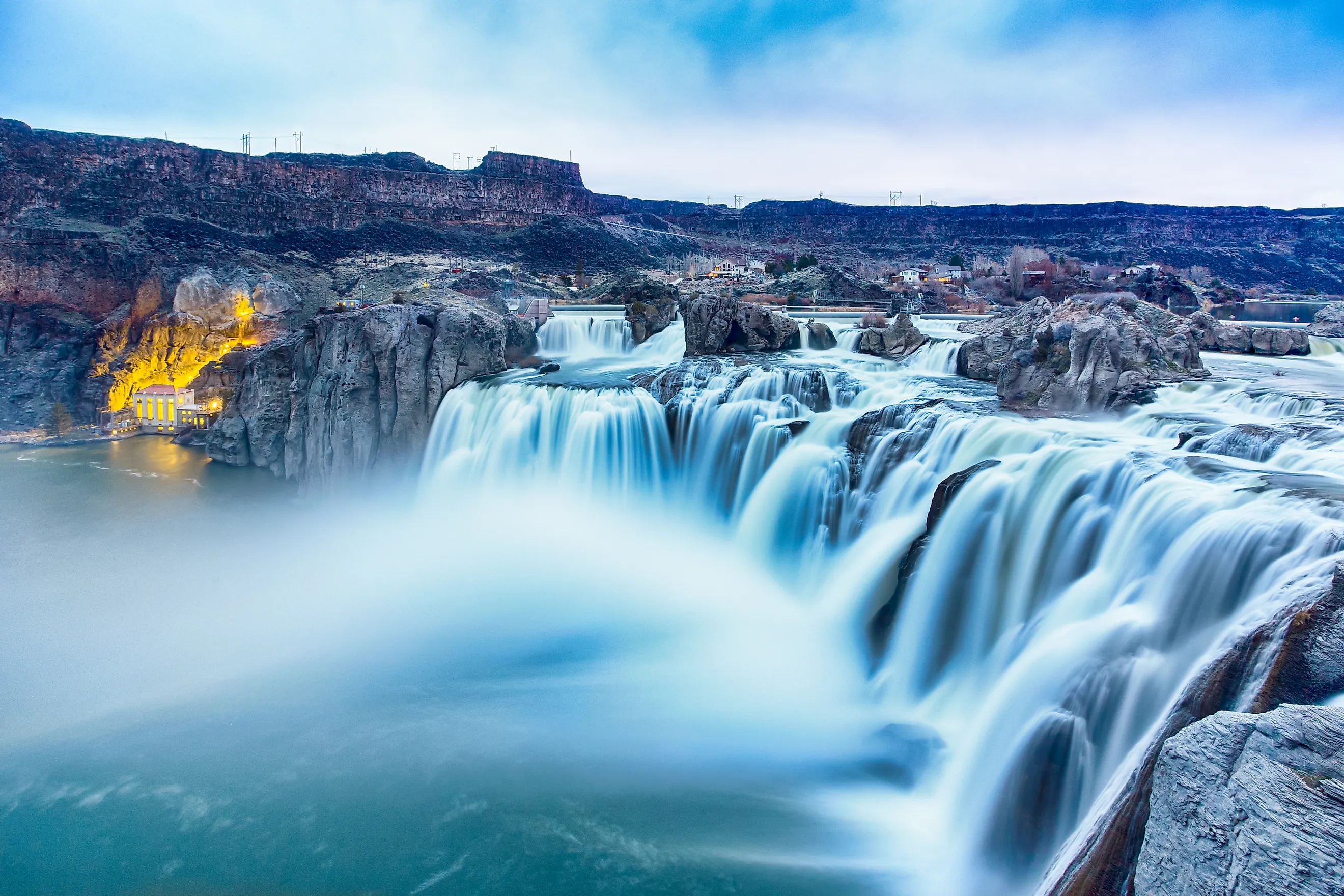
Many of the best natural spots in Idaho are along the Snake River, and this waterfall park is no exception. Located three miles away from the city of Twin Falls, Shoshone Falls drops 212 feet, which is higher than Niagara Falls.
Since their discovery by settlers in the 1840s, tourists have continued to come here to view the vast waterfalls and the rainbows that form from its misty waters. The best time to visit the falls is during the spring when the mountain snow melts, bringing a deluge of up to 32,000 cubic feet per second. It is easy to see the falls, as there is an overlook area right next to the parking lot.
You can explore the surrounding canyon via the Canyon Rim Trail, which follows the Snake River Canyon for 8 miles. There are smaller waterfalls you can see throughout this trail.
Idaho Falls
Craters of the Moon National Monument and Preserve (3-hour, 15-minute drive)

Along the Snake River Plain is a land that was formed by lava flows and is filled with volcanic cinder cones that closely resemble the surface of the moon, hence the name Craters of the Moon.
There is only one paved road leading into this remote park, which suits its almost alien-like atmosphere of steep volcanic cones. Visitors can spend hours hiking up the cones here, from Inferno Cone to the smaller mini volcanoes of the Splatter Cones. There is evidence everywhere of the old lava flows, such as at the Tree Molds Trail, named after the trees that were encased in lava. Truly daring explorers can go underground into one of the lava tube caves. Due to its remote location, the monument is popular to visit at night for dark sky observing.
Museum of Idaho (within the city)

If you choose to arrive through Idaho's second most visited airport, the Idaho Falls Regional Airport, you will be able to visit some of Idaho's best museums, such as the Museum of Idaho. It aims to bring "the world to Idaho, and Idaho to the world." It has a focus on both history and science to tell the entire story of Idaho.
On the history side, it has exhibits on the Shoshone-Bannock Tribes, and a recreated 19th century frontier town meant to resemble what Idaho Falls looked like. It embraces the complex nature of Idaho's journey to statehood and the struggles of minorities through the A Complex State exhibit. On the science side, it has an exhibit on the massive creatures who wandered the earth before the dinosaurs called Life Before Dinosaurs: Meet The Permian Monsters.
The museum knows how to make science fun, as it hosts screenings of Jurassic Park with expert commentary on the dinosaurs in the film.
Idaho Falls Greenbelt & Riverwalk (within the city)

Many cities are set up around a river, but few can lay claim to a waterfall. Idaho Falls is situated next to a gorgeous waterfall off the cliffs of the Snake River. The Idaho Falls Greenbelt & Riverwalk offers an urban escape to walk right up to the 600-foot-wide waterfall that the city is named after.
The Greenbelt is a five-mile trail accessible on both sides of the Snake River. You can cross over between the sides using the Floating Bridge, open seasonally. Along this trail are several places you can jump off for a bite to eat, such as the Snake River Bar & Grill or the Snow Eagle Brewing and Grill. One stop on the trail is the Idaho Falls Temple of the Church of Jesus Christ of Latter-day Saints, with a well-manicured flower garden and visitors center.
Idaho Potato Museum & Potato Station Cafe (30-minute drive)

Just under a half-hour drive away from Idaho Falls in Blackfoot, you will find the quirky Idaho Potato Museum. Potatoes are Idaho's primary cash crop. Located in the historic Oregon Short Line Railroad Depot, this museum inspired quite a bit of community debate when it was being built, as many questioned whether folks would want to visit. The museum is definitely worth the trip, both to learn the history of potatoes and try out some delicious potato creations.
The museum catalogs many interesting stories in the potato industry, such as the largest potato crisp that was made by the Pringles Company. Visitors can pick up a potato-themed souvenir from its gift shop or eat a fresh-baked potato from the Potato Station Cafe. It recommends ordering ahead, as all of the potatoes are made fresh on site!
Massacre Rocks State Park (1 hour, 13-minute drive)

The Oregon Trail and California Trail were the primary historic routes for pioneers moving west in search of gold or farmland to settle. One of the stops that emigrants approached with apprehension was Massacre Rocks, a narrow passage through boulders along the trail. The name refers to a conflict between emigrants and Shoshone groups in August 1862, in which members of a passing wagon train were killed during a series of encounters near the rocks.
Visitors to the park today can view interpretive signs about the history and geological features of the rocks, and go hiking through the land. There is plenty of outdoor recreation at the park, ranging from picnicking at Register Rock, where many settlers etched their names, to trying out a challenging disc golf course.
Hear the Echoes of the Past and the Wonders of the Present in Idaho
These day trips allow you to hear the echoes of the recent and distant past. The Massacre Rocks State Park harkens back to the days of anxious pioneers, while the Basque Museum celebrates the ongoing legacy of Basque immigrants in the West. The Craters of the Moon National Monument, on the other hand, tells a much older story: how ancient volcanoes once covered Idaho in lava and left behind a moonlike landscape. These day trip ideas are just a few of the unusual and intriguing places you will find in Idaho.
.jpg)