9 Old-Timey General Stores In Wisconsin
Wisconsin's historic general stores function as a record of the state's 19th-century maritime and industrial logistical systems. These surviving storefronts were established as essential supply nodes for fishing villages and logging camps long before modern transit corridors were fully developed. In the lake-filled region of Manitowish Waters, one such outpost still bears the physical scars of a 1934 federal law enforcement shootout. Along the Door Peninsula, compact mercantiles reflect the requirements of 1890s harbor ports, while inland gristmills maintain retail operations as a continuation of 1860s industry.
Read on to find out more about these nine old-timey stores in Wisconsin.
Ehlers General Store, Cornucopia

Positioned on the south shore of Lake Superior, Cornucopia serves as a staging point for trips to the Apostle Islands and the sea caves of the Bayfield Peninsula. Ehlers General Store has anchored the village since 1915, originally established as a supply stop for isolated lakeshore settlers and commercial fishing crews.
The store now operates as a combined hardware shop, grocery, and deli, functioning as a primary year-round provisioning point for residents and seasonal travelers. The retail inventory reflects the dual role the store has played across more than a century: practical hardware for trade and maintenance alongside packaged goods and sandwiches for sailors, anglers, and day-trippers heading to the harbor.
Vorous General Store, Fish Creek

Constructed in 1895, the Vorous General Store dates to an era when the village served as a critical port for Lake Michigan fishermen and the region's expanding fruit orchards. Its compact architectural footprint is a functional leftover from a time when harbor commerce was governed by the distance from the docks to the local mercantile.
The building's history as the community's primary post office highlights the dual role these structures played as both logistical supply centers and essential communication nodes for maritime laborers. Today, its preservation maintains the physical continuity of the historic streetscape, providing a tangible record of how 19th-century commercial buildings managed the transit of goods and information. The structure still serves as a retail space and a structural reminder of the logistical systems that once controlled the economy of small Great Lakes ports.
Little Bohemia Lodge General Store, Manitowish Waters

For travelers navigating Manitowish Waters' extensive chain of lakes, the Little Bohemia Lodge serves as a primary logistical node, combining hospitality and essential supplies under a single roof in the same configuration that has historically defined the lake-country outpost. The site is also well known for the physical evidence of a high-profile 1934 shootout between the FBI and the John Dillinger gang, with bullet holes still embedded in the windows and interior walls.
Norske Nook, Osseo

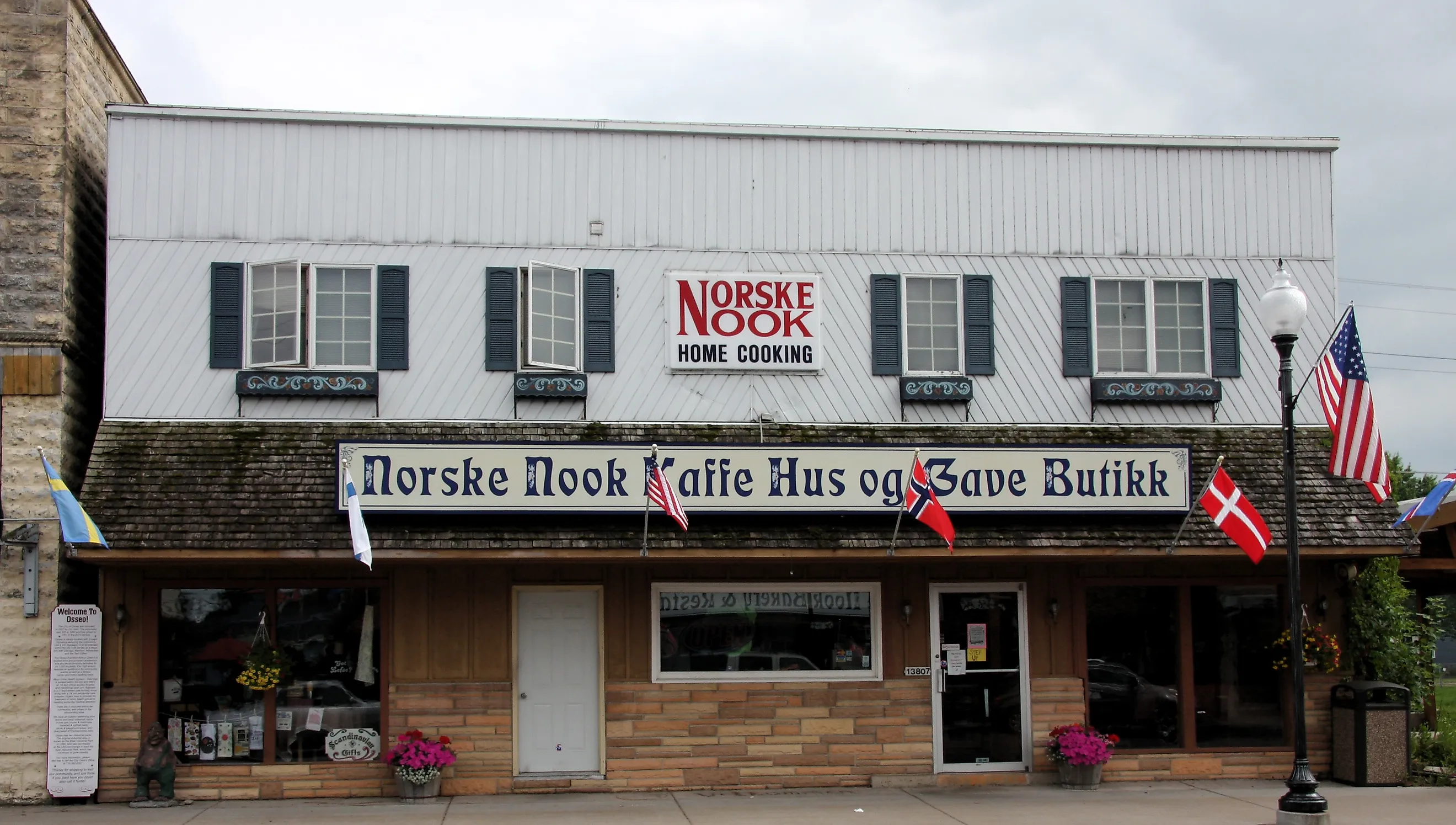
Many of Wisconsin's old-world general stores offer more than trade goods. Though originally founded in 1973 as a local restaurant, the Norske Nook has taken up the mantle of local mercantile, offering an array of bakery items, foodstuffs, and general merchandise.
Through a shop space that highlights the area's Norwegian heritage, this shop has grown into a community staple. Customers come from neighboring communities for the baked goods, Scandinavian cookware, textiles, and decorative folk art that adorn the Nook.
Dells Mill & Museum Store, Augusta

Bridge Creek serves as the primary power source for Dells Mill, a five-story gristmill that has occupied this riverbank since the 19th century. Built in 1864 from hand-hewn timber and held together with wooden pegs, the structure remains one of the state's most intact industrial relics from the Civil War era. The onsite museum store offers a historic assortment of classic goods produced by the local Amish communities, from grains to jams and jellies.
The General Store at Old World Wisconsin, Eagle

For an entirely authentic experience, the general store at Old World Wisconsin in Eagle recreates the atmosphere of a late-19th-century rural mercantile within an original period structure relocated to the museum grounds. As a piece of living history, this shop goes beyond souvenirs, educating visitors about how general stores once operated as central economic and social institutions in Wisconsin's farming settlements.
Wollersheim Winery, Prairie du Sac

When Agoston Haraszthy first developed the hillside vineyards above the Wisconsin River in the 1840s, he laid the foundations for what would become a historic farmstead and wine supply center adapted for modern visitors, the Wollersheim Winery.
Later expanded by the Kehl family, the limestone buildings remain among the oldest agricultural structures of their kind in the state. The shop today emphasizes wine, regional food products, and heritage goods.
The Wade House Stagecoach Inn Store, Greenbush

Near the Kettle Moraine landscape, the Wade House complex in Greenbush preserves the roadside pit-stop tradition that once supported Wisconsin's earliest overland travel routes. The period store-and-stagecoach-era setting captures the practical role these businesses played for travelers moving between rural settlements, while catering to modern customers. The preserved structure and curated goods make it one of the clearest surviving links between the modern trail corridor and the state's 19th-century commercial geography.
Tester and Polin General Merchandise Store, Alma

Overlooking the Mississippi River in Alma, the Tester and Polin General Merchandise Store stands as a physical link to the 1860s grain-and-produce economy that shaped the development of Wisconsin's bluff county river towns. Constructed in 1861, the limestone-and-brick building served as a primary trade node where upland farmers exchanged regional crops for provisions and everyday merchandise. This barter-based logistical system was essential to river settlements, enabling the store to serve as a mediator between isolated agricultural producers and the Mississippi shipping routes.
Positioned on the narrow strip of land between the river and the bluffs, the storefront's vertical architectural style reflects the geographic constraints of a 19th-century port town. The interior preserves the sturdy layout of an era when mercantile floor plans were designed to accommodate the heavy transit of bulk agricultural goods alongside hardware and household inventory.
A Record In Storefronts
Across diverse Wisconsin settings, from lake-edge harbors and mill yards to stage stops and river bluffs, the state's old-timey general stores continue to uphold tradition while meeting modern needs. The aesthetic may feel antique, but the service and supply are as necessary as ever. Purposes may have shifted from their origins, but the function as community logistical nodes has not been lost along the way.