10 Oldest Founded Small Towns To Visit In Indiana
Indiana has a history that goes back far, from Native American tribes to French settlement. The oldest town in Indiana was first settled by the French in the 1700s. Another town, New Harmony, was founded by a group of German religious utopians in the 1800s. In fact, many of these small towns have rich histories of German immigration, which is still reflected in their culture, cuisine, and architecture. Read on to learn more about 10 of the oldest small towns in Indiana.
New Albany

Located on the Ohio River, the land that became New Albany was first claimed by the Scribner brothers from 1812 to 1813. The town was officially incorporated in 1817, just one year after Indiana became a state. Today, New Albany has a well-known historic district that includes the Culbertson Mansion State Historic Site, a Victorian house from the late 1800s, and the Town Clock Church, which was part of the Underground Railroad helping escaped slaves. The town also has popular walking trails, such as the Ohio River Greenway, which stretches 7 miles to nearby communities like Clarksville and Jeffersonville. There are also the Campbell-Woodland Nature Trails and Silver Hills Historic Nature Trail & Wildlife Sanctuary, perfect for gentle walks in the woods. Be sure to try some of the local restaurants and bakeries, like the Honey Creme Donut Shop and the New Albanian Brewing Company.
Marion

Founded in 1826 by Martin Boots and David Branson, the city gained its name for the American Revolutionary War General Francis Marion. Marion had seen settlement prior to its official founding, also being the site of the Battle of the Mississinewa in the War of 1812. Travelers can visit that battlefield today along with other historic sites such as the James Dean Birth Site Memorial, the birthplace of the famous Hollywood actor. There's plenty of unique sites in town as well, such as the Garfield statues that are part of the Grant County trail honoring cartoonist Jim Davis, and the Quilters Hall of Fame. For places to go for a walk, consider the picturesque Gardens of Matter Park. There's plenty to see in this charming Indiana town.
Jasper

Named after a precious stone mentioned in the Bible as the foundation of New Jerusalem, Jasper was first founded in 1830 and became an official town in 1866. It has a long history of immigration, especially German Catholic residents who still influence the community with their culture and traditions. To learn more about Jasper, visit the Dubois County Museum, the largest county museum in Indiana, or explore the Old Jasper district with historic buildings like the Schaeffer Barn and a One Room School House. Nearby in Ferdinand, you can also visit the Monastery Immaculate Conception of the Sisters of Saint Benedict and St. Benedict's Brew Works. For outdoor activities, visit Patoka Lake & Recreation Area or Ferdinand State Forest.
New Harmony

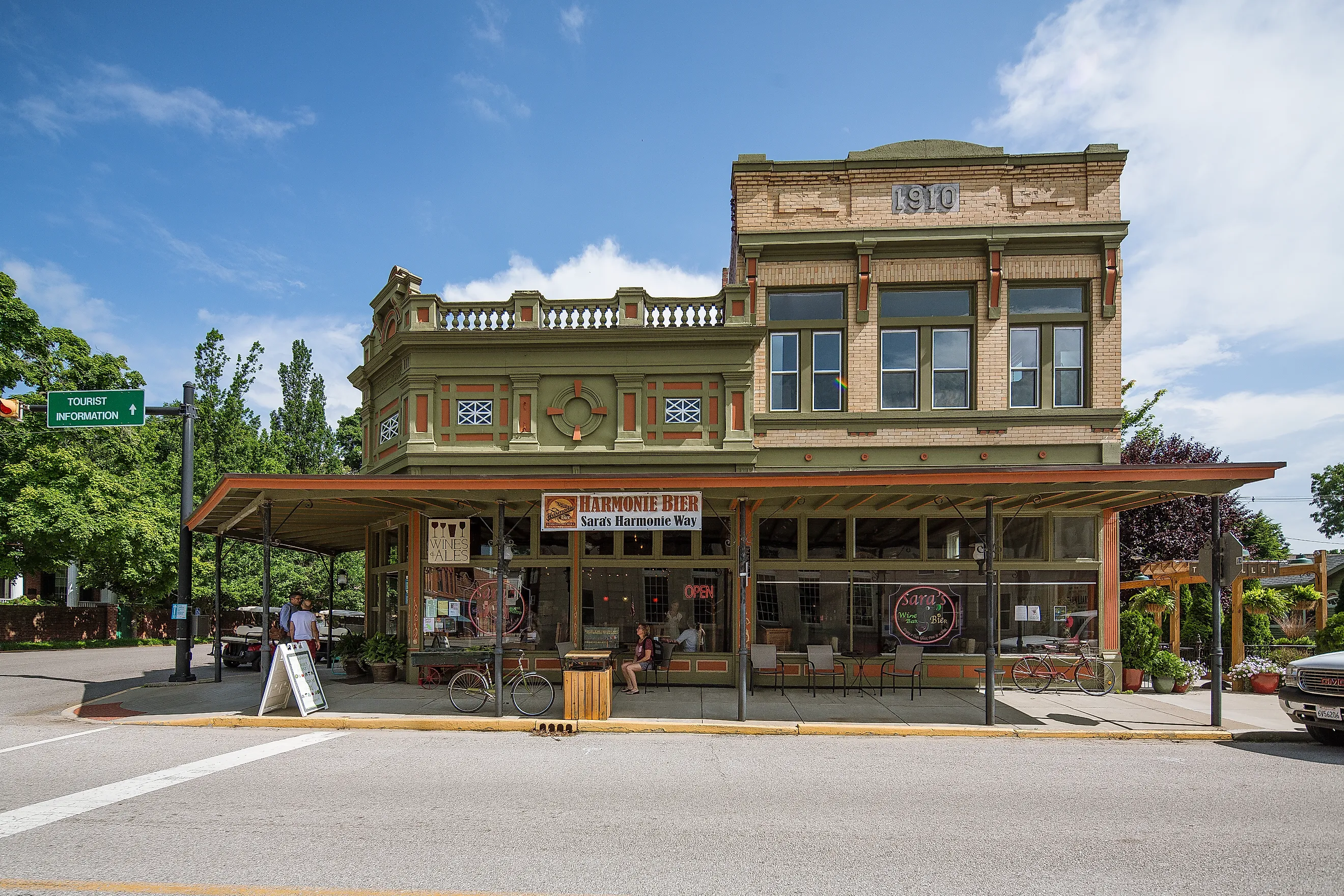
New Harmony has a long history of trying to create perfect societies. In 1814, the Harmonie Society, a group led by George Rapp, moved to the area to build an ideal community. In 1825, the community was sold to Robert Owen, who started his own utopian project. Today, New Harmony has many historic sites you can visit, such as the Thrall's Opera House, Rapp-Owen Granary, and the Harmonist cemetery. There are also other interesting places like the Harmonist Labyrinth, Cathedral Labyrinth, Harmonie State Park, and more. Come see what made this town attractive to these utopian groups.
Corydon

Every list of old Indiana towns should include Corydon. Started in 1808, Corydon was the state capital from 1816 to 1825 before moving to Indianapolis. Because of this, Corydon has many historic sites to visit. These include the Corydon Capitol State Historic Site, Governor Hendricks' Headquarters, the Battle of Corydon State Site, and the Constitutional Elm, where the first state constitution was signed. You can see all these sites on a walking tour of the town. For other activities, visit Indiana Caverns underground. This historic town is a great place for a day trip.
Oldenburg

Oldenburg has been around for a long time, as its name suggests. Like Jasper, it has always had a large German Catholic community. The first settlers arrived in 1817, and the town was officially laid out in 1837. If you enjoy traditional Catholic church architecture, Oldenburg is a great place to visit, with the Holy Family Church and the Chapel of the Immaculate Conception offering beautiful views. Because of their tall spires, these churches have earned Oldenburg the nickname the Village of Spires. The town is also known for its German restaurants and shops, including the Brau Haus, Wagner's Village Inn, A Beautiful World, and The Golden Turtle Trading Center.
Clarksville

Located just a few miles from New Albany, Clarksville has been around since the 1700s, even before Indiana became part of the United States. It was started in 1783 in the old Northwest Territory and is now a lively community with many places to visit. For history fans, the Falls of the Ohio State Park has a museum showing fossils from the Devonian period on the Ohio River, and you might even find some fossils on the riverbank. Other sights include the Colgate Clock, the Clarksville Little Theater, and the Derby Dinner Playhouse. While visiting the Ohio River Greenway, you can also stop at Lewis and Clark Park to learn about where Meriwether Lewis and William Clark first met and started their journey west.
Madison

European settlement in Madison began in the early 1800s, with the first settlers arriving in 1805 and the first cabin built in 1806. Many buildings from the 1800s still stand in Madison, including the Lanier Mansion built in 1844 and the Jeremiah Sullivan House from 1818. Just outside town in Lancaster, the Eleutherian College, built by Neil's Creek Anti-Slavery Society in 1848, is another historic site worth seeing. The town's history is also seen in the beautiful tombs in Springdale Cemetery, where many American heroes, including Civil War veterans, are buried. After exploring the historic sites, you can relax by the waterfalls at Clifty Falls State Park.
Lafayette

The first settlement in the area around Lafayette was the French Fort Ouiatenon, located across the Wabash River since 1717. Eventually the area passed under British control and then American and was platted in 1825. It was named after the French officer General Lafayette, who served in the American Revolution. There are many historic sites both inside and around town, including Tippecanoe Battlefield Park, the site of the 1811 battle that preceded the War of 1812, and Prophetstown State Park. You can also see the site of Fort Ouiatenon at the Ouiatenon Preserve. For other things to do, consider visiting the Art Museum of Greater Lafayette or try out a mead at Arvin's Acres Winery & Meadery. It's an ideal place to chill out.
Vincennes

We saved the oldest for last on this list. Unlike many other towns claimed by France, the French actually set up a settlement in Vincennes in 1732. The area was taken over by the British during the Seven Years' War and later became part of the United States. There are many historic buildings here, including the French House, built by a French settler in 1809; the Red House, the original Capitol Building and the oldest government building in the Midwest; and the Jefferson Academy, founded in 1801 by Governor William Henry Harrison. You can visit Harrison's mansion at Grouseland or see a monument marking the conquest of the Northwest Territory at George Rogers Clark National Historical Park. Vincennes has many historic sites worth seeing.
Plan A Visit To Historic Indiana
Indiana might not be as famous for deep American history as the original 13 colonies, but its oldest towns are packed with the real thing. From Vincennes and its 1732 French settlement to the utopian experiments at New Harmony and the first state capitol at Corydon, these ten towns trace early Midwestern history through battle sites, courthouses, mansions, and working colleges. Add in the parks, breweries, and local shops along the way, and a road trip through historic Indiana rewards a slow pace.