8 Undiscovered Small Towns on the Pacific Coast
On the far northern California coast, Mendocino stands on a headland above the Pacific with a population of barely 900. Up the shoreline, Bandon guards the mouth of Oregon's Coquille River, and Forks catches more rain than any town in the contiguous United States. The Pacific Coast, or the West Coast of the US, has more than a thousand miles of shoreline, and its best small towns are the ones travelers pass on the way to the famous stops. Each one has held onto a specific identity, a Russian-era fort, a cranberry harvest, or a fjord full of glaciers. They reward anyone willing to slow down and look between the big names.
Mendocino, California

Founded as a logging settlement in 1852, the village that became Mendocino was first called Big River, after the waterway that meets the Pacific at its southern edge. The town now stands on a headland ringed by Mendocino Headlands State Park, where sandstone bluffs, sea tunnels, and a path down to Big River Beach lie a short walk from the center. The Kelley House Museum, dating to 1861, occupies one of the oldest homes in town and serves as its historical society. A few miles north, Russian Gulch State Park has a fern-filled canyon and a 36-foot waterfall, plus a collapsed sea cave that the surf still churns through.
Mendocino has been an artists' town since the 1950s, and the Mendocino Art Center is the heart of that scene, with studios, exhibits, and classes in ceramics and textiles. The Highlight Gallery shows handmade furniture and fine crafts, and the Mendocino Theatre Company stages plays year-round in a small house near the coast. Casual meals turn up at the village's cafes and inns, several with patios and seasonal seafood menus.
Bandon, Oregon

Bandon lies at the mouth of the Coquille River on Oregon's southern coast, in cranberry country that supplies much of the state's crop. Old Town, rebuilt after a 1936 fire leveled the city, faces the waterfront with shops and the Bandon Historical Society Museum, which traces the river's shipping history, the cranberry industry, and the fire itself. South of town, Face Rock State Scenic Viewpoint looks out on sea stacks tied to a Native Coquille legend, and its tide pools appear at low tide. On calm mornings the artist collective Circles in the Sand rakes labyrinths into the beach for visitors to walk.
The Coquille River Lighthouse, first lit in 1896, stands across the water at Bullards Beach State Park, where a long sand spit separates the river from the sea. Nearby, the Washed Ashore project makes giant sea-creature sculptures entirely out of plastic pulled from local beaches, a pointed look at ocean trash. The offshore rocks and islands belong to the Oregon Islands National Wildlife Refuge, home to nesting seabirds and hauled-out sea lions. For lunch, Tony's Crab Shack on the waterfront serves fish tacos and steamer clams.
Pismo Beach, California

Pismo Beach calls itself the Clam Capital of the World, a nod to the giant Pismo clams once dug by the bucketload along its shore. Each winter, tens of thousands of monarch butterflies cluster in the eucalyptus at the Monarch Butterfly Grove, one of the larger overwintering sites in California, roughly between late October and February. The pier and the wide beach are the center of downtown, and Eldwayen Ocean Park gives quieter access to the water a little to the south. Price Historical Park preserves the 19th-century Price Anniversary House, home of one of the area's founding families.
Downtown also has a small wine scene, including the Sans Liege tasting room, where the Central Coast winery pours its Rhone-style reds a short walk from the sand. At Dinosaur Caves Park, on the bluffs south of the pier, the city hosts an Art in the Park market on summer weekends. For the signature meal, Splash Cafe has served clam chowder in a sourdough bread bowl from its walk-up counter for decades.
Forks, Washington

Forks calls itself the Logging Capital of the World, and it is also the rainiest town in the contiguous United States, with more than 100 inches a year. The Forks Timber Museum, on the south edge of town, lays out the pioneer and logging history with old tools, photographs, and a hand-carved canoe. Down the road, John's Beachcombing Museum shows one man's decades of Pacific flotsam, including Japanese glass floats and lost cargo washed up on the coast. The town has leaned into a second identity as the setting of the Twilight novels, which brought a wave of fans after the books and films took off.
That side of town is easiest to see at the Forever Twilight in Forks Collection, a free gallery inside the Rainforest Arts Center with screen-worn costumes and props from the five films, said to be the largest such collection anywhere. Across the street, Native to Twilight pairs Olympic Peninsula tribal art with movie souvenirs made by locals. Beyond the fandom, Forks is the nearest town to the Hoh Rain Forest, part of Olympic National Park, where moss-hung maples and a quiet river trail lead through one of the country's rare temperate rainforests.
Sitka, Alaska

Sitka carries a 19th-century nickname, the Paris of the Pacific, from its years as the capital of Russian America. That history is thickest at Baranof Castle Hill, the bluff where Russia formally handed Alaska to the United States in 1867, and at the Russian Bishop's House, an 1843 log building now part of Sitka National Historical Park. The Sheldon Jackson Museum, in an octagonal 1897 building, is home to one of the state's deepest collections of Alaska Native art and tools. Totem poles stand along the park's rainforest trail near the water.
Mount Edgecumbe, a dormant volcano with a snow-dusted cone, rises across the sound, and a long trail climbs toward its summit. In town, the Alaska Raptor Center rehabilitates injured bald eagles and owls and lets visitors see the birds up close before they return to the wild. The Sitka Sound Science Center operates a working salmon hatchery and touch tanks stocked with local sea life. Ludvig's Bistro, a small harborside room, plates Sitka salmon and rockfish with a Mediterranean turn.
Florence, Oregon

Old Town Florence lies along the Siuslaw River, a restored waterfront of early-20th-century storefronts now full of galleries, restaurants, and a Saturday market. The Siuslaw Pioneer Museum lays out the area's 19th- and early-20th-century logging and fishing history, and the Oregon Coast Military Museum honors local veterans a short drive away. North of town, the Darlingtonia State Natural Site protects a bog of cobra lilies, the carnivorous pitcher plants that trap insects, on a short boardwalk loop. The town markets itself as Oregon's Coastal Playground, and the dunes just south back up the claim.
About 13 miles up the coast, Heceta Head Lighthouse throws the strongest beam on the Oregon coast from a 56-foot tower first lit in 1894, with the old keeper's house below it now a bed and breakfast. The nearby Hobbit Trail tunnels through salal and shore pine to a hidden beach, a short walk off Highway 101. Back in town, Homegrown Public House pours local beer, and the Waterfront Depot, set in an old train station, is a longtime favorite for its crab-crusted halibut.
Anacortes, Washington

Anacortes grew up on salmon, with 11 canneries along Guemes Channel by the early 1900s that earned it the title Salmon Canning Capital of the World, and the smoke of its mills gave it a second nickname, the City of Smokestacks. That maritime past shows at the Anacortes Maritime Heritage Center, which displays the restored snagboat W. T. Preston. Downtown, murals of the cannery era decorate the building walls, and Cap Sante rises above the marina with a drive-up overlook of the harbor and the San Juan Islands. Most visitors know the town only as the ferry gateway to the San Juans, but this corner of Washington has plenty of its own.
Cap Sante Park and the larger Washington Park, on the island's western tip, offer forest loops, campsites, and a one-way loop road above the water. The Guemes Channel Trail follows the shoreline past old pilings and wildflowers with the channel in view the whole way. At Rosario Beach, in nearby Deception Pass State Park, tide pools lie below a carved Samish story pole, the Maiden of Deception Pass. The Swinomish Casino and Lodge overlooks Padilla Bay east of town, and Adrift, a downtown restaurant, cooks Northwest seafood and produce.
Valdez, Alaska

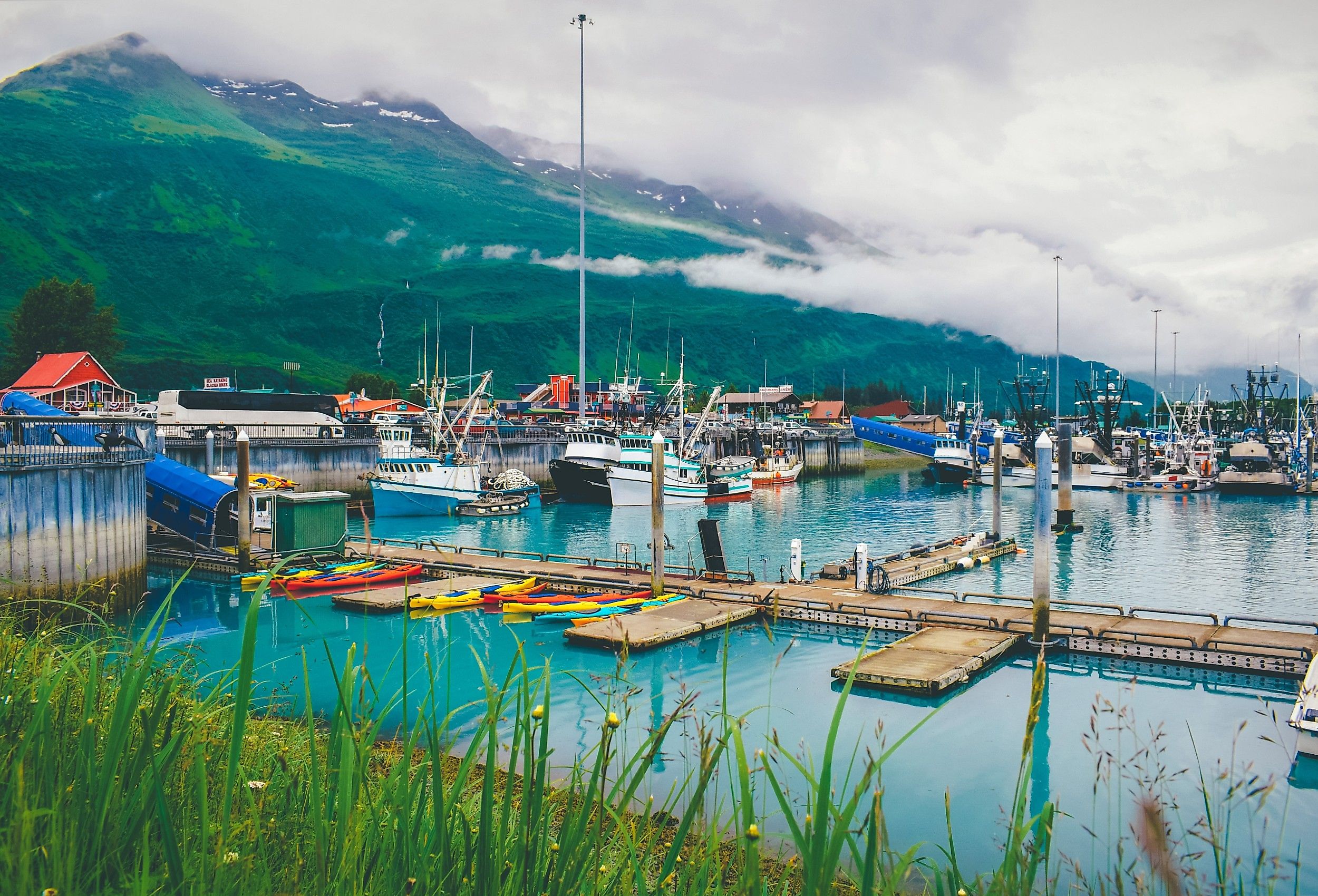
Ringed by the Chugach Mountains at the head of a deep fjord, Valdez earns its nickname, the Switzerland of Alaska, with waterfalls spilling down green walls all summer. It is the northernmost ice-free port in North America and the end of the trans-Alaska pipeline, a story the Valdez Museum tells alongside the gold rush, the 1964 earthquake, and the Exxon Valdez oil spill. The drive in threads Keystone Canyon, where Bridal Veil Falls and 300-foot Horsetail Falls drop beside the highway and rafters paddle the Lowe River in summer. A pack-train path called the Goat Trail climbs about a mile and a half into the canyon from the Bridal Veil pullout.
Prince William Sound opens south of town, and day cruises with operators like Stan Stephens push out toward the Columbia Glacier past sea otters, humpback whales, and puffin colonies. Closer in, the short Dock Point Trail loops above the harbor and the Duck Flats wetlands, and Allison Point brings shore anglers elbow to elbow when the pink salmon come in. The town has a small arts scene too, with the Valdez Art Co-op showing local work downtown. For a warm meal, A Rogue's Garden stocks groceries and pours soup and smoothies.
Where the Coast Slows Down
None of these towns is a secret, exactly. Sitka sees cruise ships, and Pismo Beach is busy all summer. What survives in each is a small scale that the crowds never erase. Anacortes hides behind its ferry terminal, Valdez behind its pipeline, and Florence behind its dunes, and each rewards the traveler who stops to look. The best of the Pacific Coast is often in the towns that never made the front of the brochure.