The Most Charming River Towns In Massachusetts
Massachusetts evolved along its rivers, a fact that countless small communities still bear witness to. Shelburne Falls has its flower-covered crossing over the Deerfield River. Concord has the Old North Bridge where the Revolution began. Newburyport still has its Federal-era seaport at the mouth of the Merrimack. Add Stockbridge and Great Barrington in the Berkshires, with Historic Deerfield and Ipswich farther east, each adding a walkable riverside. Together they make a road trip worth taking.
Stockbridge

The Housatonic River winds gently past the edge of Stockbridge, a Berkshires village that looks much as it did when Norman Rockwell first captured it on canvas. The famous American illustrator lived here for the last 25 years of his life, using the town and other nearby locations as models. His best-known view of the place, 1967's Stockbridge Main Street at Christmas, portrays many of the same storefronts that line the street today.
This painting is just one of nearly a thousand pieces by the artist that hang at the Norman Rockwell Museum. Founded in 1969 and the largest public collection of his work, its 36-acre grounds are set overlooking the river. For a Stockbridge River photo of your own, follow the footpaths leading to the property's riverside bench.
Be sure to also allocate a little time to wander Main Street Stockbridge. The Red Lion Inn is a must-visit and has been serving travelers since 1773. Across the street, the Austen Riggs Center was the psychiatric hospital where Rockwell's wife sought treatment. Just a few doors down sits the Stockbridge General Store, another must-see building from the painting.
Great Barrington

Down in the southern Berkshires, the Housatonic River runs right through the middle of Great Barrington. Here, the Housatonic River Walk, a scenic half-mile greenway, follows the west bank from Main Street, with canoe access and an overlook named for William Stanley. Stanley was the local inventor who first lit the town's stores with alternating current in 1886, one of the first such setups in the country.
The same path passes the W.E.B. Du Bois River Park, named for another of the town's best-known sons. Du Bois was born here in 1868 and was the first African American to earn a doctorate from Harvard. His boyhood home, two miles from downtown, has a self-guided interpretive trail, and a walking tour links the places tied to his early life around the center.
Great Barrington has done a superb job of preserving its Main Street heritage, too. With large chain stores banned, the Downtown Great Barrington Cultural District features locally owned businesses like The Bookloft, while around the corner on Castle Street, the Mahaiwe Performing Arts Center was opened in 1905 and still promotes a roster of music, film, and dance. Interestingly, the center takes its name from the Mohican word for "the place downstream."
Concord

The Concord River starts off where the Sudbury and Assabet Rivers meet at Egg Rock. That exact spot has shaped Concord ever since its founding way back in 1635. Half a mile downstream, the Old North Bridge stands where colonial militia turned back British troops in 1775, a clash that was later called "the shot heard round the world." Today, a wooden replica replaces the original bridge, and the Minute Man statue unveiled in 1875 stands guard at the far end.
Beside the bridge, the Old Manse, a clapboard house built in 1770, overlooks the battlefield. A little upstream, the marshes of the Great Meadows National Wildlife Refuge present ideal conditions for birdwatching. The family-run South Bridge Boat House rents canoes and kayaks for those wanting to paddle downstream to the bridge and back. It's only a three-mile journey and passes nesting herons, basking turtles, and riverside homes.
Just two miles south of downtown Concord, Walden Pond preserves the shoreline where Henry David Thoreau lived from 1845 to 1847 and wrote Walden. A replica of his one-room cabin has been built, and the famous pond itself is open for swimming and walks around its wooded edge.
Newburyport

Positioned at the mouth of the Merrimack River, Newburyport rebuilt itself around the waterfront that once made it one of New England's busiest ports. The rebuilding was necessary after Downtown Newburyport was destroyed in what became known as the Great Fire of 1811. As a result, the Market Square Historic District is one of the largest collections of Federal-era commercial buildings in the country.
A wander through the historic district reveals rows of three- and four-story homes, as well as shops with offices above, ringing the square around Market House from 1823. Nearer the river on Water Street, the Custom House Maritime Museum occupies a granite building designed in 1835 by Robert Mills, the architect of the Washington Monument. It tells the story of the port and of the U.S. Coast Guard, whose first revenue cutter was built here in 1791.
As for the river, Waterfront Park and its 1,100-foot boardwalk are the stars of the show. Highlights of a riverside stroll include passing moored yachts and working docks and plenty of benches inviting you to stop and enjoy the views.
Historic Deerfield

Set along a mile-long single street laid out in 1671, Historic Deerfield is set in the village of Old Deerfield where the Deerfield River loops through Pioneer Valley. Much of this old street is now a National Historic Landmark and open-air museum with restored heritage homes open for guided tours of rooms furnished with Americana dating from 1650 to 1850.
Ashley House, built in 1734 for the village minister, shows the comforts of the river-valley elite, while Stebbins House, built in 1799, has original French wallpaper depicting the voyages of Captain Cook. The Flynt Center of Early New England Life rounds out the collection with changing exhibits of furniture, textiles, and silver.
At the north end of the street, Memorial Hall Museum occupies a brick building put up in 1798. It served as the first home of Deerfield Academy, a prep school founded in 1797 that still operates in the village. Memorial Hall itself became a museum in 1880, making it one of the oldest in the state. Its most important relic is the scarred Old Indian House Door, a reminder of the raid by French and Native forces in 1704.
Shelburne Falls

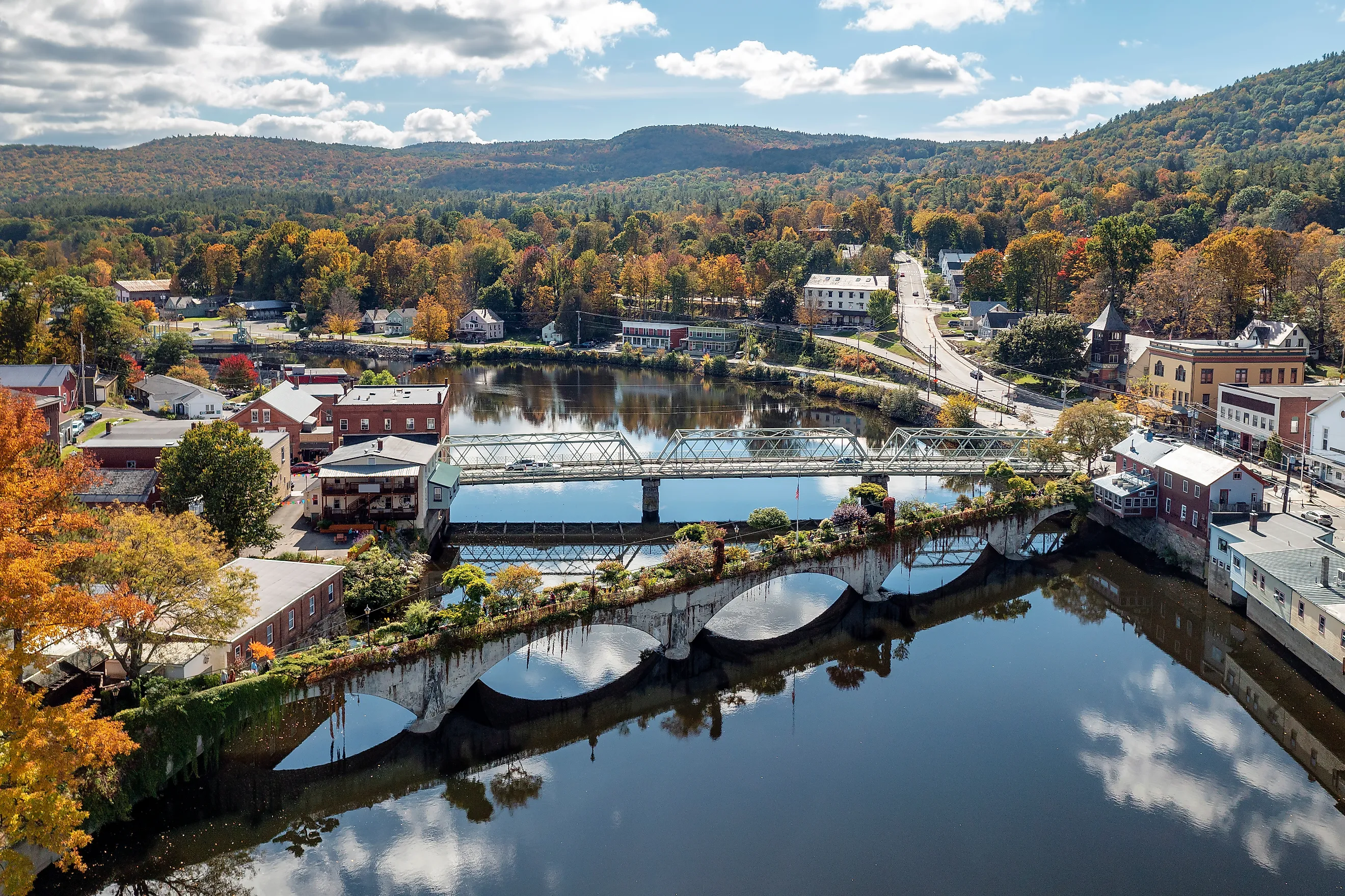
A humble old trolley bridge gives Shelburne Falls its signature view. Known as the Bridge of Flowers, it was built in 1908 to carry streetcars across the Deerfield River but lost its rail service 20 years later. To the rescue came the Shelburne Falls Area Women's Club, which planted the original flowerbeds the following year when the bridge reopened as a planted walkway. The same group continues the tradition today, filling the span with more than 500 varieties of flowers, shrubs, and vines that bloom from April through October.
A short walk downstream, a series of 50 Glacial Potholes mark the base of Salmon Falls. These smooth, round basins were ground into the granite riverbed over thousands of years as the current spun loose stones in tight circles. The exposed rock also shows the light and dark banding formed when continents collided to build the Appalachians. An overlook, just below the town's hydroelectric dam, gives a clear view of both the potholes and the falls.
Ipswich

Tidal Ipswich River runs through the center of Ipswich, an old North Shore town founded in 1634. It then crosses under one of its most important landmarks: the Choate Bridge. Built in 1764, it's the oldest documented two-span masonry arch bridge in the United States. Legend has it that its architect watched the opening from atop the bridge on horseback, ready to bolt to safety if the arches gave way. They stood firm, and the granite bridge still carries traffic.
The Sidney Shurcliff River Walk is a must-stroll path near Main Street that includes a footbridge with superb views of the Choate Bridge. Where the river reaches the sea, the Crane Estate is home to the Great House, a 59-room mansion completed in 1928. From here, the views along its Grand Allee, a half-mile lawn that runs to the Atlantic Ocean and the four-mile-long Crane Beach, are memorable indeed.
Rivers Run Through Massachusetts
The Deerfield rushes past Shelburne Falls. The Merrimack winds through Newburyport. These seven towns owe their distinctive character to the rivers they're built on. Some grew up as mill villages, some as ports, some as river crossings, but each made the river a part of daily life. None of these places is large, and most can be seen in a day, which makes them easy to string together into a longer drive across the state. Pick one for a weekend, or follow the rivers across the Berkshires and the coast to visit all seven.