10 Offbeat Washington Towns To Visit In 2026
A frying pan the size of a garage door counts as a landmark in Washington. So does a museum built entirely around kites. The state hides its best personality in towns most road maps barely register. Long Beach keeps a taxidermied "alligator man" behind glass. Toppenish painted its history across 75 downtown walls. These ten towns skip the usual sightseeing for something stranger in 2026.
Long Beach

Long Beach sits on a 28-mile peninsula, about 2.5 hours from Portland, Oregon, and it leans hard into the weird. Marsh's Free Museum sets the tone. Its shelves are crammed with antique slot machines and oddball curios, all presided over by "Jake the Alligator Man," a half-human, half-alligator sideshow gaff that has been the town mascot for decades.

Across the street looms what Long Beach bills as the World's Largest Frying Pan. The fiberglass replica stands almost 15 feet tall, handle and all, and measures close to 10 feet across. It dates to a 1941 clam festival and is still the town's favorite photo stop. A few blocks over, the World Kite Museum cinches the eccentric reputation: it is the only U.S. museum devoted entirely to kites, their history, science, and art. Then the half-mile Long Beach Boardwalk runs you out through the dunes to the open Pacific.
Roslyn

Roslyn spent the 1990s pretending to be Cicely, Alaska, on the cult series "Northern Exposure," and this old coal-mining town has milked that fame ever since. Fewer than 1,000 people live here, packed into a historic district of brick storefronts, local art, and easy access to the outdoors.
The Roslyn Cafe mural still greets visitors exactly as it did in the show's opening credits, and a steady line of people angle for the same shot. For something stranger, climb the Roslyn Cemetery, a hillside split into 26 separate burial grounds for the immigrant miners who worked the coal seams below.
The Brick Saloon bills itself as Washington's oldest continuously operating tavern, pouring since 1889. Its strangest feature runs along the foot of the bar: a 23-foot spittoon trough with real running water. Once a year, locals race toy boats down it at a spittoon regatta.
Soap Lake

Soap Lake wraps around a high-alkalinity mineral lake that Native tribes prized for its healing mud, about 2.5 hours east of Roslyn. People have made the trip for more than a century to soak in water and muck found nowhere else in the state.
The mud is the main event. Visitors slather on the slick, mineral-heavy sludge, let it bake in the desert sun, then rinse off in the lake, a folk ritual the whole town is built around. A flat path traces the shoreline, an easy walk timed for the desert sunset.
Smokiam Park adds beach access, picnic tables, and a scattering of public art. It is exactly the low-key stop you would expect from a town whose entire pitch is slowing down.
Poulsbo

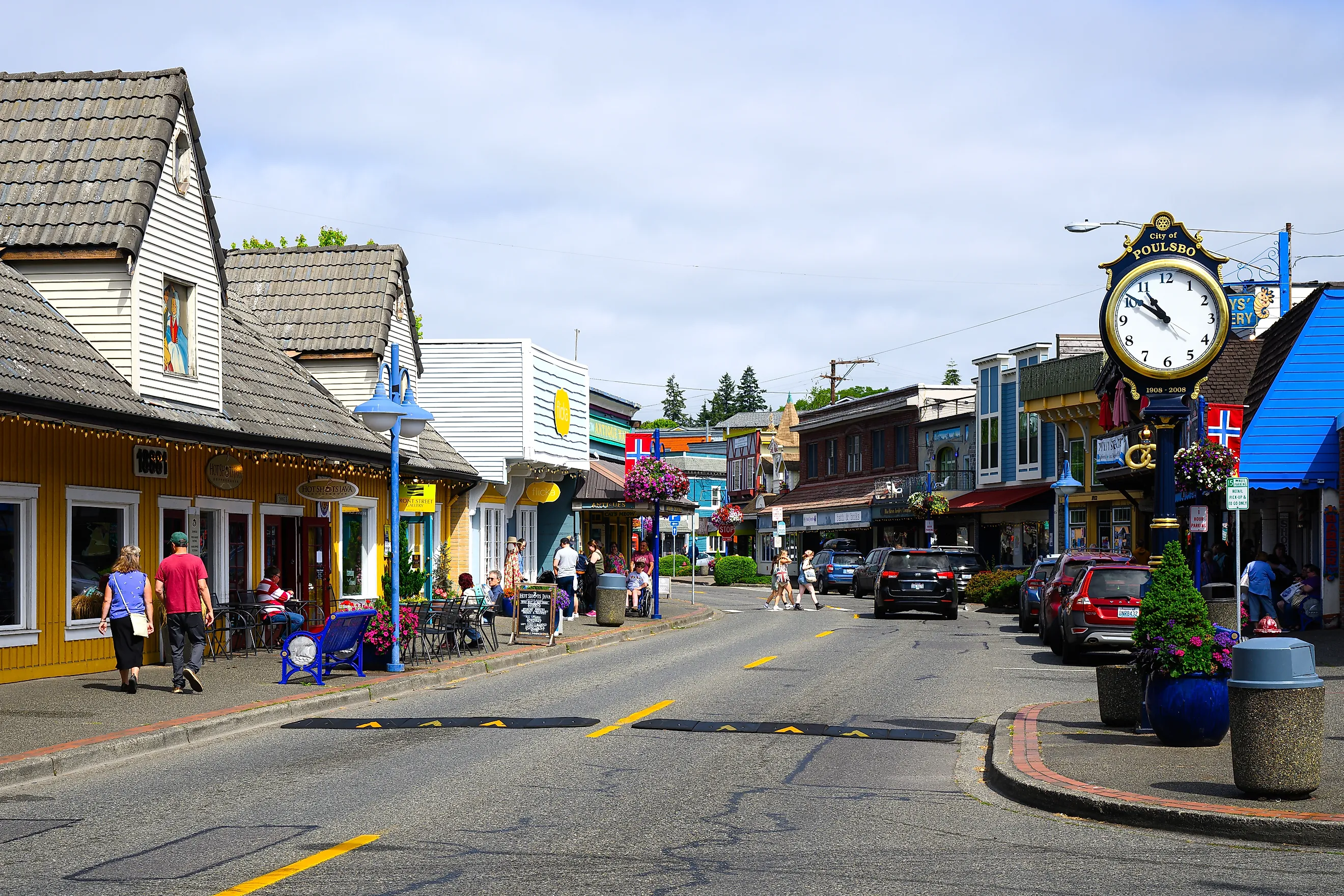
Norwegian immigrants settled Poulsbo in the 1880s because the fjord-like bay and mountains reminded them of home, and the town has played up that heritage ever since. Locals call it "Little Norway," and it sits an hour from Seattle, close enough for a day trip.
Start at Sluys Poulsbo Bakery, a historic shop that turns out Norwegian lefse, a soft potato flatbread, alongside its famous Poulsbo bread. Viking Avenue runs the theme down the main drag, past Norse storefronts and Viking street art built for a slow stroll.
Families can duck into the Poulsbo Marine Science Center, a pocket aquarium with a touch tank full of Puget Sound sea life. Nearby, Muriel Iverson Williams Waterfront Park looks out over Liberty Bay, where Scandinavian longboats sometimes ride at anchor.
Winthrop

In the 1970s, Winthrop rebuilt its entire downtown to look like an 1890s Old West frontier town. The result is a mountain community of wooden boardwalks, hitching posts, and false-front shops strung along the North Cascades Highway.
The Shafer Historical Museum spreads across an outdoor site of original pioneer cabins, vintage mining gear, and antique vehicles that map how the valley was settled. From there, the wooden sidewalks lead past Western-style boutiques and saloons.
The Spring Creek Pedestrian Bridge, a suspension span over the Methow River, links downtown to the trailheads across the water. A few minutes out, Pearrygin Lake State Park serves up clear water for swimming and paddleboarding.
Raymond

Raymond turned a coastal lumber town into an open-air steel gallery. More than 200 life-size steel silhouettes line its streets and highways, a short drive north of the Long Beach Peninsula. About 2,900 people live here.

Drive it or walk it, hunting down steel loggers, deer, herons, and pioneers, each one cut to freeze a piece of local history. The Northwest Carriage Museum fills in the rest with 19th-century horse-drawn carriages, sleighs, and period dress. The Willapa Seaport Museum keeps the maritime artifacts and old photographs of Willapa Bay's seafaring past. And for a quiet stretch of the legs, the Willapa Hills Trail follows a gravel rail bed deep into coastal forest.
Port Townsend

Port Townsend is a Victorian seaport with a steampunk streak, one of just three Victorian seaports on the National Register of Historic Places. Its 19th-century architecture and busy arts districts look out over Puget Sound toward the Cascades.
Fort Worden's abandoned concrete gun bunkers stood in for the backdrop of "An Officer and a Gentleman," and trails wind through them along the Puget Sound shoreline. The Uptown Historic District shows the town's other face: ornate brick buildings and restored "painted ladies," the elaborate Victorian houses.
The Port Townsend Aero Museum keeps a hangar of still-airworthy antique planes from aviation's early decades. Down on Fort Worden's beach, the Port Townsend Marine Science Center pairs a touch tank with a full orca skeleton.
Toppenish

Toppenish calls itself the "City of Murals," and it earns the title with more than 75 large outdoor murals splashed across its downtown walls. The town sits entirely within the Yakama Reservation, and its art threads Native American heritage through pioneer history.
The murals are why most people come. Guided tours walk you past carefully researched scenes of pioneer life, Native traditions, and early farming. Each June, a crew of artists paints a full wall-sized mural in a single day while crowds watch.
The Yakama Nation Cultural Center is built around a 76-foot stylized winter lodge, with exhibits on the history and traditions of the Yakama people. The American Hop Museum, the only one in the country devoted to the crop, tells the story of a plant that shaped this whole valley. And the Toppenish Rodeo has run every July since the 1930s, kicking off with a Wild West parade.
Coupeville

Coupeville played the seaside setting for the 1998 film "Practical Magic," and its 19th-century Victorian buildings still line the water. As the heart of Ebey's Landing National Historical Reserve, it ranks as Washington's second-oldest town, founded in 1853.
Coupeville Wharf is the town's signature shot, a red wooden pier from 1905 reaching out over Penn Cove. Walk its length for the shoreline views, then poke into the gift shop, the casual restaurant, and the marine exhibits, including a gray whale skeleton. Just outside town, the Ebey's Landing bluff trail opens onto Puget Sound, the Olympic Mountains, and farmland preserved exactly as it looked in the 1800s.
Penn Cove put the town on the map for mussels, pulled straight from the water offshore and served year-round. Back in the center, Front Street lines up independent bookstores, antique shops, and boutiques inside original 19th-century seaside buildings.
Concrete

Concrete leans all the way into its industrial name, and just over 700 people call it home. Pull off the highway and a row of towering silos greets you, "Welcome to Concrete" painted straight across them. They are leftovers from the Superior Portland Cement plant, which once supplied the region's Ross and Diablo hydroelectric dams.
The old Concrete High School is the town's proudest oddity: built entirely of concrete, the historic building bridges directly over a local road, and you can visit both the school and the passage running beneath it. On Main Street, the Concrete Theatre, a restored 1923 movie palace, still screens films and hosts live shows.
The Superior Portland Cement Company Ruins let you walk among the weathered silos that mark the town's factory past. And the Henry Thompson Bridge, built in 1916, ranked among the longest single-span concrete arch bridges in the West when it opened; it still carries walkers over the Skagit River with a clear view up the valley.
Where Washington Keeps Its Strangest Corners
These ten towns share a stubborn refusal to look like anywhere else. A giant frying pan, a spittoon regatta, a highway lined with steel deer, a school built over a road: each is a small bet that character beats convention. The payoff is a Washington that surprises instead of repeats. Point the car down the two-lane highways, and the odd landmarks start doing the work that guidebook attractions usually claim.