12 Off-The-Beaten-Path Towns In California
The best of California takes some work to reach. Shelter Cove sits down twenty miles of switchbacks through the redwoods on the Lost Coast. Borrego Springs became California's first Dark Sky Community for its brilliant desert nights. A gold prospector crawled into the crystal cave under Murphys back in 1885. Roy Rogers and Gene Autry built Pioneertown as a working Western film set in 1946.
Shelter Cove

Highway engineers routed Highway 1 inland around the King Range because the terrain here was too steep to build on, and that single decision left Shelter Cove stranded on what became known as the Lost Coast. Reaching it means a roughly 20-mile drive on a winding mountain road through Coast redwoods. The isolation is the whole appeal.
The black sand beaches give the shoreline its look, and no, this is not volcanic sand. It comes from graywacke sandstone and dark shale eroding out of the high cliffs and grinding down in the surf, so the charcoal grains sit against white foam in a way photographers chase.
The King Range National Conservation Area wraps around the town, its peaks climbing past 4,000 feet within a few miles of the water. Roughly 80 miles of trails run through it, and the backcountry holds Roosevelt elk, bald eagles, and black bears.
The Cape Mendocino Lighthouse anchors the town's history, though it did not start here. The 43-foot iron tower first lit at Cape Mendocino in 1868, where its beam sat 422 feet above the sea, the highest focal plane of any lighthouse in the country. After the Coast Guard abandoned it and rust set in, volunteers dismantled the tower and trucked it 30-some miles south, reassembling it at Mal Coombs Park in Shelter Cove, where it opened to visitors in 2000. You can walk the grounds and tour the exterior in summer.
Ferndale

Dairy farmers got rich here in the late 1800s, and they spent it on the ornate Victorians that locals call Butterfat Palaces. The whole town is a state historic landmark, its painted storefronts and gabled homes running the length of Main Street and the blocks around it.
The Victorian Inn stands a block off Main Street, built in 1890 entirely from local redwood. Its Eastlake detailing and ground-floor tavern put you squarely in the cattle-boom era that paid for it all.
Russ Park is the counterweight to the architecture. The land was donated as a bird sanctuary in 1920, and its trails run under a canopy of Sitka spruce, grand fir, and Douglas fir hung with moss.
At the end of Ocean Avenue, the 1868 Ferndale Cemetery climbs straight up a steep hillside. Terraced paths thread past the moss-covered headstones and obelisks of the town's early pioneers, sailors, and dairy families, with the surrounding hills and forest closing in.
Los Alamos

Los Alamos runs just seven blocks and holds fewer than 1,900 people at the north end of Santa Barbara wine country. That small footprint carries both a 19th-century stagecoach past and a food scene that pulls in drivers from across the state.
The 1880 Union Hotel is the town's centerpiece. It began as a telegraph station and a Wells Fargo stagecoach stop, and its restored weathered-wood exterior still reads like the set of a Western.
Bell's is the reason a lot of people make the drive. The French bistro, run by Per Se alums Daisy and Greg Ryan, has held a Michelin star since 2021. Reservations for the prix-fixe dinner go fast.
Down the street, the Depot Trading Post runs as an antique collective inside the town's 1880s freight building, the last surviving station of the old Pacific Coast Railway. Browse the booths and you are shopping inside the railroad history itself.
Borrego Springs

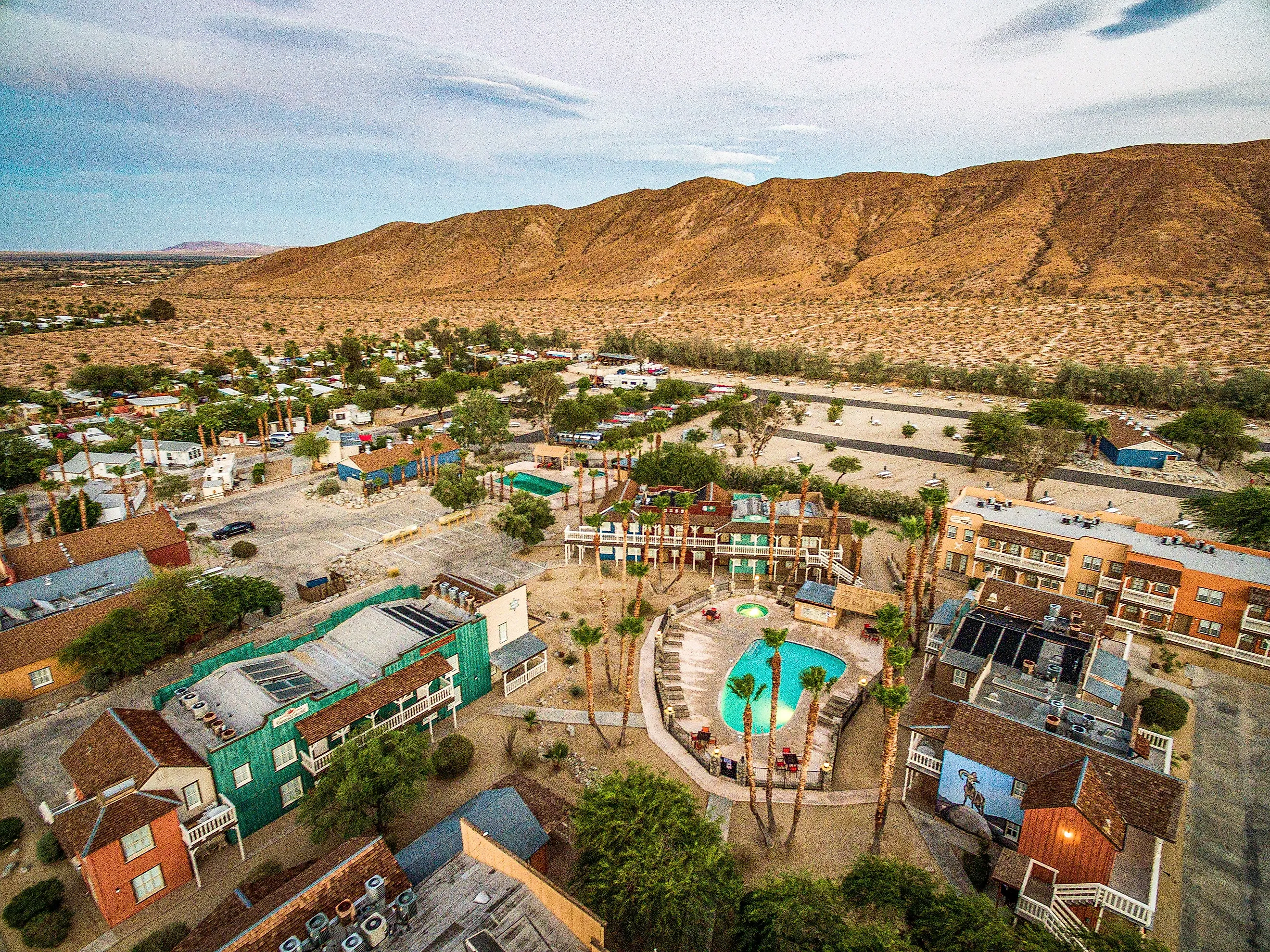
No stoplights, and that is by design. Borrego Springs sits inside Anza-Borrego Desert State Park, and in 2009 it became California's first certified International Dark Sky Community, the second in the world after Flagstaff. Residents run informal stargazing sessions through the cool months, when the desert nights turn clear and the Milky Way is unmistakable.
Fonts Point looks out over the Borrego Badlands, a maze of eroded canyons that earns its nickname as California's Grand Canyon. The view runs deepest at sunrise and sunset, when low light throws long shadows and the walls turn red, pink, and gold.
The Galleta Meadows sculptures, also called Sky Art, scatter across the desert floor around town. Artist Ricardo Breceda built more than 130 freestanding metal figures between 2008 and 2012, everything from prehistoric mammals to a 350-foot serpent that dives under Borrego Springs Road. Viewing is free and the fields stay open at all hours.
Christmas Circle Community Park sits at the center of town and becomes the hub of Borrego Days each fall, a long-running festival with a parade, craft booths, and food vendors. The exact dates shift year to year, so check before planning around it.
Murphys

Gold Rush money built Murphys in the 1850s, and the stone walls, iron shutters, and old locust trees lining the street have outlasted the mines. Today the town leans into wine, but its strangest attraction is underground.
In September 1885, gold prospector Walter Mercer noticed cool air rising from a small hole near Murphys and squeezed inside to find a system of crystalline chambers. Mercer Caverns opened to paying visitors that same month and now ranks as the longest continuously operating show cave in California. Guides lead tours down lighted stairways past stalactites, flowstone, and a rare aragonite formation, a piece of which was shown at the 1900 Paris World's Fair.
Above ground, Murphys Historic Hotel has taken in guests since 1856 and survived a fire in 1859. A framed copy of its original register hangs in the lobby, carrying the signatures of past guests including Mark Twain and Ulysses S. Grant.
Milliaire Winery, founded in 1983, is the town's oldest family-run label, known for old-vine Zinfandel. Its shaded back patio looks out over Angels Creek.
Graeagle

About 500 people live in Graeagle, which started life in the early 1900s as a company mill town. The rows of bright-red wooden cabins with matching red roofs that once housed mill workers now hold independent shops, bakeries, and cafes along a walkable center.
The Graeagle Millpond sits at the heart of it. Engineers built the pond to float logs to the sawmill, and it has since become the town's summer gathering spot, where people swim, fish, picnic on the lawns, and rent paddleboats.
A few miles up the mountain, Plumas-Eureka State Park and the Johnsville ghost town preserve the area's hard-rock gold mining past. Indoor and outdoor museum displays hold mining machinery and natural history, the ghost town keeps its weathered buildings and old stamp mills, and forest trails climb from there toward Eureka Peak.
Dunsmuir

Dunsmuir grew up as a railroad town in the steep, tree-lined canyon of the upper Sacramento River, in the shadow of Mount Shasta. In the 1800s it was a busy engine station, where helper locomotives were coupled on to haul trains over the mountain grades to the north. The town quieted as rail work faded, and it now markets its tap water under the slogan "Home of the Best Water on Earth."
Just off the highway, Hedge Creek Falls spills over a wall of dark basalt. A short trail switchbacks down the canyon and runs behind the falls, where you can stand in a shallow recess and look out through the sheet of water.
The Dunsmuir Historic Commercial District holds the town's railroad-era core, a run of early 20th-century brick and Art Deco buildings. A fountain donated in 1886 by Alexander Dunsmuir, the coal heir whose name the town took in exchange for it, stands at the center.
Avila Beach

A ring of hills shelters Avila Beach inside San Luis Obispo Bay, giving it a microclimate that runs warmer, sunnier, and less windy than the coastal towns around it. It stays sunny on days when nearby Pismo and Morro Bay disappear under fog.
The Avila Beach Pier has reached into the bay since 1908, when it served the area's shipping trade. The Harbor District closed it in 2015 over structural concerns, and a long repair effort has reopened roughly the first half to foot traffic, with the rest still under construction.
Just outside town, Avila Hot Springs has drawn soakers since oil prospectors tapped the mineral water in 1907. The main pool holds a steady 104 degrees Fahrenheit year-round, and the grounds add waterslides for kids.
Point San Luis Lighthouse sits on a headland above the bay, lit in 1890 to steer ships clear of the reefs. It is the last of three identical Prairie Victorian lighthouses that once stood on the West Coast; its twins near Eureka and San Diego are long gone. Visitors reach it by trolley or on a docent-led hike along the Pecho Coast Trail.
Three Rivers

Three Rivers takes its name from the forks of the Kaweah River that meet within the area, and it guards the southern entrance to Sequoia National Park. Most visitors blow through on their way to the big trees, which leaves its riverfront and small arts scene to the people who stop.
Along the North Fork sits the Kaweah Post Office, a one-room wooden building that is one of the country's smallest and oldest surviving post offices. It served the Kaweah Co-operative Commonwealth, a utopian socialist colony founded in 1886, and predates Sequoia National Park, which absorbed the colony's land. The Postal Service ended full service here in 2010, and volunteers now keep it open as a landmark and a much-photographed stop.
The Three Rivers Historical Museum on Sierra Drive gives travelers the backstory of the Kaweah canyon before they head into the high country. Out front stands a Paul Bunyan figure carved from a single redwood log by a local artisan in the mid-1900s.
Three Rivers Brewing Company works as the town's living room, a casual pub where locals and hikers coming down off the mountain trade tables.
Bridgeport

At 6,463 feet, Bridgeport spreads across a wide valley in the Eastern Sierra along Highway 395, ringed by snow-capped peaks. The whole town is a short strip of motels, diners, and shops with a lot of open country around it.
The Mono County Courthouse stands at the center of that strip, a white two-story Italianate-Victorian building from 1880 that is California's second-oldest courthouse still in continuous use. A few steps off the main drag and you are in the town's frontier era.
A couple of miles southeast, reached by dirt road, Travertine Hot Springs is one of the best-known soaking spots in the state. Its rock pools run a relaxing 100 to 104 degrees Fahrenheit and look straight out at the Sierra Nevada.
Bodie State Historic Park lies up the road, preserved in what the state calls arrested decay. After the last residents left and the Cain family deeded the site, California took it over in 1962, and the surviving buildings, a saloon, a schoolhouse, a stamp mill, and a church, stand exactly as they were found rather than restored.
Pioneertown

Roy Rogers and Gene Autry helped build a town. In 1946, a group of Hollywood investors that included Rogers, Autry, and actor Dick Curtis founded Pioneertown in the high desert north of Yucca Valley, designing it as a working 1880s-style frontier set that doubled as a real place to live. The roughly 600 residents today share the town with a modern desert-arts crowd.
Main Street is a pedestrian-only dirt road lined with faux-1880s storefronts, a horse stable, a jail, a bank, and a bathhouse among them. On select weekends the Mane Street Stampede troupe stages free mock gunfights and reenactments in the street.
Pappy and Harriet's Pioneertown Palace started as a 1940s film-set cantina and reopened in 1982 as a music venue and restaurant. For a room in the middle of nowhere, it draws outsized talent, with the likes of Paul McCartney, Robert Plant, Leon Bridges, and Queens of the Stone Age turning up for low-key sets.
Jenner

Jenner sits on the Sonoma County bluffs at the exact spot where the Russian River pours into the Pacific. Wine-country crowds stay inland, which leaves this foggy little town to its estuary, its seals, and its ocean views.
Goat Rock Beach runs along the edge of Sonoma Coast State Park, marked by the flat-topped sea stack that gives it its name, standing right at the river mouth. Harbor seals haul out here, and the tide pools, weathered driftwood, and heavy surf reward anyone who walks the sand.
Jenner Headlands Preserve climbs above the town across 5,630 acres of coastal prairie, redwood forest, and steep ridgeline. The protected land shelters bobcats, golden eagles, and gray foxes.
Cafe Aquatica sits on the edge of the river, the place to land after a hike in the state park. The cooks work local ingredients into the clam chowder, espresso, and pastries, and the cafe hosts small live shows on weekends.
Small Towns, Specific Reasons to Go
What ties these places together is not a vibe but a list of particulars. A traveler comes to Bridgeport for a courthouse that has heard cases since 1880 and a ghost town frozen at 1962. Another drives to Pioneertown for a saloon that has booked Paul McCartney. The isolation that keeps the crowds out is the same isolation that preserved each specific thing, and you have to stand in front of it to understand why the drive was worth it.