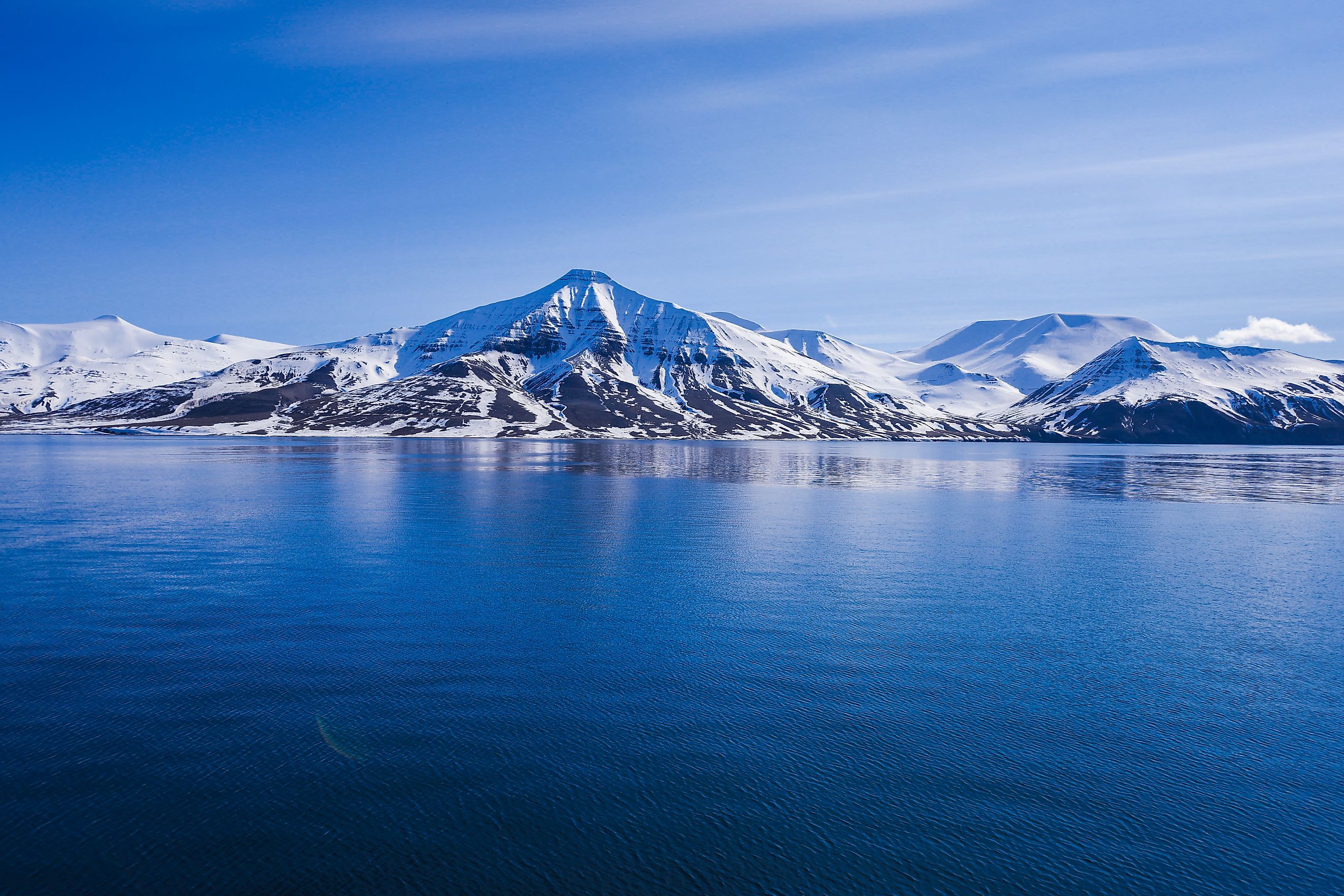
The Smallest Ocean On Earth
The smallest ocean in the world is the Arctic Ocean. This almost completely landlocked ocean is known for its treacherous ice-covered waters, which have been the cause of many shipwrecks of would-be explorers from the 16th to the 19th centuries. Despite its small size, the Arctic Ocean is of immense importance to the wildlife that live in its waters or on its shoreline and the people who live in eight countries around it. In this article, we will examine some of its geology, history of exploration, and concerns over climate change impacting this ocean.
Dimensions

The Arctic Ocean measures 5.4 million square miles (14 million square kilometers). This makes it around 3 million square miles smaller than the next smallest ocean, the Southern Ocean, and less than 9% the size of the largest ocean in the world, the Pacific Ocean.
However, for context, the Arctic Ocean is still larger than the U.S., which has a total land mass of 3,796,742 square miles (including Alaska). The Arctic Ocean is also the shallowest of the oceans, with its deepest section going down 17,850 feet in the Eurasian Basin. This makes it shallower than the Caribbean Sea, which has a maximum depth of 25,216 feet in the Cayman Trench and far shallower than the deepest ocean, the Pacific Ocean, which has a maximum depth of 36,070 feet in the Mariana Trench (the deepest point on Earth).
Due to the cold temperatures in the Arctic, significant portions of it are covered with ice at any one time. For example, on March 22, 2025, it reached its maximum ice concentration of 5.53 million square miles. This is significantly lower than ice levels in the past, around 0.82 million square miles less than levels observed from 1981 to 2010.
The Arctic Ocean borders Canada, Greenland, Iceland, Norway, Russia, and Alaska, while Sweden and Finland round out the eight Arctic states without an Arctic Ocean coastline.
Geology

There are fewer studies analyzing the geological history of the Arctic due to harsh conditions at the North Pole. By analyzing tectonic history, scientists have determined that the Arctic Ocean formed through a series of events.
The first was from 150 to 200 million years ago, when the islands of Greenland and Spitsbergen gradually moved from the equator to the tropics. Prior to this, the entire northern hemisphere was covered with one vast ocean. 50 million years ago, the Atlantic Basin continued to move up north, until eventually the Arctic Basin itself split apart, and has remained in roughly the same spot over the last 20 million years.
Studies have revealed that the Arctic is made up of two primary basins, the Eurasian Basin on the European side and the Amerasia Basin on the American section. They are divided by the Lomonosov Ridge, a submarine mountain range.
The Arctic Ocean is unique for several reasons. First off, it is nearly completely surrounded by North America, Eurasia, and Greenland. Second, around a third of its area has a continental shelf underneath it, such as the Svyataya Anna Trough, which is 110 miles wide and 300 miles long.
Exploration

The area around the Arctic Ocean has been the home of indigenous people for tens of thousands of years, but various European groups have also explored it over time. One of the earliest records of European exploration was in 330 BC when a Greek explorer named Pytheas sailed from modern-day Marseille, France, and may have sailed as far north as Iceland or the Shetland Islands. More than 1,000 years later, Erik the Red sailed from Iceland to Greenland in 982, giving it the name as a way to attract newcomers, despite the land's true icy habitats.
In the late 1500s, Europeans began exploring the Arctic as a way to reach two separate passages, one to the Northeast and the other to the Northwest. Dutch explorer Willem Barentsz first reached Svalbard in 1596, but he would later die in a shipwreck the following year. English explorer Henry Hudson would also make efforts to sail up the Hudson Bay in an attempt to find the Northwest Passage. In 1611, his crew mutinied and set him adrift in Hudson Bay with a few loyal men, and they were never seen again. A few years later, William Baffin and Robert Bylot reached 77 degrees north latitude on the west coast of Greenland, which would hold the record for the farthest distance sailed north for nearly two centuries.
In 1879, Swedish explorer Adolf Erik Nordenskiold would reach the Bering Strait across the Arctic Ocean, finally discovering a route from the Atlantic to the Pacific through the Arctic, making him the first man to make it through the Northeast Passage.
The Northwest Passage was another story. Many explorers would attempt to reach the Northwest Passage from Europe to Asia, but all failed, including Sir John Franklin, who disappeared in 1845, and his ship was not discovered until the 21st century. In 1906, Norwegian explorer Roald Amundsen finally used his small ship Gjoa to pass through the channels all the way through the Northwest Passage in a journey from 1903 to 1906. He learned from the Inuit people by wearing their clothing and using small crews to navigate the narrow ice channels. He would later go on to explore the South Pole in 1911.
Wildlife

The wildlife in and around the landmasses of the Arctic has to be able to survive intensely cold temperatures as well as blend in with the snow. Some of these creatures are quite small, such as the Arctic Fox or snowshoe hares, while others are massive, such as the polar bear.
These bears can grow up to 1,700 pounds with an average height of 8 to 10 feet. The average weight of these bears is 600 to 1,200 pounds, with females weighing less at 400 to 800 pounds. They are an apex predator, hunting seals during the spring, while pregnant females den through the winter to give birth.
One of the largest sea creatures in the Arctic Ocean is the beluga whale, which can come close to the shoreline of Alaska, Russia, Canada, and Greenland, especially during warmer summer months. They can navigate the icy waters of the Arctic, where they feed on salmon, cod, flatfish, squid, octopus, and many other creatures. They weigh an average of 3,150 pounds and can grow up to 16 feet long.
These whales can live for decades, generally 35 to 50 years, with exceptional individuals reaching 60 to 70. They form large social groups and can emit all manner of chirps and sounds that have led to them being called the canary of the ocean.
Is the Arctic Ocean melting?

Multiple scientific agencies have noted that the ice cover for the Arctic Ocean has been decreasing over time, with the WWF noting that the ice extent has been decreasing 13% every decade, with sea ice cover becoming thinner over time. Since the onset of satellite record-keeping in November 1978, scientists have observed that the ice extent has been decreasing.
It is possible in the near future that the Arctic Ocean could be completely ice-free during the summer, an event that has yet to occur historically. However, scientists disagree, with some arguing that this could occur in the 2020s and others stating it could be delayed. Climate scientists have noted that an ice-free Arctic Ocean, even seasonally, could contribute to climate change, as the ice caps reflect sunlight back, cooling the Earth, so an ice-free ocean would absorb more of that heat instead.
Some organizations have called on the eight Arctic states to dramatically reduce global CO2 emissions as a way to combat this trend, with the WWF arguing that these states should aim for net zero emissions by 2050.