Why Yellowstone Smells Like Rotten Eggs
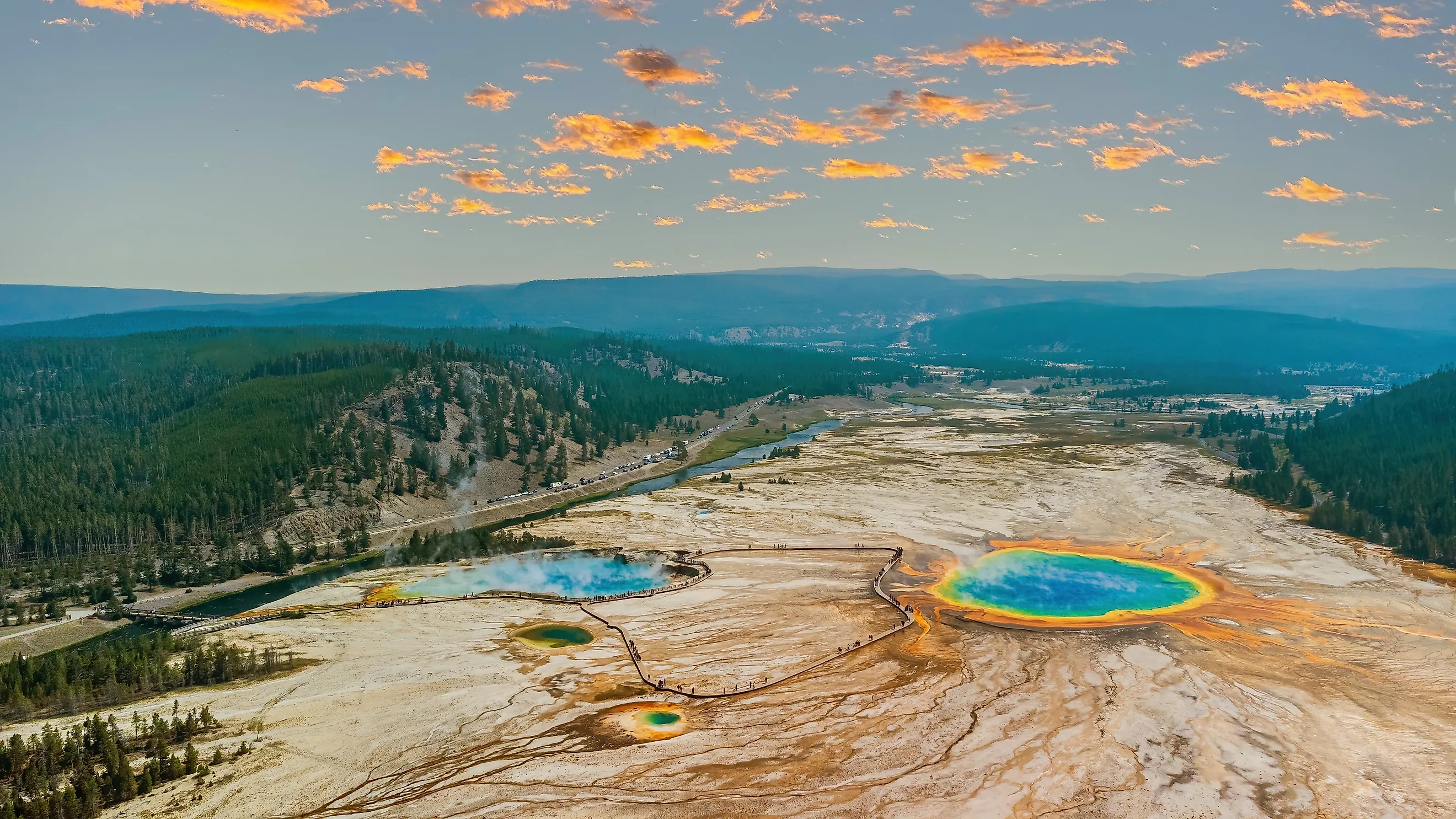
Yellowstone National Park smells like rotten eggs due to sulfuric acid. This is produced when hydrogen sulfide gas rises to the surface, breaking down the rocks and producing a smell similar to rotten eggs. The same process that creates the geysers and hot springs that Yellowstone National Park is famous for also produces these less pleasant-smelling acids. The rotten egg smell itself comes about because of thermal energy under the earth. This thermal energy is produced by the Yellowstone Caldera.
Thermal energy in Yellowstone

Yellowstone National Park became the first national park in 1872 due to its highly complex system of hydrothermal features. There are more than 10,000 of these features recorded, including many geysers such as the famous Old Faithful.
This thermal energy comes from the Yellowstone caldera that is underneath the surface of Yellowstone. Groundwater seeps down through cracks in the rock where they meet flowing magma. Although the water is heated above its boiling point, it remains in a liquid form due to the pressure until it erupts out through gaps in the rocks, via geysers.
Old Faithful has eruptions that can reach more than 130 feet in the air for several minutes at a time. It sits in the Upper Geyser Basin, which has around 150 geysers in total. Rainfall has been shown to have an impact on its cycles, as its intervals between eruptions are shorter during years with more rainfall.
The smells of Yellowstone

The rotten egg smell in particular emerges from mudpots, which are hot, churning pools of water that sit above fumaroles (vents). There are microorganisms in these mudpots that utilize hydrogen sulfide as an energy source. These life forms then convert the gas into sulfuric acid, which slowly breaks down the rocks into a muddy substance, which gives the mudpots their texture and their signature smell of rotten eggs.
One such spot is the Mud Volcano area to the north of Yellowstone Lake, which sits over the hottest vent in Yellowstone National Park at 237 degrees Fahrenheit. Here, the hydrogen sulfide makes up 0.15% of the gas emissions.
Much of the gas released in Yellowstone lacks any smell at all, as much of it is simply steam from hot water that erupts up and transforms into gas as they escape the strong pressure of the rocks. However, there are a few places in the park where one can smell a tar-like and ammonia smell, such as at the seeps at Devil's Den and at Washburn Hot Springs. This smell is most commonly found in hydrocarbons such as oil.
Scientists believe that this smell comes up from thermal activity as well, but the smell is diluted by the breakdown of organic materials from rocks in the earth's crust. The smells of Yellowstone, along with its thermal energy, often raise fears of a massive eruption.
Will Yellowstone erupt?

Due to Yellowstone's location above a volcano, some have raised concerns that the Yellowstone Caldera will erupt. During a supereruption event, the Yellowstone Caldera could send up close to 2,000 megatons of sulfur into the stratosphere, which could lead to major cooling in the Northern Hemisphere. Some have even argued that Yellowstone is overdue for an eruption.
However, scientists note that this is overblown. For example, Yellowstone has had a major eruption on average once every 725,000 years, with the last event taking place 0.631 million years ago. This means, even on average, Yellowstone is not overdue for a major eruption.
On another level, scientists estimate that Yellowstone doesn't have enough magma for a supereruption, with its levels between 5 and 15% magma. The vast majority of its core is solid rock. The U.S. Geological Survey further notes that even if Yellowstone were to erupt, it would likely be a small event, such as its most recent volcanic activity 70,000 years ago, which produced a lava flow.
If there are signs of an eruption, NASA has a plan in place to drill holes into the caldera to release water into it as a cooling agent.
Things to do

Guests can get up close to witness the mudpots, hot springs, geysers, and fumaroles. However, park authorities emphasize that these environments are both fragile and dangerous. More than 20 people have died due to entering the hot springs water in Yellowstone National Park. As a result, guests must stay on designated trails, and pets are prohibited from all thermal parts of the park.
Other than the thermal energy, guests can find more than 1,100 miles of hiking trails, located across diverse environments, some of which are more than 7,000 feet above sea level. From the southeastern side of the park, there is the short Duck Lake Trail, which only takes 1 to 2 hours to complete in the West Thumb Geyser Basin.
Hikers who want a mountaintop view can ascend the Dunraven Pass Trailhead up to Mount Washburn. Along the way, one might see wildflowers or bighorn sheep climbing up the sides of the mountain.
Fishing is another common activity in Yellowstone, as it is home to cutthroat trout, Arctic grayling, mountain whitefish, rainbow trout, and many others. All watercraft must first pass an inspection from the Yellowstone AIS to ensure no invasive species are allowed to enter the lakes, streams, and other bodies of water in the park.
Don't underestimate this rotten egg smell
Hydrogen sulfide doesn't just smell bad. It can also be hazardous for the health of wildlife and humans. In 2004, park authorities discovered five dead bison, which died due to overexposure to carbon dioxide and hydrogen sulfide gases. In 1897, photographers captured a dead grizzly bear that also died due to these gases. These gases are poisonous to humans and wildlife, and overexposure can cause sickness and death. No humans have died in Yellowstone due to these gases, but park authorities recommend leaving the area immediately if one starts to feel sick due to the rotten egg smell or other gases released in Yellowstone National Park.