The Only National Park With Wild Horses
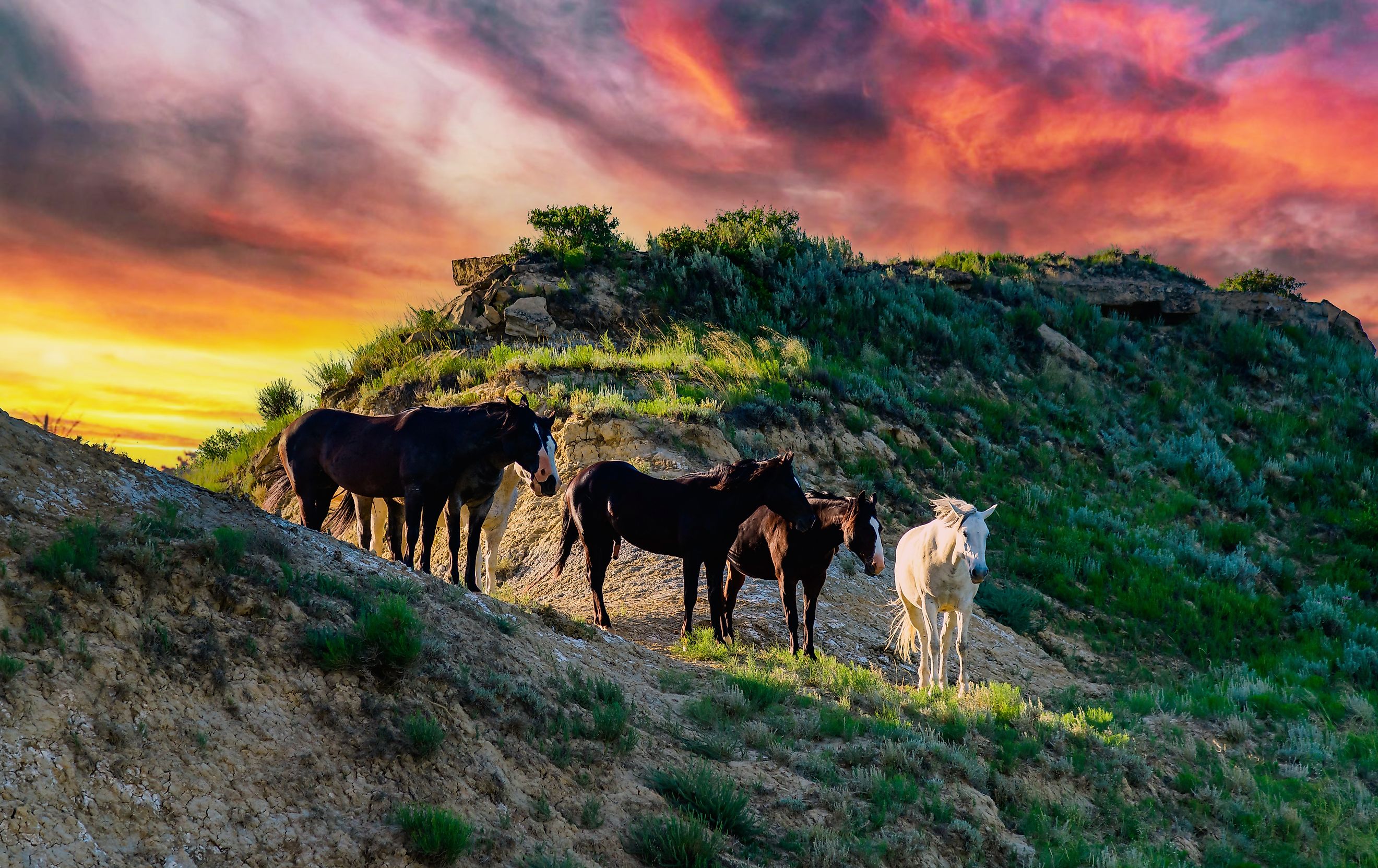
Theodore Roosevelt National Park is the only national park where free-roaming horses still range across the open badlands, on the same North Dakota ground where Roosevelt ran cattle in the 1880s. About 200 of them live here, descended from ranch stock turned loose in the open-range era. Strictly speaking they are feral rather than wild, since their ancestors were domestic animals and North America's native horses died out more than 10,000 years ago. What you can see here is rare: horse society sorting itself out in the open, band by band, the way it did before the fences went up.
Why Are There Wild Horses In Theodore Roosevelt National Park?

The feral horses roam the badlands of North Dakota, and Theodore Roosevelt National Park is the only national park where visitors can find free-roaming herds inside the boundary. The animals descend from domestic stock kept here when the land held working ranches. Rather than fence their horses into pastures, ranchers turned them loose to graze between cattle drives, and the horses grazed, formed social groups, and bred on their own much as they do now. Roosevelt himself knew this open-range scene during his ranching years in the 1880s. After the park erected a perimeter fence, a 1954 roundup removed about 200 branded animals, most of them claimed by area ranchers as trespass livestock. A few small bands slipped the roundup, and today's herd descends from those survivors.
Off the job, the horses were often treated as a nuisance, and cattlemen across the West worked for decades to clear them off the range. The 1971 Wild Free-Roaming Horses and Burros Act gave many Western herds federal protection, but it never covered these animals: it assigned management only to the Bureau of Land Management and the U.S. Forest Service, and national parks were left out from the start. The horses at Theodore Roosevelt are protected instead by a 1970 shift in park policy that recognized them as part of the historic setting and set them to be managed as a historic demonstration herd.
How The Horses Live In The North Dakota Badlands

The horses move in bands of 5 to 15, and each band keeps its own hierarchy. A typical band holds one stallion, several mares, and their young. The stallion drives and gathers the group with a low, outstretched head-and-neck posture called snaking. When a band bolts, a lead mare usually sets the pace out front while the stallion covers the rear. Mares carry foals for about 11 months and give birth in spring; the young reach breeding age around three, when they leave their birth band to form new groups. Some of those groups are bachelor bands made up only of young stallions.
A bachelor will sometimes try to cut mares away from an established band, which touches off fights between him and the band's dominant stallion. That readiness to defend a band, and the aggression that can follow, is the main reason the park asks visitors to keep their distance from the herds. Horses see, hear, and smell over long distances and pick up an approaching person well before a person expects it, so creeping up on a band or watching from close cover does not work.
Managing A Wild Herd Inside A National Park

To hold the herd to a workable size, crews use helicopters to move horses into a handling facility, with roundups running about every three to four years. Managers lean on other tools as well: contraceptive treatment, genetic study to keep the herd diverse, and lower-stress capture methods developed with nonprofit horse-advocacy groups. Once horses are removed, the National Park Service places them through donation to Tribes and nonprofits or through public auction run by the General Services Administration, including online sales.
Balancing the herd against the rest of the park's wildlife is the reason for all this handling. The South Unit, where the horses range, is shared with native large mammals such as bison, elk, and pronghorn. Unlike the bison and the elk, the horses are not native, yet they carry real cultural weight as a living piece of open-range history. Park managers weigh that history against the health of the native prairie, and the pull between the two is why the herd is tracked and its numbers capped, so grazing pressure does not tip the grassland out of balance.
Where Visitors Can See Theodore Roosevelt's Wild Horses
The herd is often visible along the park boundary from Interstate 94, so a band may turn up before visitors even reach the entrance. The horses stay within a fenced section of the South Unit, a wide stretch of flat prairie and river bottom. Trackers can also follow sign left on the ground: stallions build territorial dung piles known as stud piles, a common find along the Scenic Loop Drive.
GPS collars fitted during recent roundups have added a clearer picture of where the bands travel. Reliable spots to scan include the Coal Vein Trailhead, the park's southeast corner, the old East Entrance, the north-central boundary, the Wind Canyon road junction, the upper plateau along the Maah Daah Hey Trail, the Little Missouri River boundary to the north, Johnson's Plateau, and Jones Creek.
Other Parks Have Horses, Just Not Wild Ones
Theodore Roosevelt stands alone as the only full national park with a free-roaming herd, but it is not the only unit of the National Park System where horses run loose. The difference is the same one that applies at Theodore Roosevelt: every one of these herds is feral, descended from domestic animals rather than native to the land. Assateague Island National Seashore, straddling Maryland and Virginia, has the best-known herd, split between a National Park Service band on the Maryland side and a privately owned herd on the Virginia end. Farther south, Cape Lookout National Seashore in North Carolina has a herd of roughly 100 to 130 Banker horses on Shackleford Banks, while the small Ocracoke herd at Cape Hatteras National Seashore lives behind a fence for its own safety. The outlier is Cumberland Island National Seashore in Georgia, where a herd of 150 to 200 is left entirely unmanaged. None of these animals are truly wild, but each carries the same pull that draws people to the Theodore Roosevelt horses: a glimpse of how horses live when people mostly leave them to it.