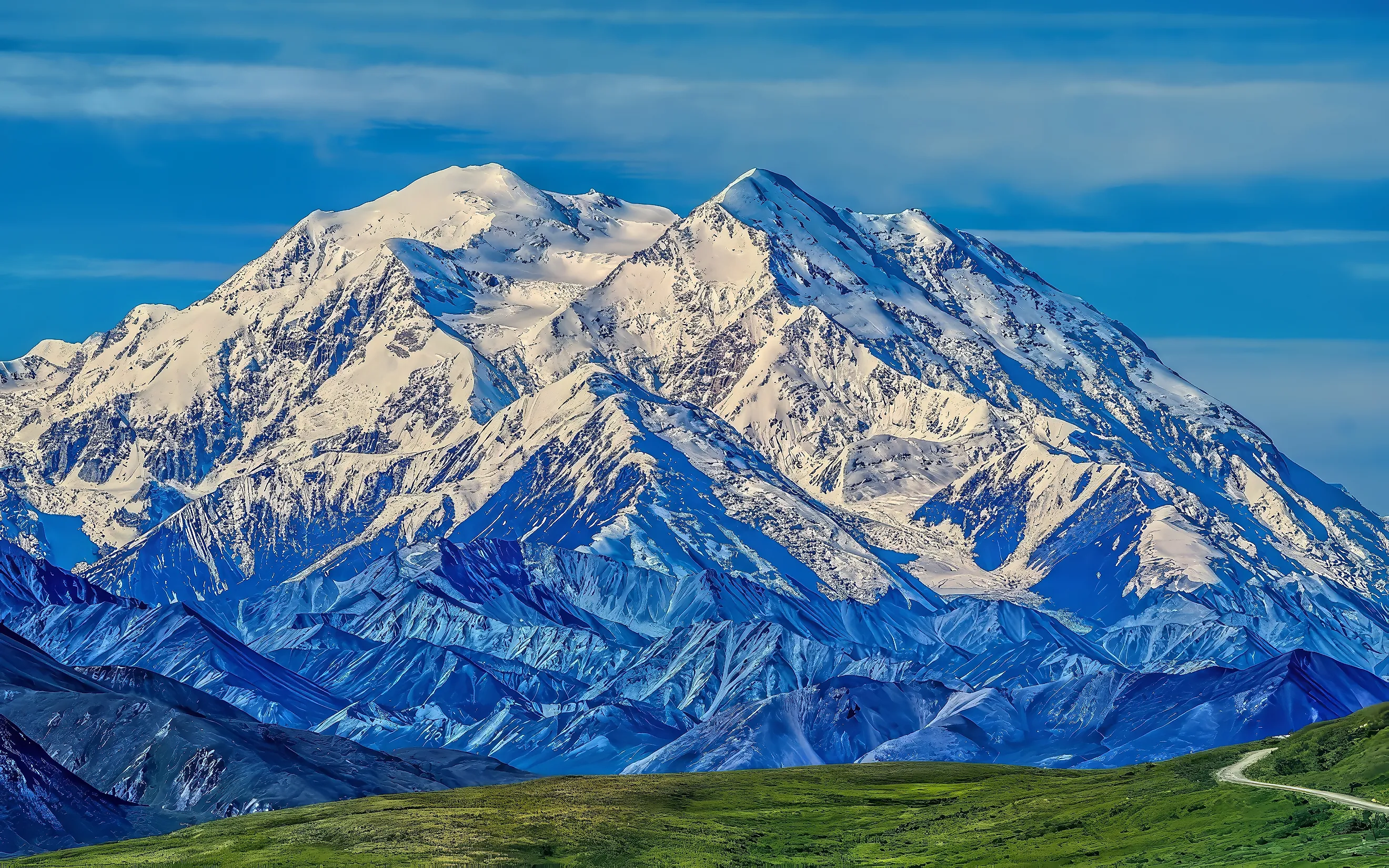
The National Park With The Tallest Mountain
Denali National Park & Preserve has the tallest mountain not just in the national park system but in all of North America. Mount McKinley(also known as Mount Denali) stands 20,310 feet tall, making it the tallest mountain in North America. Located in Alaska, the Denali National Park & Preserve is the third largest national park in the U.S. at 4.7 million acres. Below, we will discuss Mount Denali, the story behind its name, and things to do in Denali National Park & Preserve.
Mount McKinley

Mount McKinley is technically taller than Mount Everest when measured at its base. Its base is 2,000 feet above sea level, before rising up three and a half miles to its summit of 20,310 feet in elevation. Mount Everest's base, by comparison, is on a 14,000-foot elevation plain, and its summit is at 29,028 feet in total elevation.
One of the mountain's most intimidating features is the north face, the Wickersham Wall, a 14,000-foot continuous mountain face, starting in Peters Glacier and going up to the North Peak. Glaciers flow out from the base of the mountain, with some measuring as much as 3,700 feet thick.
Mount McKinley is also overall colder than Mount Everest because it sits at a higher latitude at 63 degrees north latitude, which is 2,400 miles to the north of Mount Everest. While Mount Everest has reported temperatures as low as -42 degrees Fahrenheit, Mount McKinley's lowest reported temperature was -93 degrees Fahrenheit. Beyond that, Mount McKinley is one of the windiest mountains on Earth, recording isolated bursts of more than 150 miles per hour.

The weather here can also change quickly due to the size of Mount McKinley, as storms can quickly change the weather with heavy snowfall and strong winds, making it dangerous for climbers.
Mount McKinley is part of the larger Alaska Range, which runs for 600 miles from the border between Alaska and Canada. This mountain range was created through plate tectonics dating back to 225 million to 30 million years ago, when fragments of other land masses collided and attached themselves to Alaska. Mount McKinley itself sits under the Denali Fault, which is slowly being uplifted by the Pacific Plate.
There is a bend in the Denali Fault to the north of Mount McKinley, which is pushing it up. In fact, it is still growing at a rate of half a millimeter per year. The mountain is made up mainly of igneous rock, granite, which formed below the Earth's crust.
What is the mountain's name?

The mountain has gone by several different names, depending on the group describing it. Alaskan natives to the north typically described it as the tall-one, while those to the south used a word that roughly translates to mountain-big.
Russian explorer Andrew Glazunov referred to it as Tenada, which comes from an Athabascan Native word meaning the great mountain. Russians would later call it Bulshaia Gora for Big One in Russian.
When the U.S. acquired Alaska from Russia in 1867, the mountain was largely known as Densmore Mountain after a gold prospector, Frank Densmore. Its current name was first introduced by prospector William Dickey in 1897 after then-President William McKinley. The official federal designation came in 1917 as Mount McKinley National Park, given in part due to the President's assassination in 1901.

However, there was push from Native groups to rename the mountain back to a Native name, Denali, which derives from the northern Koyukon language. Alaska first petitioned Congress to change the name to Denali in 1975, but McKinley's home state of Ohio worked to block the proposal. Alaska went ahead and changed the name to Denali National Park and Preserve in 1980, but they were unable to rename the mountain.
In 2015, President Barack Obama changed the name to Denali by executive order. However, this decision was reversed in 2025 by President Donald Trump, who signed an executive order changing the name back to Mount McKinley, in part due to his admiration for President William McKinley.
As of the writing of this article, the park's name is Denali National Park & Preserve, but the mountain's federal name is Mount McKinley.
Things to do

While climbing Mount McKinley itself is a popular activity, there are many other options for outdoor recreation in Denali National Park & Preserve. There is only one road in the park, while everything else must be accessed through backpacking.
Even from the park road, marked trails are rare, but there are a few easy ones such as the Oxbow Loop Trail, a 1.5-mile trail going around the Nenana River and into a spruce forest, or the 0.6-mile Mountain Vista Trail, which offers views of Mount McKinley.
The mountain itself is not visible from the park entrance, but during the summer one can take the Savage River Shuttle to get views of the mountain, depending on visibility.
For those willing to get a free backcountry permit, they can explore off the main road into millions of acres of wilderness. Rangers can help backpackers prepare by ensuring they have the right supplies and access to resources.
Backpackers can also take part in the Denali Alpine Wildlife Project, where they take photos of wildlife and how they are adapting to climate change, such as the American pika, the hoary marmot, or the Arctic ground squirrel.
One such creature that is of special interest to rangers are Dall sheep, a white mammal that can survive on high mountainside cliffs, using their two-toed hoofs to grip rocky surfaces. It has such a thick coat that it can't be detected by infrared imaging in the winter.
Those who want to climb Mount McKinley must apply for a special use permit. They must register at least 60 days prior to their climb attempt, so that rangers have time to get in touch with climbers and share important information and insights on how to ascend North America's tallest mountain.
Mount Denali National Park rewards effort
While casual visitors can sightsee around Mount Denali National Park & Preserve, the park's remote wilderness and challenging trails reward those willing to put in the effort. It requires careful planning and determination to go off the beaten path into the Alaska Range, whether that's finding a trail through tundra and taiga forests, or climbing up the windy and cold Mount McKinley. It isn't surprising that this mountain and park have seen so much controversy surrounding its name, as it's easy to get enthusiastic about the tallest mountain in North America.