The National Park With Lava Tubes
Hawaiʻi Volcanoes National Park sits on one of the most active volcanic landscapes in the world, and beneath its surface lies an extensive network of lava tubes formed by centuries of eruptions. These hollow passages preserve the paths once taken by molten rock, including parts of the Kazumura system, one of the longest known lava-tube caves on Earth. While other National Park Service sites contain lava tubes, Hawaiʻi Volcanoes is the primary US national park where they are a defining part of the landscape.
What is a lava tube?

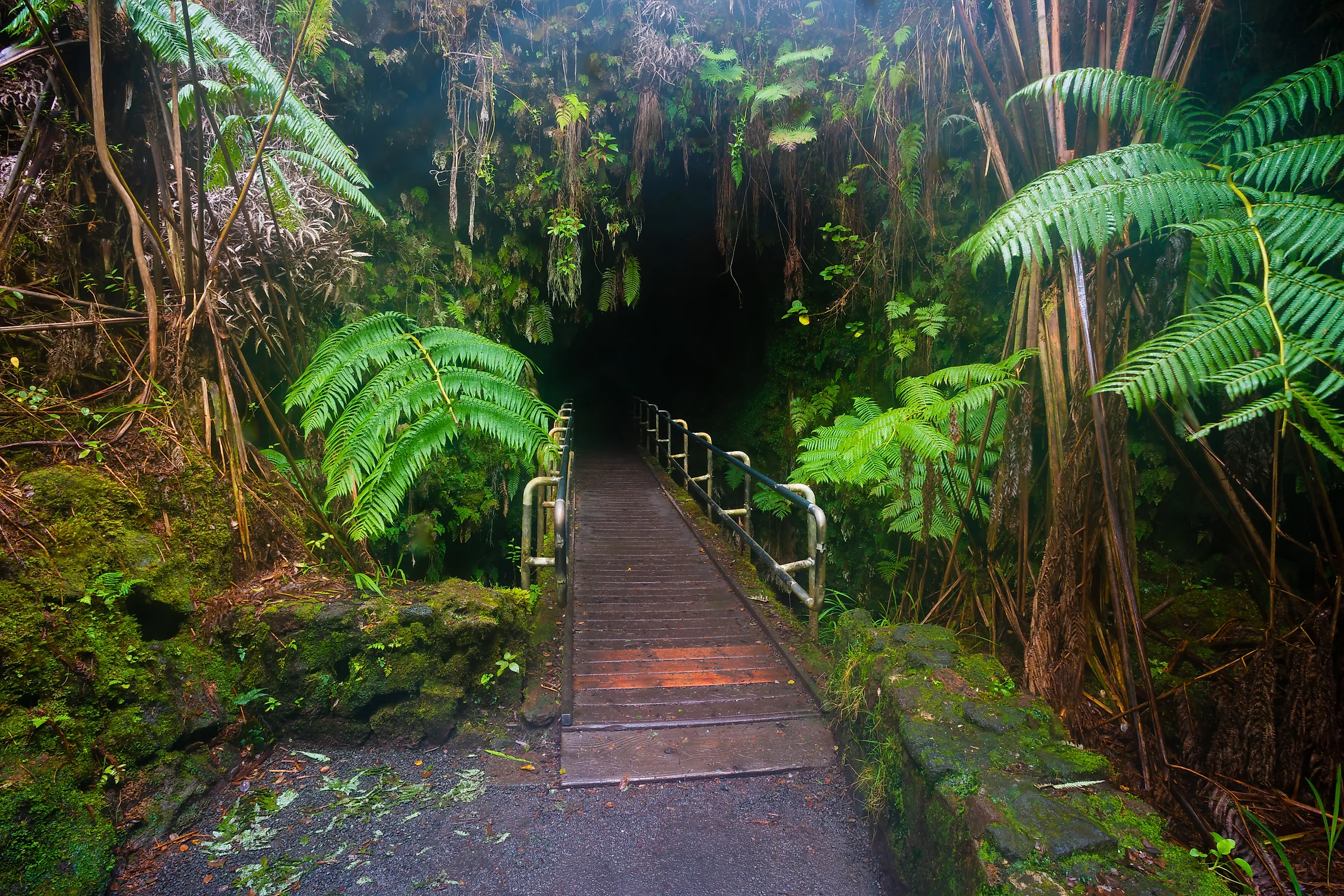
Thurston Lava Tube on Hawaii Big Island. Editorial credit: Robin Runck via Shutterstock
A lava tube is a cave that is formed when a volcano erupts, causing molten rock to flow underground. However, the outer portion of the lava gets exposed to cooler temperatures, which causes it to harden into rock. This eventually forms a roof of rock, which will become the ceiling of the cave, which at the time is called an outer crust.
The lava inside will continue to flow until it either flows out of the cave or until the volcanic eruption itself ends, causing it to drain from the tube. What is left behind is the lava tube itself. Oregon State University notes that the lava acts like a river delta, which will form smaller tubes, creating multiple passages, such as at the Lava Beds National Monument in California. In addition, the lava tube itself helps the interior lava maintain its temperature.
Unlike limestone caves, lava tubes tend to be closer to the surface and, as a result, are much more vulnerable to outside forces. They can often become buried by cave collapses or become filled with water, which is used by wildlife. In more active volcanic areas, lava may reenter the tube, destroying it, which has been documented at the Hawai'i Volcanoes National Park.
Despite their hot origin, some lava tubes wind up with ice, due in part to the high elevations. One example of this is ice caves at Craters of the Moon National Monument in Idaho. Cold air becomes trapped in these caves, and moisture in turn creates ice formations. Many of the rock formations in these tubes show evidence of volcanic activity, such as lava stalactites, formed by cooling lava flowing through the tube.
The lava tubes of Hawai'i Volcanoes National Park

The lava tubes found in Hawai'i Volcanoes National Park are the longest on Earth. It has a vast number of lava tubes, including active ones, which are sometimes visible through fumes or the hissing sound as the lava flows.
The roughly 500-year-old Ailāʻau eruption on Kilauea lasted for about 60 years and created the Kazumura Cave system. Extending more than 40 miles, Kazumura is widely recognized as the longest and deepest lava tube on Earth.
Currently, the only lava tube open to the public is the Nahuku, formerly known as the Thurston Lava Tube, was documented by a USGS survey team in 1912. It was originally named after Lorrin A. Thurston, a prominent publisher who explored and publicized the tube in 1913. He was a politician and lawyer in Hawaii who helped overthrow the Kingdom of Hawaii. Due to this controversy, the lava tube's name was changed. Unfortunately, much of the lava formations were removed by tourists, and today no one is allowed to touch the walls of this cave. This tube was formed fairly recently, geologically speaking, just over 500 years ago.
The volcanoes of Hawai'i Volcanoes National Park

The most active volcano in the park is Kilauea, which formed 280,000 years ago. Its name comes from a Hawaiian word meaning spewing or spreading. In Hawaiian mythology, it is the home of the fire goddess Pele.
The geology of this volcano is difficult to measure, as about 90% of its surface was made by lava flows within the last 1,000 years. Geologists believe that the volcano experienced nearly constant eruptions from 200 to 1000 CE and from 1500 to 1800. It is called a shield volcano due to its long, shallow slopes resembling the shape of a shield.
Kilauea has experienced 53 distinct eruptive episodes since December 23, 2024, with its most recent event occurring between August 12 and August 13, 2026. During this 9.6-hour event, lava fountains reached a maximum peak of 500 feet.
Mauna Loa is the largest active volcano on Earth, standing 13,681 feet above sea level. If measured from its base in the ocean, it is 30,000 feet tall, which is taller than Mount Everest. Its name translates to long mountain, with one summit caldera and two rift zones. Eruptions tend to begin at the summit before moving to one of the rifts zones.
It is less active than Kilauea, having erupted 34 times since 1843. Its most recent eruption took place in 2022 and prior to that in 1984. During this eruption, new fissures opened up, with one sending 50 to 100 cubic yards of lava per second down close to the Daniel K. Inouye Highway, although the flow ended right before reaching the road.
Myths

To Native Hawaiians, Hawai'i Volcanoes National Park is a crucial component of their culture, especially in terms of their mythology.
As mentioned above, Pele is the goddess of volcanoes. According to one story, her uncle Lonomakua took her into a lava tube and taught her about the various celestial bodies, along with the ocean and the moon. He then instructed her on how to make fire with a block of wood and a stick. From this lesson, she produced the fire that would flow throughout the volcanoes of Hawaii.
Pele herself is not viewed as malevolent, but as creative and at times unpredictable. As a result, one Hawaiian tradition is to ask Pele for permission before travelling through her volcanic landscape.
Things to do

Within Hawaiʻi Volcanoes National Park, lava flows, calderas, and rainforest trails reveal a landscape shaped by repeated eruptions. Mauna Loa began forming between 600,000 and 1 million years ago, while Mauna Ulu, a volcanic cone on Kīlauea, was created by lava flows from 1969 to 1974.
Hike through rainforests, such as the Halema'uma'u Trail, which will take you to the floor of the Kilauea caldera. Some hikes take one down through former lava lakes such as the Kilauea Iki crater, formed by an eruption in 1959. Today, this lava lake is showing signs of life, with plants growing in the cracks of the earth.
The land also shows signs of human activity, including petroglyphs. Up to 23,000 petroglyphs can be seen from the boardwalk trail at the Pu'uloa Petroglyphs, which were carved into a lava flow from 500 to 550 years ago.
Leave no trace in this volcanic park

When visiting the Hawai'i Volcanoes National Park, it is necessary to take precautions to avoid harming the fragile rock formations, petroglyphs, and other landmarks. One of the best ways to do this is to stay on the trail in a protected environment. This is also important for your own safety, due to the active lava flows. The park recommends that visitors follow the pono pledge: I pledge to be pono on the island of Hawai'i. The word pono means righteous, meaning one should be respectful and mindful of other visitors, the land, and the Native people who call this volcanic landscape home.