See Lake Superior From These American Summits
With the lower elevation of the Midwest, it can often be difficult to get a nice overlook of the Great Lakes. But there are mountains tucked away in Minnesota and Michigan's Upper Peninsula that offer views that put the lake's true size into perspective.
After all, the word lake doesn't do these bodies of water justice, as Lake Superior alone is larger than the entire land area of South Carolina. But these mountains are impressive in their own right, as they are made of rocks that are so old and hard they can withstand the pressure of vast glaciers that dug out the basins that now host the Great Lakes during the last Ice Age.
Huron Mountains

Located in the Upper Peninsula, the Huron Mountains contain some of the oldest rocks in the state. They are part of the larger Canadian Shield, the ancient rock core of North America is made of hard Precambrian rock that dates back at least 2 billion years. Formed under immense pressure, these rocks are resistant to the erosive forces of wind, rain, and glaciers, which have worn down many other ridges and hills.
In this mountain range, there are several named peaks with views of the Great Lakes. The most accessible is Sugarloaf Mountain. Just outside of the city of Marquette, it is only 470 feet above Lake Superior, but offers an overlook onto Lake Superior and several of its islands close to the shoreline.

For a higher view of Lake Superior, Mount Arvon is about 900 feet higher than Sugarloaf. At 1,979 feet, it's the highest point in Michigan. In order to reach the summit for the view, hikers have to struggle through rocky and at times muddy terrain.
Much of the Huron Mountains is owned by the Huron Mountain Club, which was founded in 1889 to provide hiking, fishing, and other outdoor activities 30 miles northwest of Marquette.
Porcupine Mountains

Located on the northwestern end of the Upper Peninsula, the Porcupine Mountains are a very old environment, featuring about 31,000 acres of old-growth forest. It is often shortened to the Porkies, as the mountains aren't very tall, with its highest point 20 feet lower than Mount Arvon at the 1,958-foot-high Summit Peak.
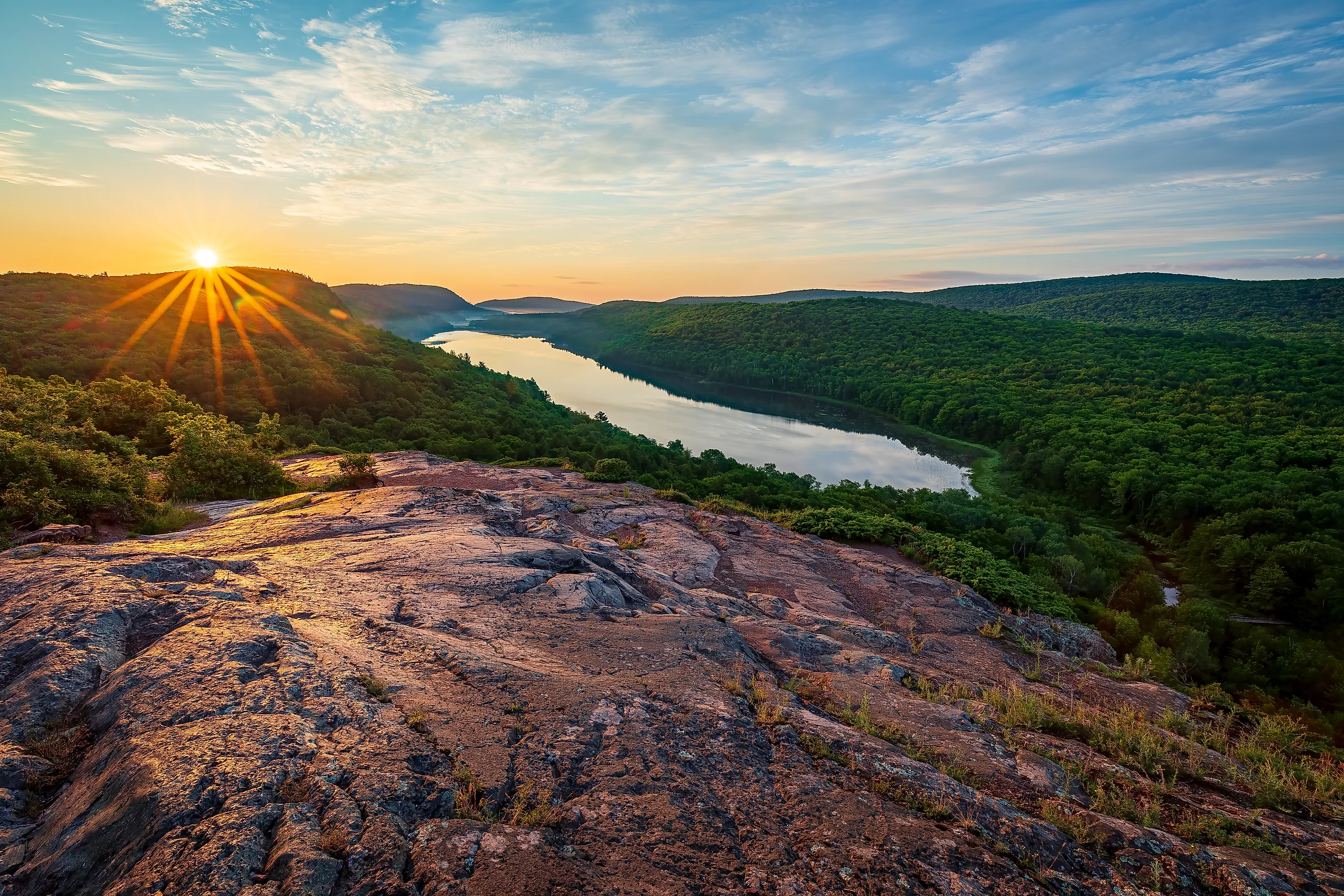
The mountains have a volcanic history, with 1.1-billion-year-old basalt rocks visible along its Lake Superior shoreline. The Great Lakes aren't the only thing one can see up in these mountains; there's also a magnificent blue lake known as Lake of the Clouds.

Located in the Porcupine Mountains Wilderness State Park, this small lake gets a lot of photographs due to its deep blue color amid a sea of tall, twisting old-growth trees.
This state park also offers the highest view in the mountain range atop the Summit Peak Observation Tower. From here, one can see Lake Superior's greatest features, someties even the Isle Royale National Park off the coast as a freshwater island and the Apostle Islands National Seashore towards Wisconsin.
Sawtooth Mountains

The Sawtooth Mountains are one of several ancient mountain ranges in Minnesota that have survived around a billion years of erosion. Nestled on the North Shore, these peaks offer a rare high Minnesota view out onto Lake Superior.
The Sawtooth Mountains were formed through major North Shore eruptions around 1.1 billion years ago. It left behind layers of lava that grew to more than 5 miles in thickness, stretching for more than 150 miles. These layers of cooled volcanic rocks were carved by glaciers, but were not completely flattened, instead giving them a ridgelike appearance.

One of the tallest mountains in this range is Moose Mountain at 1,688 feet above sea level. There are several ways to reach the top of Moose Mountain and see the North Shore of Lake Superior, either by riding a gondola and walking the remaining 1 mile or going for a much larger hike through woodlands and waterfalls.
From Moose Mountain, one can also go on the Superior Hiking Trail leading to the Mystery Mountain overlook over Lake Superior.
Brockway Mountain

Brockway Mountain is a ridge located on the Keweenaw Peninsula of Michigan that stands at 1,320 feet above sea level and is often considered one of the best places to go to look at Lake Superior.
The mountain is an ancient alluvial fan, meaning it is made up of rocks and sediment carried down by fast-moving mountain streams and deposited in a fan shape onto a flat valley floor. Over millions of years, these deposits cemented into hard rock, which eventually stood out as a ridge after the softer rock around it eroded away.
This same depositional process can be seen today at the edges of the Himalayan Mountains. However, unlike the geologically young Himalayas, Brockway Mountain is ancient, dating back roughly 1.1 billion years.

Today, visitors can drive up to the top of Brockway Mountain via the Brockway Mountain Drive. Going up nine miles, it is noteworthy for its 360-degree view of Lake Superior. From the overlook, one can see Isle Royale National Park on non-cloudy days. It is the highest elevation drive one can make between the Rocky Mountains to the west and the Appalachian Mountains to the east. The road leading up to the top was built in the 1930s during the heart of the Great Depression when, in order to revitalize the economy and give young men work, they were employed in a variety of construction projects.
These mountains are very small
While officially referred to as mountains, they are very small in comparison to the other mountain ranges in the US The Rocky Mountains regularly eclipse 14,000 feet in elevation, while the tallest mountains in the Appalachians are more than 6,000 feet tall. By comparison, none of these overlooks are taller than 2,000 feet.
The reason for their short stature is multifaceted. For one, there are no active tectonic plates in the Midwest that would build mountains. For another, high zones throughout the Midwest have been flattened over time by glaciers, with only areas missed by the glaciers or ones made of erosion-resistant rock able to survive. If anything, it's incredible that places this tall still exist in the Midwest, and enable one to stand out and see the immense power of the melting glaciers that formed the biggest freshwater lake on Earth, while also offering a rare mountain hiking adventure for residents or visitors to Michigan's Upper Peninsula and Minnesota's North Shore.