7 Most Beautiful Gothic Churches In The United States
Gothic architecture came to the United States through European influence and slowly adapted to local materials, beliefs, and landscapes. It is known for pointed arches, tall spires, stained glass, and detailed stone or woodwork that draw the eye upward. These features create a strong sense of height, light, and brilliantly careful craftsmanship.
The first major wave was the Gothic Revival in the 1800s. American architects looked to medieval European cathedrals and recreated their forms using modern building methods. In rural areas, this style evolved into Carpenter Gothic, where builders used wood instead of stone. These churches kept steep roofs and pointed windows, but felt simpler and more intimate.
In the early 1900s, Collegiate Gothic appeared on university campuses, blending Gothic design with academic settings. Immigration, religious traditions, and regional culture shaped how these churches looked and where they were built. Together, they form some of the most striking historic religious buildings in the country. With that, here are some of the most beautiful Gothic churches in the United States.
Cathedral of St. John the Divine - New York City, New York

Cathedral of St. John the Divine stands in Morningside Heights, New York, and is one of the largest churches in the world. Construction began in 1892, and the building is still unfinished, which is why it is often called “St. John the Unfinished.” Early plans leaned toward a Byzantine style, but the design later shifted to Neo-Gothic or Gothic Revival under the guidance of architect Ralph Adams Cram.
The result is a mix of French and English Gothic influences, seen in its pointed arches, tall vaults, and detailed stonework. Inside, visitors can see massive sculpted portals, a large rose window, and the chapels of the seven nations. The cathedral also hosts rotating modern art installations, which add contrast to the historic setting.
You can walk through the long nave to view sculpture exhibits, explore the Biblical Garden outside, and often spot peacocks on the grounds. The cathedral also hosts poetry readings, concerts, and public events throughout the year.
Washington National Cathedral - Washington, DC

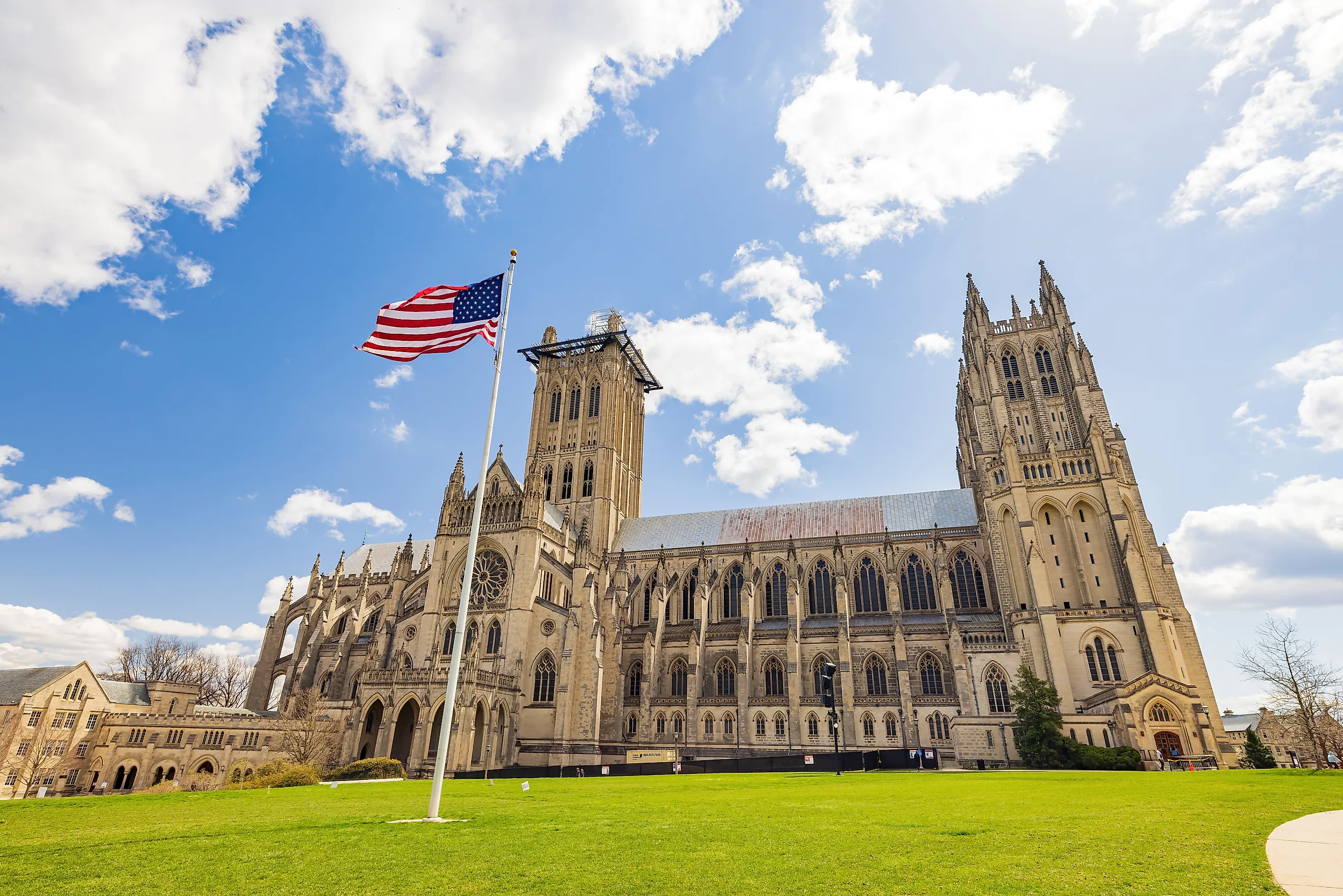
Washington National Cathedral stands on Mount St. Alban in northwest Washington, DC. Construction began in 1907 and ended in 1990, making it one of the longest building projects of its kind in the country. The cathedral follows the Neo-Gothic style and was built using hand-carved limestone. Its design includes flying buttresses, tall towers, pointed arches, and detailed stone carvings.
One of its most unusual features is the Space Window, which holds a real moon rock brought back by the Apollo 11 mission. Visitors often notice the carved figures on the exterior, including the famous Darth Vader grotesque added in the 1980s. Inside, the high vaults and stained glass create a quiet and reflective setting.
You can walk through the surrounding gardens, explore the crypt level chapels, or join a guided tour. Climbing the observation tower gives wide views of the city. The cathedral also hosts regular organ recitals and services open to the public.
St. Patrick’s Cathedral - New York City, New York

St. Patrick’s Cathedral is one of the best-known Gothic Revival or Neo-Gothic churches in the United States. Construction began in 1858 under architect James Renwick Jr., and the cathedral opened in 1879. Built from white marble, it stands out on Fifth Avenue with twin spires that rise 330 feet above Midtown Manhattan.
The exterior features pointed arches, carved details, and large rose windows. Inside, the nave feels open and tall, with vaulted ceilings and long rows of columns. Visitors often notice the bronze doors, the detailed side chapels, and the large pipe organ. Stained glass windows made by French and English studios line the walls and filter soft light into the space.
You can attend a mass or music concert, explore the crypt where cardinals are buried, or walk Fifth Avenue to photograph the cathedral from different angles.
Grace Cathedral - San Francisco, California

Grace Cathedral sits on Nob Hill and is one of the finest Neo-Gothic or Gothic Revival churches in the United States. Its story began during the 1849 Gold Rush with a small wooden Grace Chapel, where miners attended services and donated gold dust. Over time, the parish expanded and relocated uphill, becoming a significant social and spiritual hub before the 1906 earthquake and fire destroyed the church.
After the disaster, the Crocker family donated land on Nob Hill for a true cathedral. Construction of the current building began in 1927 under architect Lewis Hobart, who used steel and concrete to support a French Gothic design. The cathedral opened fully in 1964 and later welcomed figures like Martin Luther King Jr. and Duke Ellington.
Today, visitors can walk the indoor and outdoor labyrinths, see the AIDS memorial altarpiece, join yoga sessions, and enjoy sweeping views of San Francisco from the hilltop setting.
Duke University Chapel - Durham, North Carolina

Duke University Chapel stands at the top of Chapel Drive on Duke’s West Campus in Durham, North Carolina. It is one of the last major examples of the Collegiate Gothic style in the United States. The chapel opened in 1932 and was designed by Julian Abele, a pioneering African American architect. Its design draws from English Gothic churches, with tall stone walls, pointed arches, and a strong vertical form.
The chapel has a 210-foot tower that can be climbed for wide views of the campus. Inside, there are 77 stained glass windows that show scenes from the Bible, along with three pipe organs, including a Flentrop organ. A 50-bell carillon rings out across campus, and the chapel seats about 1,600 people.
Visitors can attend interfaith services, explore the interior, or walk to the nearby Sarah P. Duke Gardens after their visit.
St. Michael's Episcopal Church - Anaheim, California

St. Michael’s Episcopal Church is a rare example of Carpenter Gothic architecture in Anaheim, Southern California. Built in 1876, the wooden church has welcomed worshippers for nearly 150 years. It first stood at the corner of Emily and Adele Streets before being moved to South Street in 1955 to preserve the building.
C. P. McKinney built the church in the Carpenter Gothic style, a wood-based version of Gothic Revival. This style became popular in the mid-1800s when builders adapted the Gothic design for regions with easy access to timber. Key features include pointed arch windows, steep rooflines, board-and-batten siding, wood trim, and a small bell tower with a simple steeple.
Inside, much of the original woodwork remains intact. Visitors can attend services, walk through nearby Founders Park, or explore local history sites. In 2004, the church was added to the National Register of Historic Places, recognizing its architectural and cultural value.
Princeton University Chapel - Princeton, New Jersey

Princeton University Chapel is one of the finest examples of Collegiate Gothic architecture in New Jersey, United States. Completed in 1928 by the firm Cram, Goodhue & Ferguson, the chapel was designed by architect Ralph Adams Cram to echo medieval English cathedrals. The tall stone structure uses sandstone and limestone and stands at the heart of the Princeton campus.
When the chapel first opened, students were required to attend Sunday services, and Christian imagery shaped much of its design. Biblical stories appear throughout the stained glass, carved wood, masonry details, and woven tapestries. For many years, worship followed Christian traditions.
Over time, the role of the chapel changed with the campus community. After a major restoration about twenty years ago, the building reopened with an interfaith ceremony that included Buddhist, Jewish, Islamic, and Christian prayers. Today, visitors can study the stained glass, walk the surrounding quads, or attend services that welcome people of many faiths.
Where Stone, Light, and History Endure
Gothic churches in the United States show how an old European style took on new life across different regions. From massive stone cathedrals in large cities to small wooden churches in quiet towns, each building reflects the place and time in which it was built.
Gothic Revival brought dramatic height and detailed stonework to growing cities. Carpenter Gothic adapted those ideas using wood and simpler forms. Collegiate Gothic blended faith, education, and architecture on university campuses.
Together, these churches stand as lasting examples of careful design, skilled labor, and shared history. Visiting them helps connect architecture, culture, and community across generations.