6 Strange Discoveries About Stonehenge
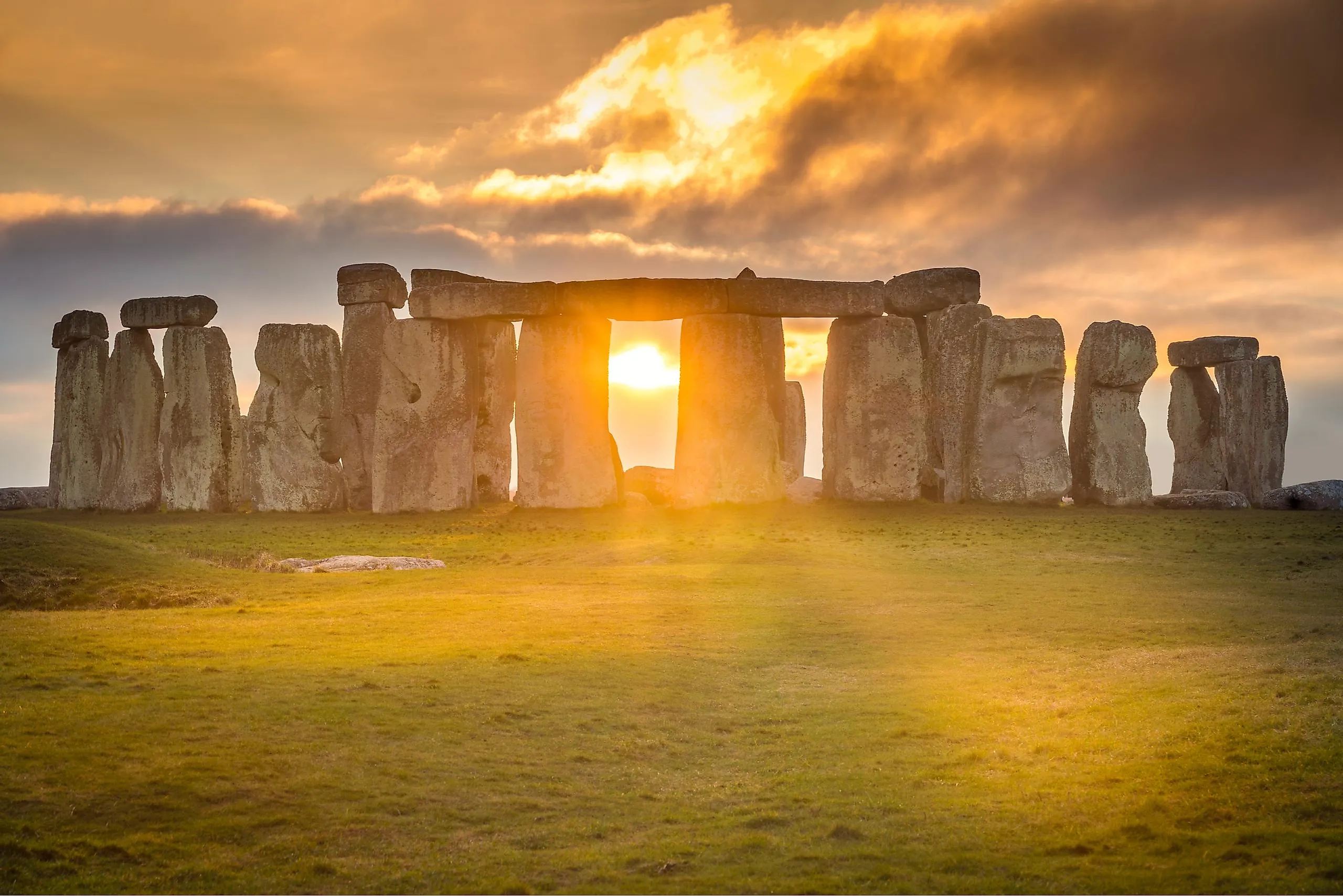
Rising from Salisbury Plain like a giant’s building blocks, Stonehenge is without doubt one of humanity's most perplexing ancient monuments. Built in phases in what is now Wiltshire, England, between 3000 BC and 1500 BC, this UNESCO World Heritage Site attracts over a million visitors each year to marvel at its tall sarsen stones.
And they’re certainly impressive. Some of these incredible sentinels reach heights of 7 meters (23 feet) and weigh in at a whopping 25 tons, leaving one to wonder just how they could have been put in place without the use of cranes and heavy machinery. Equally mysterious is the exact purpose of this ancient wonder. While it’s known that the site served as a burial ground and an astronomical observatory, other uses, such as it possibly having been a place of healing for people who came on a pilgrimage from across Europe, can only be surmised.
Despite centuries of investigation, Stonehenge continues to yield surprising secrets that reshape what we thought we knew about the story of one of Earth’s most mysterious places.
The Giant Hidden Ring Around Stonehenge No One Saw Coming

In 2020, archaeologists from the University of Bradford announced what Professor Vince Gaffney called "an astonishing discovery." Using remote sensing technology as part of the Stonehenge Hidden Landscapes Project, researchers identified a massive ring of at least 20 prehistoric shafts surrounding Durrington Walls, a major henge monument located about three kilometers (two miles) from Stonehenge.
Each shaft measures approximately 10 meters (33 feet) in diameter and plunges five meters (16 feet) into the chalk bedrock. The circle, stretching more than two kilometers (1.2 miles) across and the largest prehistoric structure ever identified in Britain, was carbon-dated to have been constructed around 2500 BC. Initially dismissed as natural sinkholes, research confirms they were, in fact, monumental and human-made over centuries, suggesting an understanding of land and its uses was far more sophisticated than previously thought.
The Secret "Builder Village" Where Stonehenge Workers Partied

Durrington Walls concealed another remarkable revelation. Excavations led by the University of Sheffield between 2004 and 2006 uncovered a massive settlement that may once have been home to the very people who erected Stonehenge. Believed to have once contained as many as 1,000 dwellings and 4,000 residents, more than 38,000 animal bone fragments were also recovered, the vast majority of them from pigs.
According to isotope analysis performed by English Heritage, the group responsible for the preservation of Stonehenge, these domesticated animals weren’t locally raised. They were, in fact, brought from as far away as northeast Scotland, more than 700 kilometers (434 miles) to the north. Many bones were even found with traces of meat still attached, indicating feasts were not at all uncommon at the time. The remains also suggested these gatherings likely occurred during winter, coinciding with midwinter solstice celebrations, an important time for early Britons.
The Six-Ton Stone That Traveled 700 Kilometers from Scotland

Geologists have long assumed Stonehenge's six-ton central Altar Stone originated in Wales alongside the monument's other bluestones. That assumption was called into question in August 2024 when research published in Nature revealed that it, too, likely came from northeast Scotland. Using state-of-the-art technology, researchers matched this massive slab of sandstone to rocks from the Orcadian Basin, an area that encompasses the very tip of northeastern Scotland and some of its most northerly islands. This completely unexpected discovery suggests a level of sophisticated sea navigation or an equally daunting overland journey centuries before the wheel had even reached Britain.
The Bones of "Outsiders" Cremated Hundreds of Kilometers from Home

While it’s well-established that Stonehenge functioned as Britain's largest Late Neolithic burial ground, researchers were shocked to discover something completely unexpected: not everyone buried there was a local.
The cremated remains of at least 58 individuals interred between 3180 BC and 2380 BC have been found at the site, enabling researchers to analyze bone fragments from 25 of them. The results were staggering. Ten showed signatures indicating they lived over 200 kilometers (125 miles) away in western Britain, possibly Wales, where Stonehenge's bluestones are known to have originated. Even more interesting was the fact that carbon isotope analysis suggested some were cremated with wood from dense forests, quite unlike those found near Stonehenge, which would mean their remains were transported to Salisbury Plain for burial.
The Possible Existence of a "Superhenge"

In September 2015, the Stonehenge Hidden Landscapes Project unveiled evidence for what researchers at the time dubbed "Super Stonehenge." This remarkable monument, potentially five times larger than Stonehenge itself, was believed to be buried at Durrington Walls, where the team identified up to 90 massive standing stones arranged in a line, some originally standing 4.5 meters (15 feet) tall.
Upon closer examination, however, the stone columns were revealed to be large pits that likely once contained wooden posts. The deliberate engineering and colossal scale of these pits suggest a sophisticated belief system that involved shaping the land on an unprecedented scale. The purpose of the structures and their formation is largely speculative, but what is clear is that they were created deliberately.
An Entire Missing Sarsen Core Hidden in Florida

In 1958, Robert Phillips was working for a diamond cutting company contracted to repair cracks in one of Stonehenge's sarsen pillars. Three cores were drilled into the stone to insert reinforcing metal rods. Phillips wound up keeping one as a souvenir, taking it with him when he emigrated to the United States in 1977.
On the eve of his 90th birthday in 2018, he returned the artifact to English Heritage. Results published in Science Advances in July 2020 matched the core's geochemical signature to sarsens from West Woods on the Marlborough Downs, 25 kilometers (15 miles) north of Stonehenge. Without his really knowing it, Phillips' actions, some 70 years earlier, had helped settle centuries of debate.
As for the other two cores from the samples that Phillips and his team removed? Nobody knows where they are or what happened to them, leaving another Stonehenge mystery yet to be solved.
The Final Word
Despite having been studied for at least four centuries, it’s only recently that Stonehenge has revealed some of its longest-held secrets. The past decade alone has produced discoveries that challenged what we thought we understood about this remarkable site and Neolithic Britain. Not only did these ancient builders maintain trade routes that spanned the length of ancient Britain, but they also used technologies we still don’t properly understand to move massive stones hundreds of kilometers. Stonehenge clearly has many more secrets to share.