Leading Honey-Producing States In The US
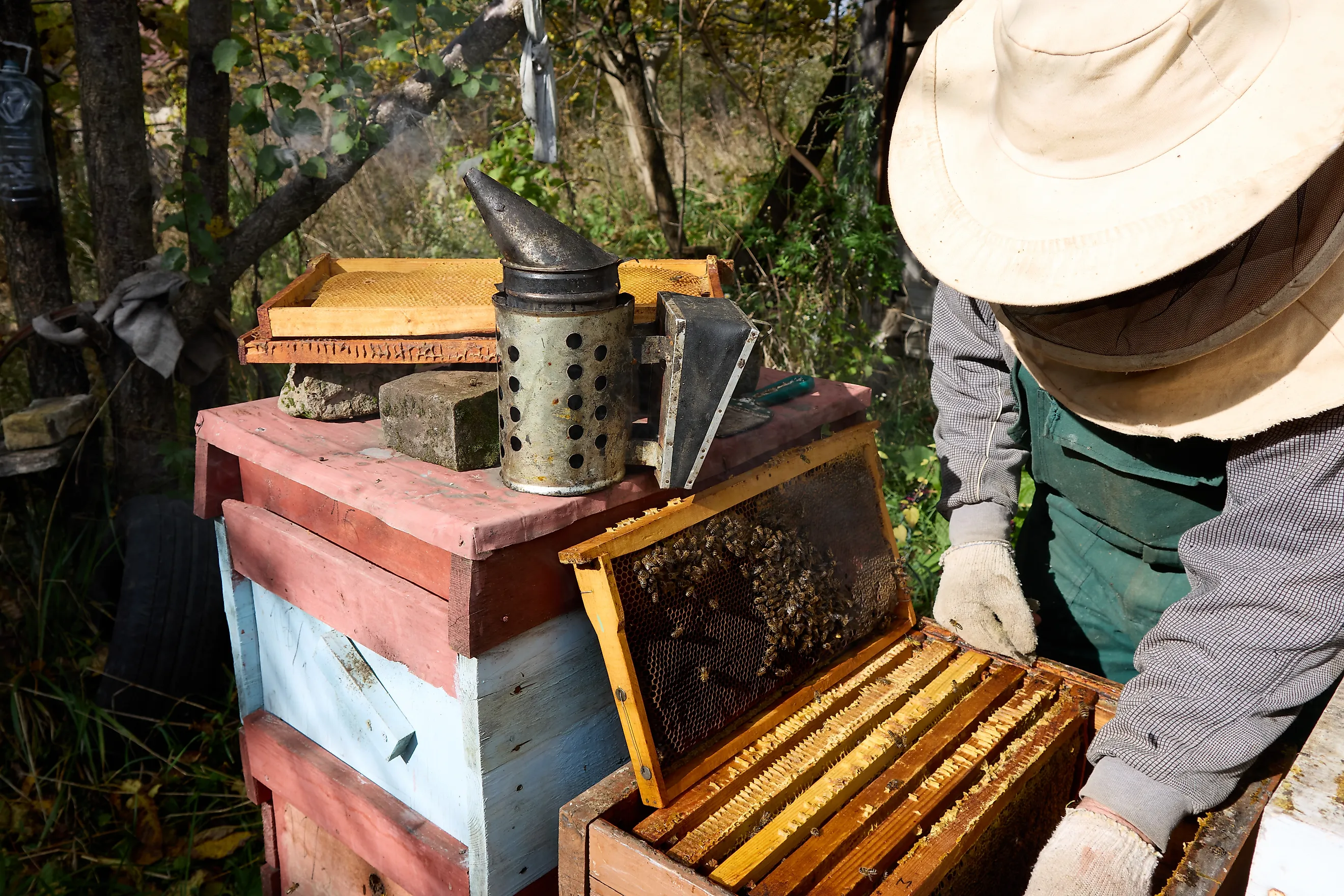
American beekeepers just had their worst year on record. US honey production fell 14 percent in 2025 to 116 million pounds, the lowest annual total since the USDA began keeping count in 1939, as varroa mite die-offs tore through commercial operations across the Dakotas, the Plains, and Florida. The 2.41 million colonies that survived to make honey averaged just 48 pounds each. Price was the only bright spot: it jumped 27 percent to $3.05 a pound, lifting the crop's value to $352.9 million, with pollination contracts adding another $224.7 million. North Dakota took the top spot again, its 23rd straight year in front and unbroken since 2003, though even its crop ranked among the state's smallest in years. The ten states below are the largest producers by 2025 volume, per USDA National Agricultural Statistics Service (NASS) data released March 13, 2026; the table at the end covers the top 20.
1. North Dakota (30.82 million pounds)

One pound in every four of America's honey came from North Dakota in 2025. The state pulled in 30.82 million pounds, nearly three times the next-largest crop, from 460,000 colonies averaging 67 pounds each. That was worth $58.3 million, the highest haul of any state, even though North Dakota's $1.89-per-pound average was the lowest price in the country, a reflection of the commercial-wholesale market that dominates the state.
The lead is no fluke. The Prairie Pothole Region across the Dakotas and eastern Montana is one of the best honey bee forage environments on Earth, where sweet clover, alfalfa, sunflower, and canola bloom in sequence from May through September. North Dakota has finished first every year since 2003, with no real challenger in sight. Its 2025 crop was among the smallest the state has logged in years, dragged down by the same varroa die-offs that battered the rest of the industry.
2. California (11.03 million pounds)

California is the country's biggest honey consumer and its second-biggest producer. Its 11.03 million pounds in 2025 came from 315,000 colonies at just 35 pounds each, the third-lowest yield in the top ten, for a crop worth $28.3 million at $2.57 a pound. Production has held fairly steady through the state's recurring droughts, fed by sage, eucalyptus, manzanita, citrus, and avocado blossom for the colonies that stay in state year-round.
The real story is almonds. Central Valley growers need roughly 2.4 million hives for the February-March bloom, about three-quarters of all the managed honey bee colonies in the country. California keeps only 500,000 to 600,000 of its own. The rest roll in by semi-truck from North Dakota, Montana, Minnesota, and South Dakota for what the industry calls, without exaggeration, the largest paid pollination event on Earth.
3. Montana (10.46 million pounds)
While most of the country's hives were collapsing, Montana's were booming. The state was one of the few to grow its crop in 2025, turning out 10.46 million pounds from 123,000 colonies. Its bees averaged 85 pounds each, the best yield of any top-ten state and bettered nationally only by Mississippi's small but productive operations at 89 pounds. The $22.8 million crop pushed Montana past South Dakota into third place nationally for the first time in years. Montana's honey output has more than doubled over four decades, riding the same Prairie Pothole forage that powers the Dakotas.
Operations here run big. A handful of commercial beekeepers work upward of 30,000 hives across leased land statewide, and for the largest, pollination contracts bring in $6 million or more a year on top of honey. The annual circuit hauls hives to California's almond orchards in February, Washington's apple and cherry orchards in April, and Wisconsin's cranberry bogs in June.
4. South Dakota (8.20 million pounds)

South Dakota's beekeepers watched more than a third of their crop vanish in 2025. Production fell 38 percent from 2024 to 8.20 million pounds, the steepest one-year drop among the top ten and enough to cost the state its third-place rank to Montana. The crop came from 205,000 colonies at 40 pounds each and $2.44 a pound, worth $20.0 million. The state's Department of Agriculture blamed a one-two punch: extended summer drought across western South Dakota and severe varroa losses through the autumn.
Most South Dakota honey is the alfalfa-sweet clover blend typical of Northern Plains prairie. The state's roughly 200 commercial operations are a major winter launch point for the almond-pollination convoys headed to California. The 2025 collapse hit yields harder than hive counts: operators held on to their colonies, but the bees inside simply weren't filling the combs.
5. Minnesota (5.65 million pounds)
Inside a brick building on the University of Minnesota's St. Paul campus, scientists have spent more than a century breeding bees that fight back. The U of M Bee Lab, founded in 1918, is one of the oldest and most active apiculture research centers in the country, known internationally for breeding hygienic stock: honey bees selected for their knack at detecting and tearing open diseased or mite-infested brood before an infestation spreads. It is one of the most promising long-term weapons the industry has against Varroa destructor.
Minnesota itself produced 5.65 million pounds in 2025 from 113,000 colonies, averaging 50 pounds each at $2.38 a pound, a $13.4 million crop. The state shares the Upper Midwest farmland that drives the Dakotas, but heavier forest cover and more mixed farming give its honey a more varied profile than the prairie monoculture. Wild basswood, blooming in July, adds a note many connoisseurs prize over commodity clover.
6. Michigan (3.74 million pounds)
Michigan honey tastes like an orchard because Michigan's bees mostly work the orchards. The state produced 3.74 million pounds in 2025 from 89,000 colonies at 42 pounds each and $3.27 a pound, a $12.2 million crop. That premium price reflects a heavier share of direct retail and specialty sales than the big Plains states ever see. The varietals track specific blooms: cherry honey from the Traverse City region, apple honey from the Lower Peninsula orchards, and blueberry honey from the western fruit belt.
Michigan beekeepers earn about a third of their income from pollination and the rest from honey and hive products such as beeswax, pollen, and propolis. Pollination season runs late April into early July, more than twice as long as California's almond window, because the state's fruit growers bloom in sequence rather than all at once.
7. Florida (3.62 million pounds)
Most of Florida's honey isn't really made in Florida. The state's 3.62 million pounds in 2025 came from 113,000 colonies at just 32 pounds each, the lowest yield in the top ten, and that low number is the whole point: Florida's mild winters make it a prime overwintering ground for commercial hives that produce most of their honey while parked elsewhere over the summer. The crop's $14.2 million value, padded by Florida's $3.94 retail average, understates how central the state actually is to the industry.
The honey Florida does make comes mostly from orange blossom, a single-floral varietal that fetches premium prices, plus tupelo, palmetto, gallberry, and Brazilian pepper. Citrus acreage has shrunk sharply over the past decade as huanglongbing, or citrus greening disease, has spread, taking a deep bite out of the orange blossom crop. Florida is also America's bee nursery: packages and queens ship north by the truckload every spring to restock colonies that died over the winter.
8. Louisiana (3.29 million pounds)
Louisiana's signature honey comes from a tree nobody wanted. The Chinese tallow, an aggressive invasive that has colonized the Gulf Coast, is the state's great summer nectar source, and Louisiana is effectively the only place in the country that bottles tallow honey at scale: a pale, mild honey with a faint twang that some producers market as a Cajun taste. The state's other crops run to willow, white clover, and the goldenrod and aster that close out the fall.
Louisiana's 2025 total was 3.29 million pounds from 62,000 colonies, averaging 53 pounds each at $2.47 a pound, $8.1 million in all. The heart of the industry is the Atchafalaya Basin, the largest river swamp in the country, where beekeepers also draw a genuine tupelo honey from the water tupelo of its cypress swamps, a different tree from the prized Ogeechee tupelo behind the famous honey of the Florida Panhandle. Beyond the basin, the hives work cotton and soybean across the Mississippi and Red River floodplains.
9. Idaho (3.02 million pounds)

While the rest of the country's bees were dying, Idaho's were quietly climbing. The state leapt from 13th to 9th in 2025, producing 3.02 million pounds, up about 20 percent year over year while almost everywhere else fell. That crop came from 104,000 colonies at just 29 pounds each, the second-lowest yield in the top ten, at $2.07 a pound, worth $6.2 million. The mix of a high colony count and a low per-colony yield is the tell: Idaho is a recovery ward, not a primary production state.
Many of the colonies counted in Idaho belong to commercial outfits that park their hives there for queen breeding, colony recovery, or summer rest between pollination contracts in California, Washington, and Oregon. The honey Idaho does make comes mostly from clover, alfalfa, and wildflower forage across the Snake River Plain and the high-desert ranges of the south.
10. New York (2.91 million pounds)
New York beekeepers got $5.14 a pound for their 2025 honey. North Dakota's commercial operations averaged $1.89. That gap captures the two opposite poles of the American beekeeping economy. New York made just 2.91 million pounds from 52,000 colonies, a modest total next to the Plains states. But a 56-pound average yield and a retail-heavy market lifted the crop's value to $15.0 million, the fifth-most valuable honey crop in the country despite ranking tenth by volume.
New York honey comes from clover, alfalfa, basswood, and the wildflower forage of the Finger Lakes, the Hudson Valley, and the Adirondack foothills. Buckwheat honey, dark and strongly flavored and once a New York signature, has staged a niche comeback over the past decade. The state's beekeepers also pollinate apple, blueberry, and cucurbit growers across the western and central counties.
Why North Dakota Dominates
The Prairie Pothole country that grows North Dakota's honey also makes the Great Plains the command center of America's migratory beekeeping economy. Commercial keepers hold their hives in the Dakotas, Montana, and Minnesota through the summer to make honey, then load them onto semis in late autumn and ship them to milder states (Texas, Florida, California) for the winter. The biggest operations move 16,000 to 30,000 hives in a single yearly loop, crisscrossing the country chasing blooms.
The engine driving all of it is California almond pollination. The state's almond acreage roughly tripled between 2000 and 2024, but its local hive population never kept pace, leaving a gap that out-of-state colonies fill. Almond pollination contracts run $180 to $220 per hive for the three-to-four-week bloom, and the largest operations clear $3 million to $6 million a year on pollination alone. Pollination now out-earns honey for many beekeepers: $224.7 million in 2025 pollination income against $352.9 million in honey value, with most of that pollination money concentrated in a small subset of large operations.
The squeeze is biological as much as financial. Varroa destructor mites drove colony deaths sharply higher through 2024 and 2025; NASS logged a 7 percent drop in honey-producing colonies between the two years, and Apiary Inspectors of America survey data put annual losses above 50 percent for many commercial outfits. Spending on varroa control jumped 34 percent in 2025 to $22.2 million nationally, the biggest single-line cost increase anywhere in the industry. Plains drought, pesticide exposure, climate swings, and habitat lost to row-crop expansion all pile on top of the underlying mite pressure.
The Top 20 Honey-Producing States in 2025
Here are the top 20 states by 2025 honey production, with colony counts, yields, and total value, from the USDA NASS data released in March 2026. USDA publishes individual estimates only for these 20 states; the rest are lumped together as "Other States," because releasing single-operation data would breach confidentiality rules.
| Rank | State | 2025 Production (1,000 lbs) | Colonies (1,000) | Yield (lbs/colony) | Value ($1,000) |
|---|---|---|---|---|---|
| 1 | North Dakota | 30,820 | 460 | 67 | 58,250 |
| 2 | California | 11,025 | 315 | 35 | 28,334 |
| 3 | Montana | 10,455 | 123 | 85 | 22,792 |
| 4 | South Dakota | 8,200 | 205 | 40 | 20,008 |
| 5 | Minnesota | 5,650 | 113 | 50 | 13,447 |
| 6 | Michigan | 3,738 | 89 | 42 | 12,223 |
| 7 | Florida | 3,616 | 113 | 32 | 14,247 |
| 8 | Louisiana | 3,286 | 62 | 53 | 8,116 |
| 9 | Idaho | 3,016 | 104 | 29 | 6,243 |
| 10 | New York | 2,912 | 52 | 56 | 14,968 |
| 11 | Oregon | 2,349 | 87 | 27 | 4,909 |
| 12 | Mississippi | 2,225 | 25 | 89 | 5,162 |
| 13 | Texas | 2,160 | 72 | 30 | 8,446 |
| 14 | Georgia | 2,144 | 67 | 32 | 7,890 |
| 15 | Iowa | 2,108 | 34 | 62 | 11,446 |
| 16 | Washington | 2,046 | 66 | 31 | 8,921 |
| 17 | Wisconsin | 1,500 | 50 | 30 | 6,780 |
| 18 | Pennsylvania | 1,425 | 25 | 57 | 6,170 |
| 19 | Ohio | 765 | 17 | 45 | 4,934 |
| 20 | North Carolina | 672 | 16 | 42 | 5,369 |