9 Best Towns In Italy For Retirees
Italy’s best retirement towns combine the country’s most appealing features with the services retirees depend on most. Walkable historic centers make it easier to reach markets, cafés, pharmacies, and public squares without a car. Nearby hospitals and access to the Servizio Sanitario Nazionale add long-term security, and train connections keep larger cities within reach for specialist appointments or visiting family.
These towns stretch from the Alpine north to Calabria’s southern coast. Each one pairs Italy’s scenery, food, architecture, and cultural depth with the practical infrastructure that supports a comfortable retirement year-round.
Ostuni, Puglia

Ostuni is one of Puglia's most practical retirement choices, with walkable neighborhoods, dependable medical facilities, and warm Adriatic weather throughout much of the year. About 29,800 people live in this town, including more than 15,700 over age 50.
Its whitewashed medieval center, nicknamed La Città Bianca, has cafés, grocery shops, pharmacies, and small piazzas within easy walking distance, and the Adriatic coast lies only minutes downhill by car.
RSA e Centro Diurno Mediterranea, run by Cooperativa Medihospes, combines residential support, rehabilitation, Alzheimer's memory programs, and daytime activities that help older residents stay socially active. Ospedale di Ostuni, part of the ASL Brindisi network, covers geriatrics, neurology, and cardiology, with more advanced treatment available in Brindisi about 35 to 40 minutes away.
Narrow stone lanes lead uphill to the Ostuni Cathedral, known for its rare 24-ray rose window and late Gothic façade. Nearby, Dentice di Frasso Castle in Carovigno hosts exhibitions and cultural events, and Alberobello's Rione Monti is under 50 minutes away for day trips.
Monthly living costs average about €1,230 ($1,430), lower than much of northern Italy. Seasonal temperatures usually stay between 41 and 84 degrees Fahrenheit, with warm summers and cool winters.
Cefalù, Sicily

Cefalù is a comfortable retirement base on Sicily's northern coast. It features compact streets, dependable medical care, and living costs well below much of mainland Italy. Of the town's 13,800 residents, 7,228 are over 50 years old. Fondazione Istituto G. Giglio, just outside the town center, is the area's main hospital, with inpatient and outpatient treatment across multiple specialties. For more complex care, larger facilities in Palermo are about an hour to the west.
Senior support is also available through the Casa di riposo Opera Pia "Salvatore Genchi Collotti," a residential community near the waterfront with assisted living, medical supervision, and social programs for older adults. Monthly living costs average about €1,121 ($1,304).
Beyond healthcare and affordability, Cefalù's compact layout makes day-to-day life manageable without needing a car. The Lungomare Cefalù is a flat waterfront promenade suited for regular walks, with no steep hills or heavy traffic. The Cathedral of Cefalù, a UNESCO World Heritage Site dating to the 12th century, has Byzantine mosaics regarded as among the finest Norman-Arab works in Sicily.
Above the center, the ruins of the Castello di Cefalù look out over the coastline and surrounding cliffs. The climate generally ranges from 50 to 89 degrees Fahrenheit, with warm summers and mild winters.
Orvieto, Umbria

Via del Duomo street with souvenir shops in Orvieto, Umbria.
Orvieto, in central Italy, offers retirees pedestrian-friendly streets, dependable medical access, and direct rail to Rome. The hilltop city has about 19,000 residents, including 10,464 over the age of 50. As part of the international Cittaslow movement, it emphasizes a slower-paced lifestyle.
Its largely pedestrian historic center has cafés, pharmacies, wine bars, and weekly markets within easy walking distance. A funicular links the train station with the hilltop center. Rome is about 90 minutes away by train, making larger-city services easy to reach without daily urban traffic.
Residenza Protetta Casa di Riposo San Giorgio is an assisted living residence for adults over 65, with physiotherapy, meals, recreational activities, and personalized plans. Casa Natività di Maria in nearby Morrano Vecchio has additional residential support with daily medical assistance and social programs. Ospedale di Orvieto handles general and specialist inpatient services. The hospital in Terni, about 40 minutes away, has more advanced treatment.
Average monthly living costs are approximately €1,055 ($1,226). Seasonal temperatures usually stay between 34 and 86 degrees Fahrenheit.
Sulmona, Abruzzo

A compact historic center, mountain scenery, and established senior programs make Sulmona one of central Italy's more affordable retirement options. The town is home to over 21,600 residents, including more than 12,100 people over 50.
Life centers on Corso Ovidio, a main street lined with cafés, shops, and Piazza Garibaldi, where a 13th-century aqueduct frames the square. Palazzo Mazara supports self-sufficient and partially self-sufficient older adults with nursing support, physiotherapy, a gym, reading rooms, dining facilities, and shared social spaces.
Residents also rely on Ospedale Santissima Annunziata di Sulmona for emergency care, surgery, general medicine, and outpatient care. For more advanced specialist treatment, larger hospitals in L'Aquila are about 50 minutes away.
Sulmona's confetti tradition, sugar-coated almonds arranged into decorative bouquets, is part of everyday town life and is documented at the Museo Pelino dell'Arte e della Tecnologia Confettiera. Villa Comunale has shaded walking paths and benches popular during warmer months, and nearby Parco Nazionale della Maiella opens into marked trails and mountain scenery. Seasonal temperatures typically range from 34 to 85 degrees Fahrenheit, with colder winters than many coastal Italian towns. Average monthly living costs are around €1,106 ($1,286).
Desenzano del Garda, Lombardy

Desenzano combines lakeside living with walkable streets, strong regional transport, and dependable medical access on the southern shore of Lake Garda. The wide, flat promenade has cafés, pharmacies, covered markets, and ferry connections within easy reach. Train links to Brescia and Verona reduce dependence on a car for regional travel.
The Fondazione S. Angela Merici Onlus has residential nursing, outpatient care, day programs, and home assistance for retirees whose needs change over time. Ospedale di Desenzano del Garda covers cardiology, emergency medicine, surgery, and general medicine, with larger hospitals in Brescia available for more advanced treatment.
More than 14,800 of Desenzano’s 29,300 residents are over 50, giving the Lake Garda town one of the area’s more retiree-oriented populations. Near the waterfront, the Villa Romana e Antiquarium preserves some of northern Italy's finest Roman polychrome mosaics. Sirmione, known for its medieval castle and lakeside thermal spa, is about 15 minutes away for day trips. Monthly living costs average about €1,756 ($2,039), and average temperatures usually stay between 31 and 85 degrees Fahrenheit.
Monopoli, Puglia

Monopoli is one of Puglia's more active retirement towns, with a walkable seaside center, established senior care, and a year-round harbor community. Around 23,990 of Monopoli's 47,600 residents are 50 years and older. Life centers on the old harbor and surrounding lanes, where cafés, pharmacies, fish markets, and the waterfront promenade stay active throughout the day.
RSA Stella Maris is a nursing home and day center that caters to non-self-sufficient seniors, including residents with Alzheimer's disease and other forms of dementia. Alongside full-time residential assistance, Stella Maris has outpatient services, structured day programs, and home assistance for retirees who prefer part-time or in-home care.
Ospedale San Giacomo includes emergency medicine, cardiology, neurology, surgery, orthopedics, and stroke care. A new 299-bed regional hospital serving the Monopoli-Fasano area is also expanding specialist medical access, and larger facilities in Bari are about 40 minutes away for more complex treatment.
Average monthly living costs are approximately €1,201 ($1,400). The coastal climate is typically between 44 and 84 degrees Fahrenheit.
Gorizia, Friuli-Venezia Giulia

In northern Italy, Gorizia combines reliable healthcare with a quieter cross-border setting near Slovenia. The town is home to over 33,600 residents, including 18,031 people over the age of 50. Nearby, the Collio hills are known for excellent white wines, and Oslavia has earned global recognition for its orange Ribolla Gialla.
Casa di Riposo Villa San Giusto dei Fatebenefratelli has nursing support, physiotherapy, gardens, recreational programs, and specialized dementia care for seniors with greater needs. San Giovanni di Dio Hospital covers emergency, cardiology, oncology, surgery, and specialist outpatient care. For more advanced treatment, the hospital in Trieste is about 45 minutes away and serves as one of the region's main referral centers.
Castello di Gorizia overlooks the city with its medieval borgo and World War I museum. Piazza Transalpina, once divided by the Iron Curtain, now connects Italy and Slovenia through a shared public square. Average monthly living costs are about €1,341 ($1,562) and seasonal temperatures usually range from 32 and 84 degrees Fahrenheit.
Isernia, Molise

Isernia combines low living costs, walkable streets, and dependable senior programs in the heart of Southern Italy’s Molise region. Average monthly living costs are approximately €930 ($1,083), among the lowest in central and southern Italy. The town has over 20,500 residents, including 10,242 over age 50. Life centers around Piazza Giosuè Carducci and Corso Marcelli, where cafés, bakeries, pharmacies, and small shops make daily errands manageable on foot.
Casa di Riposo e Centro Diurno Maria Gargani works as both a residential facility and daytime senior center through a partnership between Cooperativa Futura di Isernia and the Congregazione delle Suore Apostole del Sacro Cuore. Services include physiotherapy, nursing, psychological assistance, and social programs that help older residents stay active.
Villa Le Ginestre RSA, outside the center, has additional nursing and rehabilitation services. Hospital Ferdinando Veneziale di Isernia, part of the ASREM regional network, covers emergency medicine, surgery, internal medicine, and outpatient care. For more complex specialist care, the main regional hospital in Campobasso is about 50 minutes away.
The Fontana Fraterna, a 13th-century fountain assembled from Roman stone fragments, stands in Piazza Giosuè Carducci at the center of town. Nearby, the Cattedrale di San Pietro Apostolo rises above the remains of an ancient Roman temple and includes underground crypts tied to the town's earliest history. Seasonal temperatures generally stay between 34 and 86 degrees Fahrenheit.
Tropea, Calabria

Lower housing costs, coastal scenery, and established senior programs make Tropea another one of southern Italy's appealing retirement options. Calabria is one of Italy's least expensive regions and is eligible for the country's 7 percent flat-tax incentive on qualifying foreign pension income. Average monthly living costs are approximately €1,100 ($1,282).
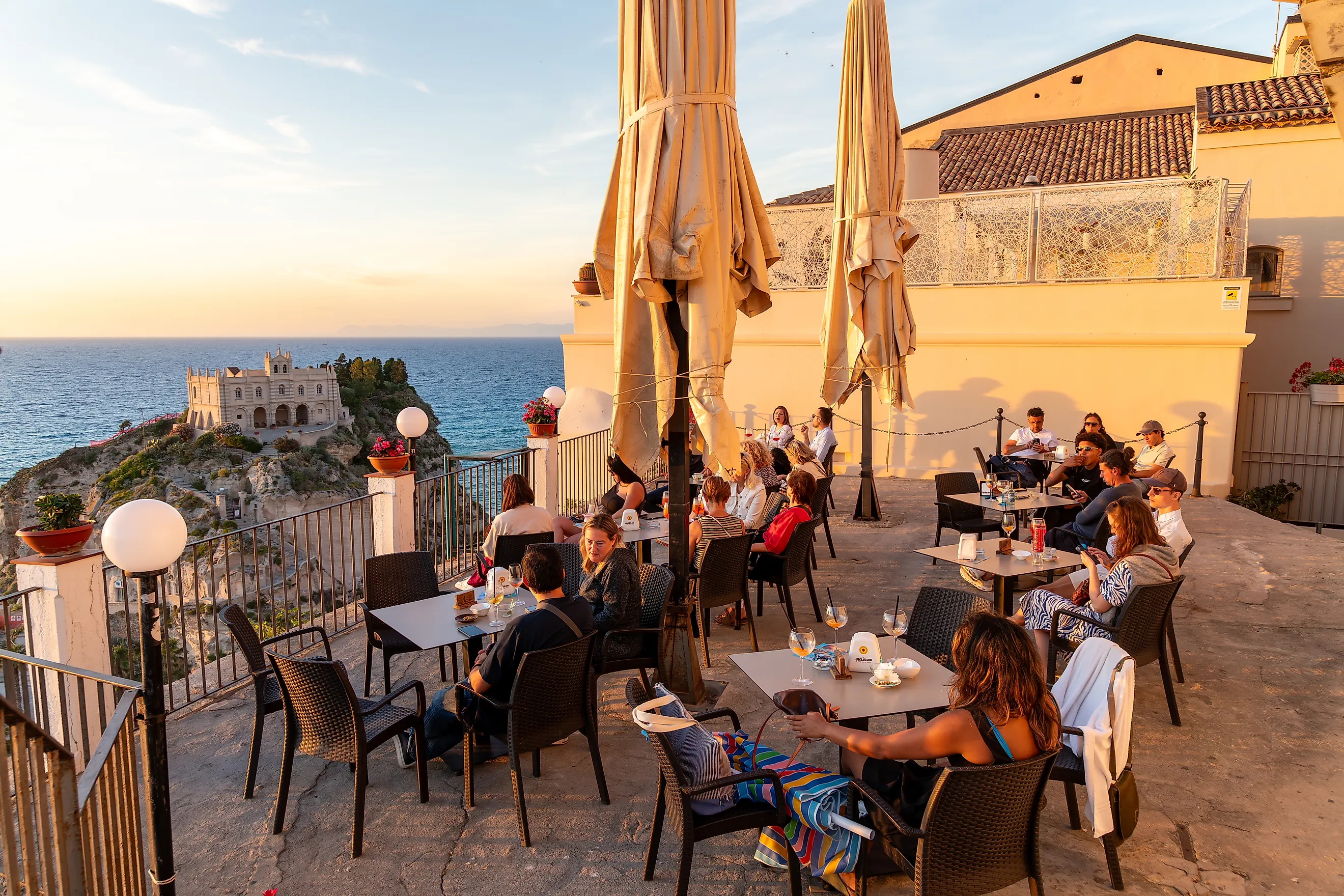
On a clifftop above the Tyrrhenian Sea, the town has about 5,600 residents, including approximately 2,900 over the age of 50. Its narrow historic center has cafés, restaurants, markets, pharmacies, and small piazzas within walking distance.
The Presidio Ospedaliero di Tropea covers emergency medicine, surgery, internal medicine, and outpatient care. Larger hospitals in Vibo Valentia are about 40 minutes away for more advanced treatment. Residential care options include Casa di Riposo "Don Mottola," a private senior residence with nursing support, physiotherapy, rehabilitation programs, gardens, and recreational activities for both self-sufficient and partially dependent residents.
The Santuario di Santa Maria dell'Isola di Tropea rises above the sea on its own rocky outcrop and connects to the center by a walking path. Nearby, Capo Vaticano has coastal walking routes and panoramic views toward the Aeolian Islands and Stromboli volcano. The climate stays mild year-round, with temperatures generally ranging from 47 to 81 degrees Fahrenheit.
Italy’s Most Livable Retirement Towns
Retirement in Italy depends on more than scenery alone. Walkable town centers, reliable healthcare, manageable living costs, and regional transportation all shape how practical life stays over the long term. The whitewashed lanes of Ostuni and Monopoli and the coastal cliffs of Tropea all balance daily convenience with historic character and a slower pace of life. In places like Orvieto and Gorizia, retirees can handle errands on foot, reach larger cities when needed, and access healthcare and senior support systems that make year-round living more manageable.