6 Must-See Historic Forts In Hawaii
Hawaiʻi's historic forts reflect the islands' strategic position in the Pacific through more than a century of foreign military interest. The earliest, Russian Fort Elizabeth on Kauaʻi, dates to 1816 and predates U.S. coastal defenses by nearly a century. After annexation in 1898, the U.S. Army built a ring of coastal artillery posts around Oʻahu: Fort Ruger embedded batteries within Diamond Head's volcanic crater, Fort Kamehameha guarded the entrance to Pearl Harbor, and Fort Weaver covered the harbor's opposite flank. Together, these sites show how military planners adapted to Hawaiʻi's terrain to control access to the Pacific, and many remain visible in parks, along hiking trails, and within museum grounds.
Fort DeRussy (Oʻahu)

Fort DeRussy sits on Waikiki Beach in Honolulu and was built beginning in 1908 to guard the southern shore of Oʻahu. Named for Brigadier General Rene Edward De Russy, the post remained active through both World Wars. Battery Randolph, completed in 1911 with walls 12 feet thick, still stands at the center of the site and now houses the U.S. Army Museum of Hawaiʻi, where exhibits trace military activity from the Hawaiian Kingdom era through modern operations. The surrounding grounds include roughly 1,400 feet of Waikiki beachfront and an ADA-accessible public park.
Fort Ruger (Oʻahu)

The Diamond Head Military Reservation was established by executive order in 1904 and designated Fort Ruger in 1909, after Major General Thomas H. Ruger. It was the first U.S. Army coastal defense post in Hawaiʻi. Engineers carved tunnels and installed batteries directly into the crater's volcanic rock, creating a layered defense system with concealed firing positions. Battery Harlow's 12-inch mortars could reach about eight miles offshore, and later installations including Battery 407's 8-inch guns extended the range further. Today, hikers on the Diamond Head Summit Trail, within Diamond Head State Monument, can explore remaining concrete bunkers and observation points overlooking the coastline.
Fort Kamehameha (Oʻahu)

Fort Kamehameha was established at the entrance to Pearl Harbor in 1909, part of the U.S. Army's plan to encircle Oʻahu in a "ring of steel" with batteries and artillery posts at key locations around the island. Battery Hawkins, Battery Closson, and Battery Selfridge made up the core of its coastal defense. Fort Kamehameha was merged with Hickam Field in 1955, and the site now sits within Joint Base Pearl Harbor-Hickam. Thirty-three original officer and NCO homes remain on the grounds and are listed on the National Register of Historic Places. Passengers flying in and out of Daniel K. Inouye International Airport can catch a glimpse of the fort and its historic homes from their windows.
Fort Weaver (Oʻahu)

Fort Weaver sits on Iroquois Point, the peninsula on the western side of the entrance to Pearl Harbor, opposite Fort Kamehameha. Established as the Iroquois Point Military Reservation around 1920 and renamed Fort Weaver in 1922 after Major General Erasmus M. Weaver, the post was part of the same coastal artillery system as Fort Kamehameha. Its armament included 12-inch seacoast mortars and 3-inch rapid-fire guns intended to engage ships and fast torpedo boats approaching the harbor entrance. A narrow-gauge military railroad linked the batteries and the ammunition magazines. The fort later hosted Nike-Ajax anti-aircraft missile batteries during the Cold War. While the area now sits near industrial and recreational zones, remnants of the fort's defensive structures are still visible from publicly accessible surrounding areas.
Russian Fort Elizabeth (Kauaʻi)

Russian Fort Elizabeth, in the Waimea region of Kauaʻi, is a rare example of European-style military architecture in Hawaiʻi. Construction of the star-shaped bastioned fort began in 1816 under Georg Anton Schäffer on behalf of the Russian-American Company, a Russian state-chartered trading and colonial enterprise that operated the territory of Russian America in Alaska. Schäffer aimed to establish a Russian foothold in the islands through an alliance with the Kauaʻi chief Kaumualiʻi, but the venture was disavowed by the Russian government and Schäffer was expelled in 1817. Kaumualiʻi's forces then took over the fort, which they renamed Pāʻulaʻula ("red enclosure") and used until around 1864. Much of the stonework was sourced from a nearby heiau (sacred Hawaiian worship site), and the outer walls remain intact enough that visitors can walk the perimeter and view interior sections.
Fort Shafter (Oʻahu)

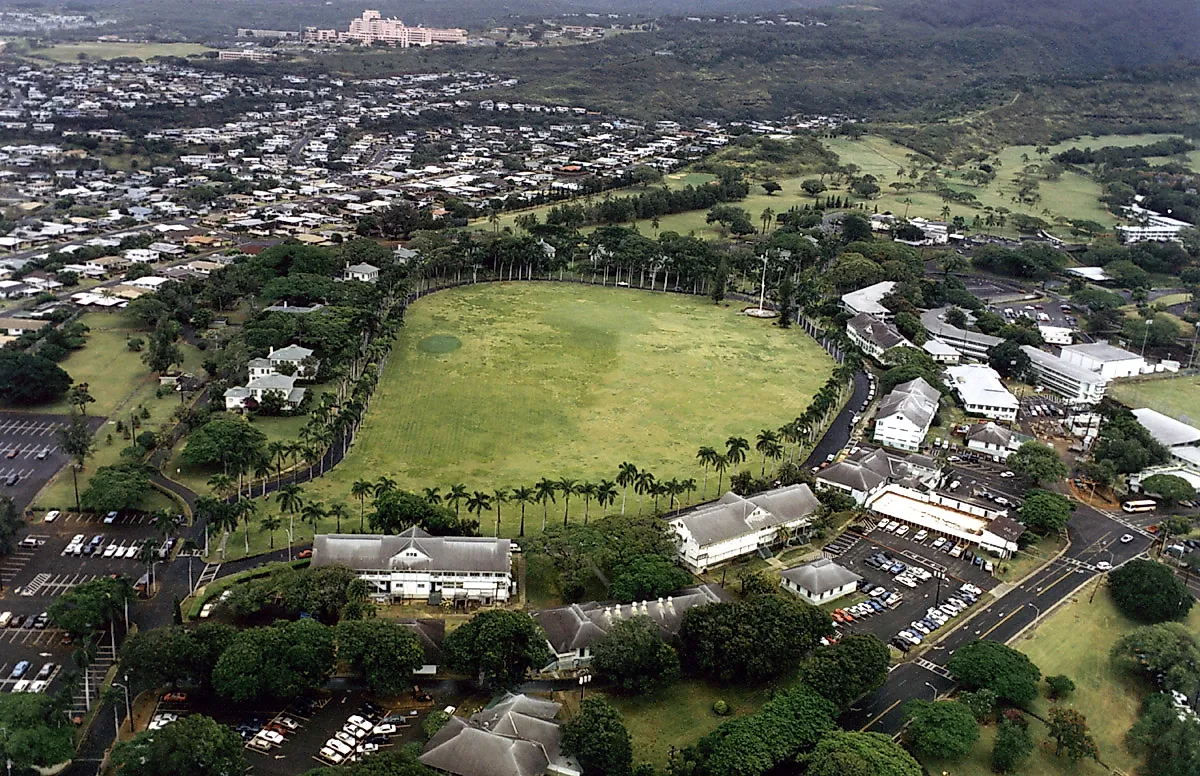
Fort Shafter, established in 1907, is often cited as the oldest permanent U.S. Army post on Oʻahu. Prior to its designation as a military installation, the land was part of the Damon Tract and was used for cattle grazing, dairy production, and fishponds. The post, located inland from Honolulu Harbor, served as a military coordination site rather than housing large artillery batteries. In 1921, Fort Shafter became the headquarters of the Hawaiian Department and has served as the senior Army headquarters in the islands since then. It is now the headquarters of U.S. Army Pacific, with a population of more than 5,000 soldiers, civilian employees, and family members. While the installation remains active, portions are accessible to the public through visitor services and special events.
Exploring Hawaiʻi's History Through Its Forts
Hawaiʻi's historic forts illustrate how military planners adapted to the islands' geography to protect their strategic Pacific position. Some sites show how elevation shaped artillery design, others focused on harbor protection, and Russian Fort Elizabeth is a reminder that U.S. control was not the first foreign interest in the islands. Today, many of these locations have been incorporated into parks, trails, and public spaces, allowing visitors to explore these enduring markers of Hawaiʻi's past.