6 Most Idyllic Small Towns In The Great Lakes
The Great Lakes and their connected waterways hold some of the most dramatic freshwater scenery in the United States, and the small towns along these shores have built their tourism economies around that natural beauty. Apostle Islands sea caves in Wisconsin, Thousand Islands channels in New York, Sleeping Bear Dunes on Michigan's Leelanau Peninsula, Turnip Rock off the Thumb, and the Mackinac Bridge straits are all accessible from small waterfront towns that serve as gateways. These six towns anchor some of the best natural-beauty tourism on the Great Lakes.
Alexandria Bay, New York

Alexandria Bay sits on the St. Lawrence River in Jefferson County, about 20 miles downstream from Lake Ontario, at the heart of the Thousand Islands archipelago that stretches 50 miles along the US-Canada border. The village is the main tourism hub for the region, with boat tours running throughout the summer season to Boldt Castle on Heart Island, a 120-room Rhineland-style castle begun in 1900 by hotel magnate George Boldt and abandoned in 1904 after his wife's death. The castle's restoration has been ongoing since 1977.
A second boat tour destination, Singer Castle on Dark Island, is a fully-completed medieval-style stone castle built in 1905 by Sewing Machine Company president Frederick Gilbert Bourne. On the mainland, Scenic View Park offers free public access to the riverfront and one of the best views of the islands from shore. Uncle Sam Boat Tours and Clayton Island Tours both operate out of the village and cover the major islands, the castles, and the narrow international waterway. Year-round population sits under 1,100, but summer brings thousands of boaters and day visitors through the village.
Bayfield, Wisconsin

Bayfield sits on the Lake Superior shore in far northern Wisconsin, at the foot of the Bayfield Peninsula and directly opposite the Apostle Islands. With a year-round population of about 530, the village swells each summer as it serves as the mainland gateway to Apostle Islands National Lakeshore, a 21-island archipelago known for sandstone sea caves, ice caves in cold winters, and six historic lighthouses. Apostle Islands Cruises, operating out of the Bayfield city dock, runs narrated trips to the sea caves, Stockton Island, and lighthouse tours through the season.
The Madeline Island Ferry Line runs year-round service from Bayfield to La Pointe on Madeline Island, the largest of the Apostle Islands and the only one with permanent year-round residents. Ashore, Big Top Chautauqua stages summer concerts and plays in a 900-seat canvas tent on the slopes of Mount Ashwabay. Bayfield's apple-orchard country on the peninsula produces the annual Bayfield Apple Festival each October, one of the largest fall festivals in the upper Midwest.
Leland, Michigan

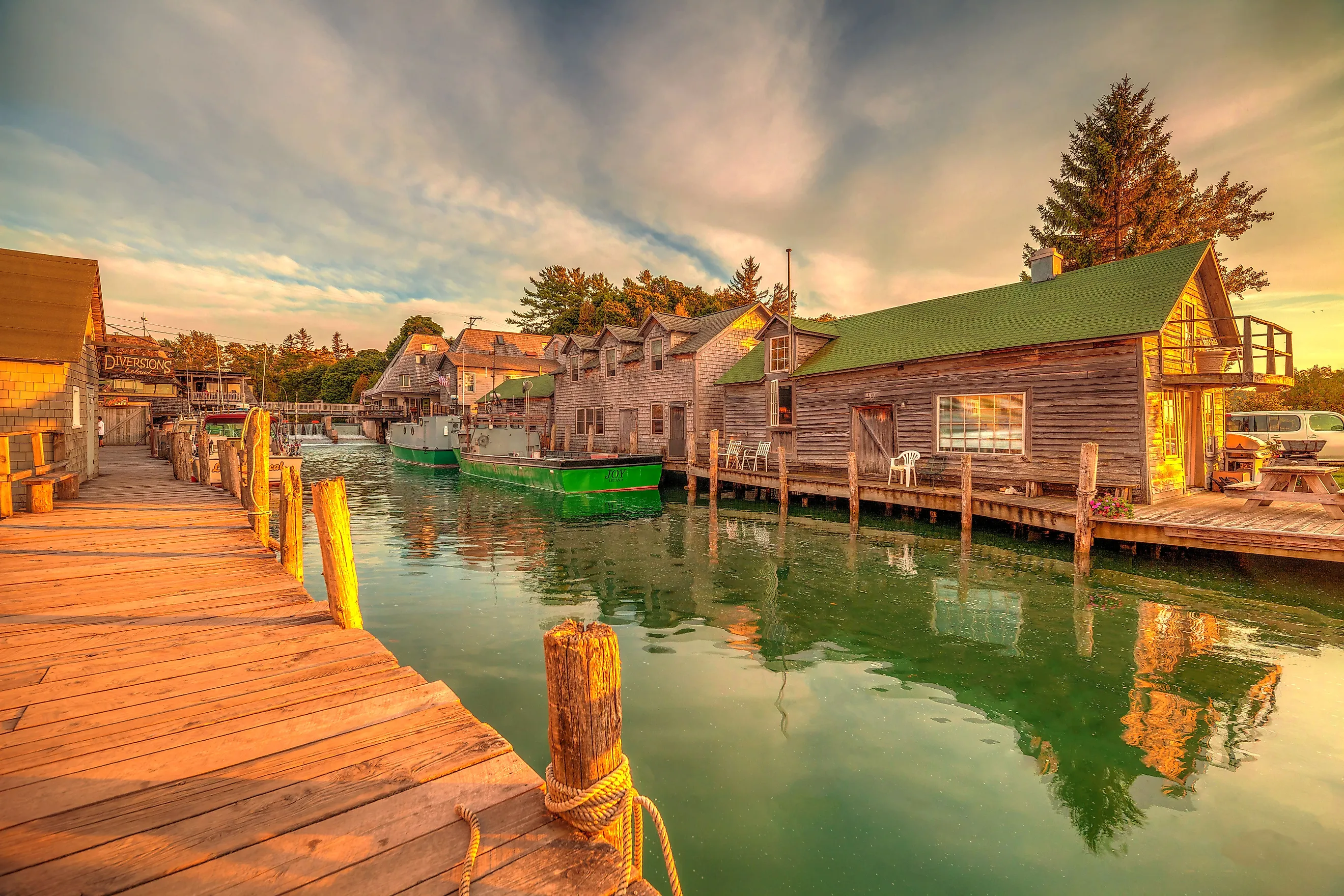
Leland, on Michigan's Leelanau Peninsula, occupies a narrow strip of land between Lake Michigan and Lake Leelanau. The village's Fishtown district, a cluster of weathered wooden fishing shanties along the Leland River, is one of the last surviving working commercial fishing villages on the Great Lakes. The shanties, some dating to the 1880s, now house shops, galleries, and small eateries alongside still-operating fish markets.
Ferry service from Leland runs to both North and South Manitou Islands, which together form part of Sleeping Bear Dunes National Lakeshore. On the mainland, Van's Beach sits just off the village, and the Old Art Building, a restored 1920s community hall, runs rotating exhibitions and classes. The Riverside Inn, dating to 1902, handles the dining side.
Mackinaw City, Michigan

Mackinaw City sits at the northern tip of Michigan's Lower Peninsula, where Lakes Michigan and Huron meet at the Straits of Mackinac. The 5-mile Mackinac Bridge, completed in 1957, connects the Lower and Upper Peninsulas and frames much of the town's waterfront identity. Ferries from Mackinaw City run to Mackinac Island, a nearly car-free resort island known for its Victorian-era architecture, the Grand Hotel, and horse-drawn carriage tours.
Historic Mill Creek Discovery Park, a reconstructed 18th-century British sawmill site, covers the area's colonial history. Colonial Michilimackinac, on the point just south of the bridge, is a reconstructed 18th-century French and British fort and fur-trading village. Two lighthouses, the 1869 McGulpin Point Lighthouse and the 1892 Old Mackinac Point Lighthouse, bracket the harbor.
Port Austin, Michigan

Port Austin sits at the tip of Michigan's Thumb on Lake Huron. The town has a year-round population just over 600 and serves as the main base for paddling tours to Turnip Rock, a small sea stack topped with trees that has become one of the most-photographed natural features on the Great Lakes. Kayak rentals run from town, and the paddle out to the rock is roughly 3.5 miles each way, though lake conditions can make the trip unsafe on rough days.
Port Crescent State Park, a short drive west, runs a designated dark-sky preserve and features some of the best remaining dune habitat on Saginaw Bay. The Port Austin Farmers Market, held Saturdays from May through October, is one of the largest in the Thumb. The annual Port Austin Fireworks over the harbor each July 3rd is a regional draw.
Traverse City, Michigan

Traverse City, at the head of Grand Traverse Bay on Lake Michigan, is the largest town in the region and the unofficial capital of Michigan's cherry industry. The town produces roughly a quarter of the country's tart cherries, and the National Cherry Festival each July draws more than 500,000 visitors over its eight-day run.
The Old Mission and Leelanau Peninsulas, which form the two arms of Grand Traverse Bay, hold more than 40 wineries between them, with growing conditions shaped by lake-effect climate moderation that allows riesling, chardonnay, and cooler-climate reds to ripen reliably. Sleeping Bear Dunes National Lakeshore, less than an hour west, is one of the country's largest freshwater dune systems. In town, the Great Lakes Children's Museum, the Music House Museum, and Clinch Park all work within a walkable footprint.
Six Small Towns Of The Great Lakes
The Great Lakes region holds the largest system of surface fresh water on the planet, and the small towns along its shores reflect the scale of that coastline. Whether the draw is a sea-cave paddle through the Apostle Islands from Bayfield, a boat tour to the Thousand Islands castles from Alexandria Bay, a ferry to the Manitou Islands from Leland, Turnip Rock off Port Austin, a bridge walk from Mackinaw City, or the cherry orchards and dunes around Traverse City, each of these six towns earns the stop.