The Trees That Survived Since The Age Of Dinosaurs
You don't need a time machine to see living members of plant lineages that shared Jurassic landscapes with dinosaurs such as Brachiosaurus. The ginkgo tree looming over the sidewalk belongs to a lineage whose fossil record stretches back more than 200 million years. Monkey puzzle trees have relatives in the Jurassic fossil record, and the Wollemi pine has a fossil history stretching back roughly 90 million years. Learn more about living plant lineages whose fossil relatives extend back to the age of dinosaurs, although the modern species evolved much later.
Ginkgo Trees

Ginkgo trees are among the oldest surviving tree species on the planet. The sole surviving species is Ginkgo biloba, with its distinctive, fan-shaped leaves that turn gold in autumn. It is often described as a "living fossil" because of its striking resemblance to ancient ginkgo fossils. Fossils of ginkgo leaves dating back more than 200 million years are almost identical to the leaves of ginkgo trees alive today.
You can see ginkgo trees growing in major cities all over the world, including New York, London, and Tokyo. They may look pretty, but female ginkgo trees smell notoriously bad (akin to human vomit) when their seeds fall in autumn. The odor comes from the seed's fleshy outer coat and may attract scavengers. Its prehistoric dispersers are unknown, although mammals, birds, and some dinosaurs have all been proposed.
Possible relatives of the ginkgo order occur in Permian rocks, while fossils assigned to the genus Ginkgo extend back roughly 190 million years to the Early Jurassic. These trees were there before the dinosaurs, during the time of the dinosaurs, and throughout the numerous extinctions and ice ages that would come before and after. The cells of these trees show remarkable longevity: studies have found that the vascular cambium of very old ginkgos can continue functioning without the signs of cellular senescence seen in other organisms.
Modern ginkgos haven't remained completely unchanged for hundreds of millions of years; like every living species, they have evolved. These are not literally the same trees, but they are remarkably similar to their ancestors of more than 200 million years ago. Their survival also owes a great deal to people. Ginkgos have been planted for centuries in Chinese temple gardens, and that long history of cultivation is a large part of why the lineage is still here at all.
The Wollemi Pine

In September 1994, a New South Wales parks field officer named David Noble rappelled down into a remote sandstone canyon in the Blue Mountains of New South Wales and found a stand of trees he did not recognize. He carried a piece of fallen foliage back with him to be identified.
The tree puzzled scientists because of its unusual appearance. It was tall and thin, with distinctive, almost fern-like leaves. The discovery was extraordinary because Wollemia represented a previously unknown living genus with close links to Cretaceous araucarian fossils. Pollen from the broader Wollemia and Agathis lineage disappears from Australia's recent fossil record roughly two million years ago. The species became known as the "dinosaur tree."
The Wollemi pine, Wollemia nobilis, has unusual "bubbly," chocolate-colored bark that vaguely resembles chocolate cereal. Its branches have a distinctive growth pattern, with long shoots carrying clusters of leaves rather than the broad, spreading structure associated with many trees.
Today, the Wollemi pine is naturally found only in a small area of Australia's Wollemi National Park. The location of these trees is kept secret to protect them from human disturbance and from pathogens that people could accidentally introduce on their boots. Wollemi pines have since been cultivated and planted in other parts of the world, including the United Kingdom, where they do well in botanic gardens and arboretums. Commercially propagated Wollemi pines are available to gardeners, but the species remains Critically Endangered in the wild, where the 2025 national recovery plan records only 45 mature individuals and 46 seedlings.
Monkey Puzzle Trees

The monkey puzzle tree (Araucaria araucana) is native to parts of Chile and Argentina. Stiff, overlapping leaves cover its branches and make the whole tree look a bit like an artificial Christmas tree. The name refers to the tree's sharp, densely packed branches and foliage, which would make it extremely difficult for a monkey, or almost any other animal, to climb. It also produces large seeds, usually described as tasting like something between a chestnut and a pine nut.
Chile protects the species as a natural monument. The Mapuche have harvested their seeds for generations, roasting the piñones whole or grinding them into flour. The tree is listed as endangered on the IUCN Red List. Historical logging, fire, and livestock grazing have all thinned the stands where it grows.
The monkey puzzle belongs to the Araucariaceae, a conifer family well represented in Late Triassic and Jurassic rocks. That does not mean the modern species itself is 200 million years old. It does mean that during the age of dinosaurs, members of this family grew across a far wider range than they do today.
Cycads

Cycads are gymnosperms rather than palms or flowering plants, whatever the resemblance suggests. Some stay close to the ground, while others build woody, tree-like trunks 10 feet tall or more.
The broader lineage of cycads has a fossil record stretching back more than 250 million years, with some of their earliest relatives appearing during the Permian Period. Cycads were widespread during parts of the Mesozoic and were eaten by at least some dinosaurs, although how much of a dinosaur's diet they made up remains uncertain. This is why the Jurassic Period is sometimes referred to as the "Age of Cycads." They survive in a wide range of environments, including rainforests and savannas.
The cycads living today are not exactly the same as the cycads of the Jurassic. Although the lineage is ancient, much of today's species diversity arose during a late-Cenozoic radiation beginning roughly 12 million years ago, and individual divergence estimates vary. Many cycad species are now endangered. Their germination is slow, their growth is slow, and they reproduce irregularly, which makes it difficult for populations to recover once they are threatened.
Redwoods

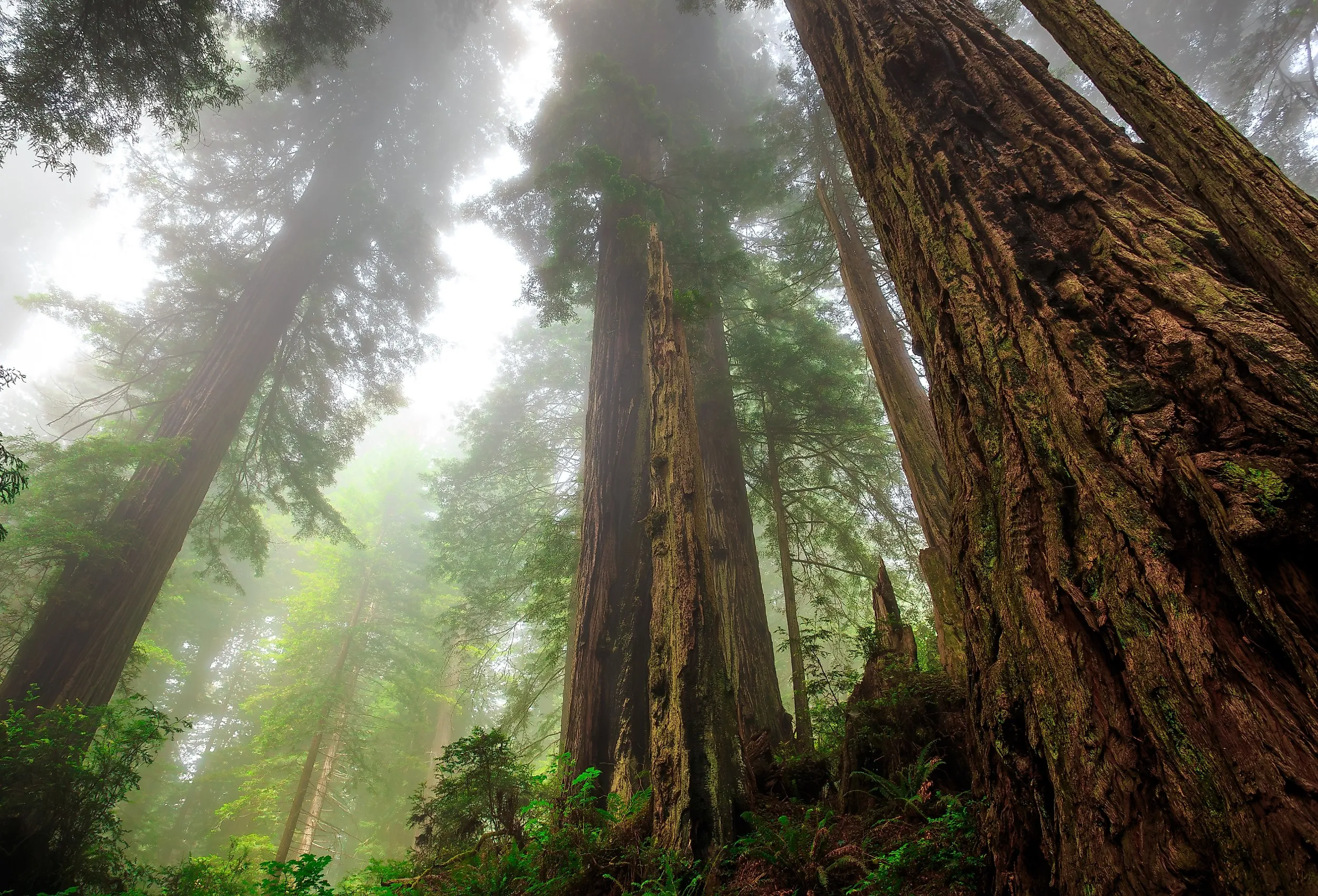
Redwoods are among the tallest and longest-lived trees on Earth. Some coast redwoods grow more than 350 feet tall and can live for around 2,000 years. Fossil relatives of today's coast redwoods were already growing during the Jurassic Period.
During the Jurassic and Cretaceous periods, redwood relatives were much more widespread than they are today. Fossils show that these trees once grew across parts of the Northern Hemisphere before their range gradually contracted as the climate changed.
Today, three closely related species make up the redwood subfamily: the coast redwood (Sequoia sempervirens), giant sequoia (Sequoiadendron giganteum), and dawn redwood (Metasequoia glyptostroboides). The coast redwood and giant sequoia are native to California, while the dawn redwood is native to China.
The dawn redwood was thought to be extinct and was known only from fossils until living trees turned up in China in the 1940s. A Japanese paleobotanist named the fossil genus Metasequoia in 1941. Two years later, a Chinese forester collected branches from an unfamiliar deciduous conifer in what is now Hubei Province, and by 1946, botanists had matched the living tree to the fossil genus. The species was formally described in 1948.
Tree Ferns
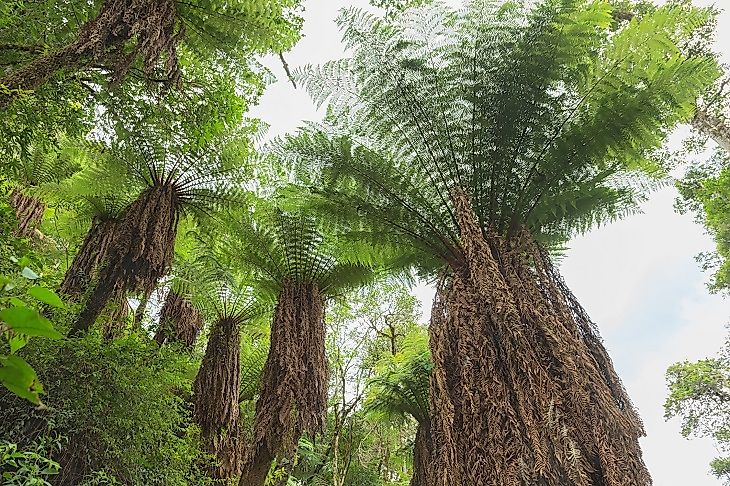
With tall trunks crowned by enormous, arching fronds, tree ferns look as though they belong in a prehistoric forest. Unlike flowering trees and conifers, they do not produce flowers, seeds, or cones. Instead, they reproduce through spores released from structures on the undersides of their fronds.
The tree fern order, Cyatheales, has an evolutionary history extending back roughly 200 million years to the Late Triassic and Early Jurassic periods. Fossils show that tree ferns were widespread during the Jurassic and Cretaceous, growing in forests across regions where dinosaurs also lived.
Modern tree ferns are found mainly in moist tropical and subtropical forests, particularly in the Southern Hemisphere. Some species grow more than 60 feet tall, although their trunks are upright rhizomes supported by masses of roots rather than the wood produced by conventional trees. Today's species are not unchanged survivors of the Jurassic, but they belong to a lineage that was already flourishing during the age of dinosaurs.
Why Did These Trees Survive When So Many Others Didn't?
There isn't a single answer as to why these trees survived when others didn't. Different species survived for different reasons, and scientists are still studying the evolutionary histories of these ancient groups.
Ginkgos tolerate pollution, compacted soil, and the other stresses of city life, which is how they became such common street trees. Six ginkgos growing within a mile or two of the hypocenter survived the 1945 Hiroshima bombing, although that remarkable episode says more about the resilience of individual trees than about the lineage's deep evolutionary persistence.
The Wollemi pine appears to have survived partly because populations became isolated in refuges. Cycads evolved strategies that allowed their ancestors to persist through dramatic environmental changes. Redwoods carry traits that help them recover from disturbance: thick bark and, in coast redwoods, vigorous resprouting after damage. Those traits improve survival after ordinary fires, but severe wildfires and drought now rank among the major threats to redwood populations.
These trees may smell bad or look a little odd, but they are living relics of a very different world. Next time you walk past a ginkgo tree, take a moment to appreciate how much its ancestors have been through to end up on your local sidewalk.