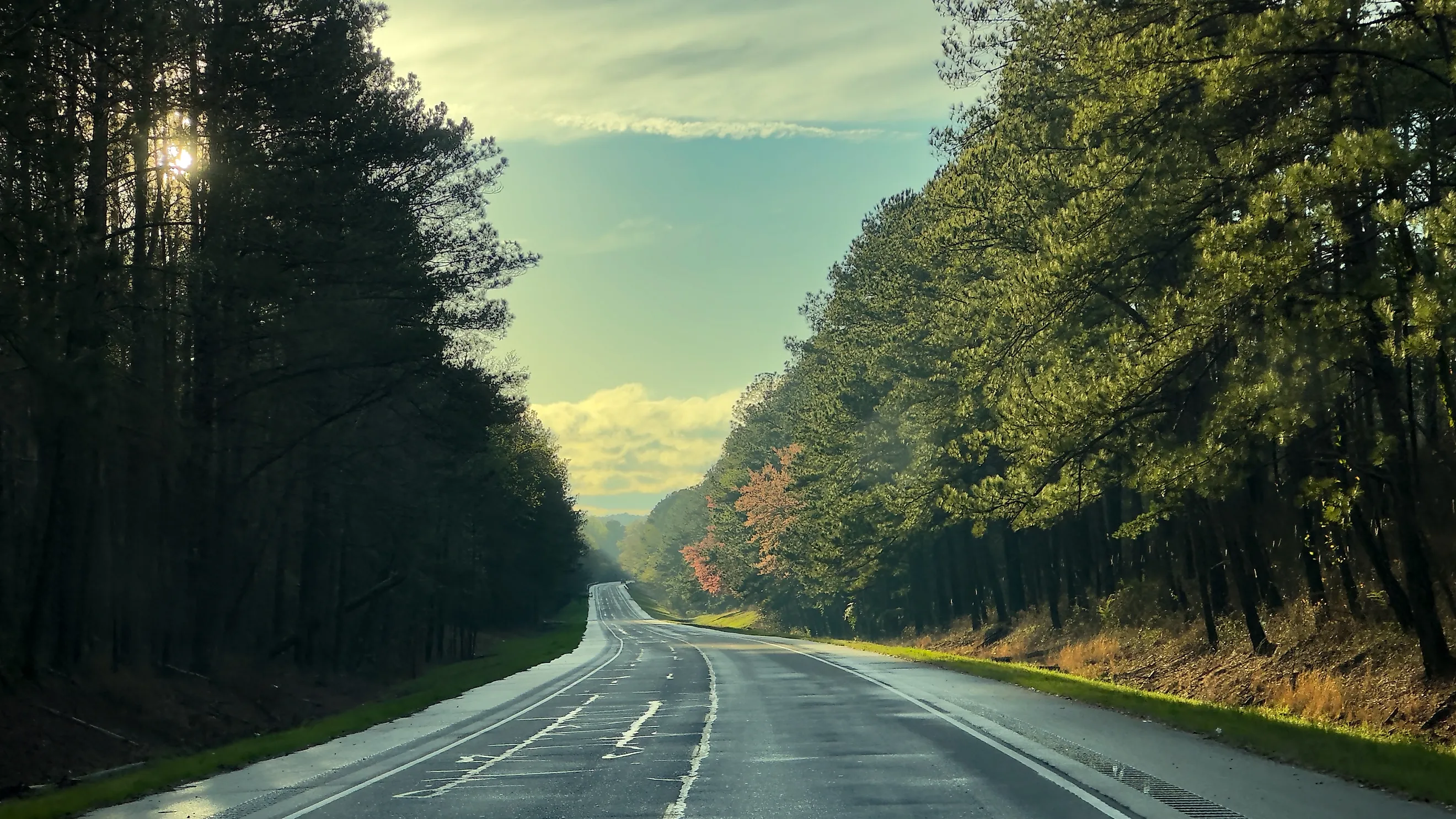
The Smallest National Forest In The United States
The smallest of the country's 154 national forests fits inside one Alabama county. Tuskegee National Forest covers about 11,000 acres of pine and hardwood. The average national forest covers a hundred times that. Ruined cotton fields became these woods after the government replanted the failed farms in the 1930s. Four more of the country's smallest national forests follow this one.
Tuskegee National Forest, The Country's Smallest

Tuskegee National Forest spreads across about 11,000 acres in east-central Alabama, less than 18 square miles in all. It sits west of Auburn and roughly 44 miles east of Montgomery, wholly inside Macon County. Only six national forests fit within a single county like this. Level ground, pine stands, and hardwood groves make up most of the terrain. The forest is small enough to walk across in a day, unlike the million-acre expanses out West.
The land here was nearly ruined before it was protected. Cotton farming and the boll weevil left the soil eroded and worn out by the 1930s. The federal government bought the failed tenant farms and replanted them, and in 1959 President Dwight D. Eisenhower proclaimed the recovered tract a national forest. Long before that, this was the homeland of the Muscogee, also called the Creek, who were forced west under the Indian Removal Act in the 1830s. The Taska Recreation Area is now a stop on the Black Belt Nature and Heritage Trail, named for the dark, cotton-growing soils of Alabama's Black Belt. Hikers walk the 8.5-mile Bartram National Recreation Trail, named for the naturalist William Bartram, who traveled the Southeast in the 1770s. Dogwoods and magnolias bloom white in late March. Birders come for pileated woodpeckers, red-shouldered hawks, and brown-headed nuthatches.
Finger Lakes National Forest, New York

New York has just one national forest, and it is nearly as small as Tuskegee. The Finger Lakes National Forest covers 16,259 acres, which ranks it second smallest in the entire system. It runs along a ridge between Seneca and Cayuga Lakes, just north of Ithaca. Much of it looks less like deep woods than open pasture.
That pasture is the forest's signature. Before the government bought the land in the 1930s, families farmed these hills, and ranchers still graze cattle on parts of it under Forest Service permits. More than 30 miles of connected trails, including the Interloken Trail, cross the ravines and open uplands. In summer, visitors pick wild blueberries and raspberries along the fence lines. Grassland and hardwood sit side by side here, a patchwork found in few other national forests.
El Yunque National Forest, Puerto Rico

El Yunque is the only tropical rainforest in the National Forest System. It covers about 28,500 acres in northeastern Puerto Rico, a short drive east of San Juan. Rain falls hard and often here, up to 240 inches in a year. All that water makes El Yunque the most biodiverse forest the Forest Service manages.
The forest is home to hundreds of species found almost nowhere else. The tiny coqui frog calls through the night and remains one of Puerto Rico's best-known cultural symbols. The endangered Puerto Rican parrot survives here in small numbers. Streams off these peaks supply close to a fifth of the island's fresh water. The Taino people once treated the highest peaks as sacred ground, and the Spanish crown declared the land a reserve in 1876. President Theodore Roosevelt made it a federal forest reserve in 1903, and it was renamed El Yunque in 2007.
Uwharrie National Forest, North Carolina

Uwharrie is the smallest of North Carolina's four national forests, at 50,645 acres. It lies in the state's south-central Piedmont, mostly in Montgomery County. The land rises into the Uwharrie Mountains, a range so old that geologists count it among the most ancient in North America. These hills once stood far taller, worn down over hundreds of millions of years.
A piece of American history lies under this ground. The country's first documented gold rush began near here in 1799, after a boy found a large gold nugget in a nearby creek. Old mine shafts still dot the area. The Birkhead Mountains Wilderness covers about 5,025 acres of backcountry within the forest. Hikers follow the Uwharrie Trail across the ridges, while off-road drivers and paddlers head for Badin Lake on the western edge.
Conecuh National Forest, Alabama

Alabama has one more of the country's smaller national forests. Conecuh National Forest covers about 84,000 acres along the Florida line, in the state's southern coastal plain. That position makes it the southernmost national forest in the country. Longleaf pine, cypress ponds, and pitcher-plant bogs cover its sandy ground.
Loggers clear-cut this land in the 1930s, and the Forest Service first replanted it with fast-growing slash pine. That choice cost the red-cockaded woodpecker much of its nesting habitat. Crews are now restoring the native longleaf pine, which the woodpecker and the gopher tortoise both depend on. The 20-mile Conecuh Trail winds through the pine flats and past quiet water like Open Pond. The name Conecuh comes from a Muscogee word meaning land of cane.
Why The Smallest Forests Still Matter
Size is an easy way to rank a national forest, though acreage is a poor guide to what lives inside one. Tuskegee's 18 square miles include recovered farmland and a piece of Muscogee history. El Yunque contains more species per acre than forests ten times its size. Small forests also sit closer to where most people live, which makes them easy to reach for a morning hike or a day of fishing. The largest forests out West cover the most ground. The value of the smallest ones is harder to measure, and no less real.