The Deadliest Forest Fires In American History
Peshtigo burned in 1871 and Lahaina in 2023, and the fires between them changed how Americans think about evacuation and public relief during forest fires. Determining the deadliest wildfire disasters in US history is not as simple as counting death tolls. Records from the 1800s are incomplete, estimates vary, and some familiar names refer to a single fire, while others encompass dozens of fires burning across a region. Modern disasters also blur the boundary between a wildfire and an urban conflagration: vegetation may carry the flames into a community, but buildings can then become the principal fuel.
The fires below are US wildland and wildland-urban disasters that were exceptionally deadly or historically consequential, presented in chronological order. These forest fires show how dangerous fire becomes when drought, wind, abundant fuel, and limited escape routes converge.
Peshtigo Fire, 1871

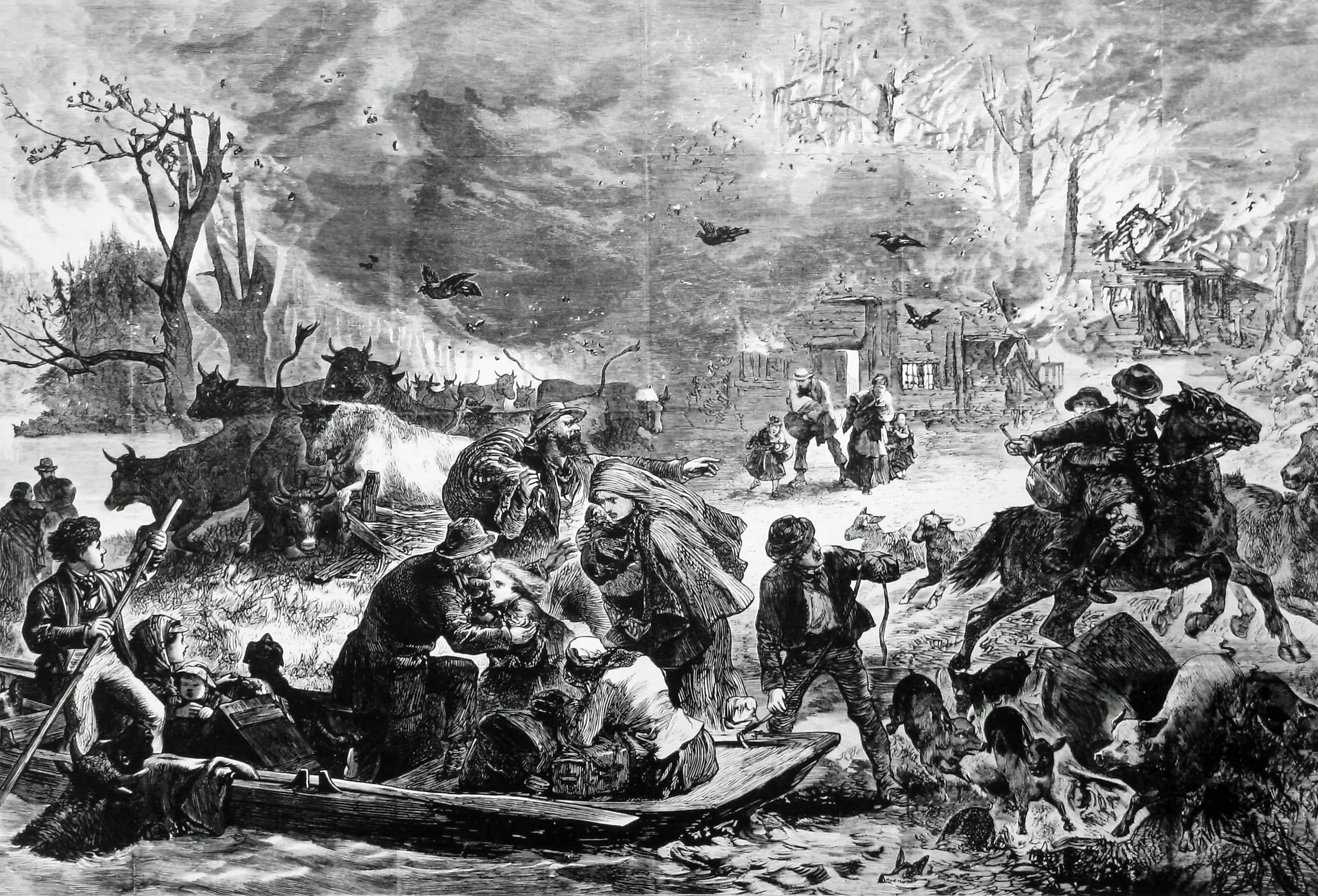
On the evening of October 8, 1871, a firestorm swept through northeastern Wisconsin and adjoining areas of Michigan. The town of Peshtigo was consumed in less than two hours, and an estimated 800 people died there alone. Across the broader fire area, the death toll is generally estimated at between 1,200 and 2,500, making Peshtigo the deadliest wildfire disaster in recorded US history. The fire burned more than 1 million acres; some estimates put the total near 1.5 million.
The source of the first spark has never been officially determined. What is clear is that drought, strong winds, logging debris, land-clearing fires, and other smoldering fires created the conditions for catastrophe. Peshtigo occurred on the same night as the Great Chicago Fire, which drew far more national attention despite killing fewer people.

Peshtigo was devastated, but it was not erased permanently: the community rebuilt and remains a city today. Its history is preserved at the Peshtigo Fire Museum and in the adjacent cemetery, where a mass grave holds the unidentified or unclaimed remains of hundreds of victims.
The Michigan Fires of 1871

Peshtigo was part of a much larger Upper Midwest fire outbreak. From October 8 to 10, 1871, major fires also struck Michigan, including the areas around Holland, Manistee, and Port Huron. The exact toll is unknown, but the National Weather Service estimates that the Michigan fires likely killed more than 500 people.
Those deaths are often overlooked when histories focus on the named fires at Chicago and Peshtigo. The Michigan disaster also illustrates a central problem with historical rankings: a regional outbreak may be remembered as several separate fires even when the events arose from the same extreme weather pattern and burned at the same time.
As in Wisconsin, months of hot, dry weather left forests and discarded timber exceptionally flammable. Strong winds then drove existing and newly ignited fires across settlements and cutover land. The scale of the 1871 outbreak became an early warning about the danger created when severe fire weather meets combustible logging waste and uncontrolled burning.
Thumb Fire, 1881

A decade later, fire again swept across Michigan. Beginning on September 5, 1881, multiple fires merged and raced across the Thumb, the eastern projection of the Lower Peninsula. The disaster burned roughly 1 million acres and killed about 282 people, although (as with other 19th-century fires) the precise total is uncertain. More than 14,000 people were left homeless or dependent on public aid.
The same forces seen in 1871 were at work: prolonged heat and drought, powerful winds, and landscapes altered by extensive logging. Smoke spread far beyond Michigan. On September 6, skies darkened across parts of the Northeast, an event remembered as "Yellow Day."
The Thumb Fire also occupies an important place in the history of disaster relief. Clara Barton and her associates had established the American Red Cross only months earlier. Its aid to victims of the Michigan forest fires became the organization's first disaster-relief operation. That is a concrete legacy of the fire; broader claims that the response single-handedly proved the organization's value to government go beyond what the historical record establishes.
Great Hinckley Fire, 1894

On September 1, 1894, two fires in east-central Minnesota merged south of Hinckley and developed into what survivors described as a tornado of fire. In roughly four hours, the blaze destroyed between 250 and 480 square miles. Minnesota's official death toll is 418, but that figure excludes some people living or working in the surrounding forests and bodies found later, so the true loss may have been higher.
Hinckley was a booming lumber town surrounded by dry branches, stumps, sawdust, and other debris left after logging. Small fires had smoldered in the region during a hot, dry summer. When the firestorm arrived, residents fled to a gravel pit, a swamp, wells, and root cellars. Some escaped on evacuation trains; others died from flames or smoke while trying to shelter.
The disaster helped push Minnesota toward a more organized approach to forest protection. In 1895, the state enacted its first forestry law and created a system of local fire wardens under a chief fire warden.
Yacolt Burn, 1902

From September 11 to 13, 1902, the Yacolt Burn swept through southwestern Washington. It burned 238,920 acres in Clark, Cowlitz, and Skamania counties, killed 38 people, and traveled 36 miles in 36 hours. Its exact cause was never established; logging operations, burning slash, and land-clearing fires were among the possible sources.
At the time, Washington had no organized statewide wildfire-fighting system. Residents and loggers largely fled, while troops from Vancouver Barracks helped evacuate people. Rain finally extinguished the burn.
The political response was significant. Washington created the office of state fire warden in 1903, and private landowners formed the Washington Fire Protection Association in 1908. The Yacolt Burn remained the largest single wildfire in Washington's recorded history until the Carlton Complex surpassed it in 2014. The modern Yacolt Burn State Forest (not a park) takes its name from the disaster.
The Great Fires of 1910

The event, often called the Great Fire of 1910 or the Big Blowup, was not one blaze. During August 20 and 21, strong winds drove hundreds of fires across Idaho, Montana, Washington, and parts of Canada. About 3 million acres burned in the Northern Rockies, entire communities were damaged or destroyed, and most of the people killed were firefighters. Federal sources differ slightly on the final toll, commonly giving 85 or 87 deaths.
The disaster profoundly shaped the young US Forest Service and strengthened the belief that aggressive suppression should be the default response to wildfire. It also helped build support for the Weeks Act of 1911, which established a framework for federal-state cooperation in fire protection.
The famous "10 a.m. policy" is part of that legacy, but it was not imposed immediately after the 1910 fires. The Forest Service formally adopted the policy in 1935, setting a goal of suppressing each reported fire by 10 a.m. the following day. Later research demonstrated that fire also plays an essential ecological role in many landscapes, and federal policy gradually moved away from universal suppression.
Cloquet, Duluth, and Moose Lake Fires, 1918

Minnesota's deadliest natural disaster unfolded on October 12, 1918. What is often called the Cloquet Fire was actually an outbreak of 50 or more fires, with two main fronts: the Cloquet-Duluth Fire and the Moose Lake Fire. Sparks from locomotives had ignited persistent fires near Tamarack on October 4 and northwest of Cloquet on October 10. When strong winds arrived and humidity plunged on October 12, the scattered fires combined and accelerated.
In less than 15 hours, more than 450 people were killed, about 1,500 square miles were burned, and towns and villages were flattened. Cloquet itself received just enough warning for factory whistles, telephone operators, officials, and evacuation trains to help more than 7,000 people escape; only five died in the city. Other communities were far less fortunate.
The disaster caused an estimated $73 million in property damage at the time (more than $1 billion in 2018, when the National Weather Service marked the centennial).
Griffith Park Fire, 1933

The Griffith Park Fire broke out in the afternoon on October 3, 1933, in Dam Canyon near the old Los Angeles Zoo. The exact cause is unknown, but what began as a small brush fire quickly grew as hot, dry winds fanned the flames. Nearby, around 3,780 workers hired to clear dry brush as part of a government make-work program tried to tamp down the flames with shovels, but the fire rapidly grew out of control. Efforts by firefighters were hampered by the sheer number of workers on-site. The fire rushed up Dam Canyon and killed 29 workers, injuring more than 100. It burned 47 acres of the park.
Today, at 4,210 acres, Griffith Park is one of the largest urban parks in the US, home to the Los Angeles Zoo, the Art Deco Griffith Observatory, the Greek Theatre, and the Hollywood Sign. A stone marker and memorial trees commemorate the 29 workers who died fighting the 1933 fire.
Oakland Hills Firestorm, 1991

The Oakland Hills Firestorm showed how a vegetation fire can become an urban catastrophe. A five-acre brush fire north of the Caldecott Tunnel was controlled on October 19, 1991, but hot spots remained. At about 10:45 a.m. the next day, the wind rekindled the fire. It raced through steep, densely built neighborhoods in Oakland and Berkeley, killing 25 people (including a police officer and a fire officer) and destroying about 2,900 dwellings.
Early damage counts included 2,449 single-family residences and 437 apartment and condominium units. The latter figure refers to housing units, not 437 apartment buildings. High winds, drought-stressed vegetation, combustible exterior materials, steep terrain, and narrow roads all contributed to the disaster.
Oakland became a landmark case in the study of the wildland-urban interface, where homes and vegetation share the same fire-prone landscape. Investigations emphasized that wildfire safety depends not only on firefighting but also on building materials, vegetation management, reliable water supplies, access, and evacuation planning.
Cedar Fire, 2003

The Cedar Fire was one of the largest wildfires in California's history when it broke out on October 25, 2003, in the 460,000-acre Cleveland National Forest outside of San Diego, after a lost hunter lit a small fire to signal for help. Fanned by the Santa Ana winds, the fire spread quickly, at an estimated rate of 3,600 acres per hour in the first 36 hours. By the time it was contained in early November, the fire had burned 273,246 acres and destroyed 2,820 buildings, according to the California Department of Forestry and Fire Protection (CAL FIRE). It killed 15 people, including one firefighter. The fire was not officially controlled until December 5, 2003.
A Cedar Fire Historic Monument and memorial garden in Lakeside, California, honors the 15 people who died in the fire, as well as first responders and survivors. A walkway features the names and dates of past California wildfires, adorned with pieces of pottery and glass found among the remnants of homes lost in the fires.
Camp Fire, 2018

At 6:33 a.m. on November 8, 2018, the Camp Fire began near Pulga Road and Camp Creek Road in Butte County, California. Driven by strong winds through dry vegetation, it reached the town of Paradise with extraordinary speed. 85 people died, making it the deadliest wildfire in California's recorded history.
CAL FIRE determined that electrical transmission lines owned and operated by Pacific Gas and Electric caused the fire. The ignition should not be described simply as power lines blown down by wind: investigators focused on failed equipment on a transmission tower, while the wind was a major factor in the fire's rapid spread.
The Camp Fire burned 153,336 acres and destroyed 18,804 residential, commercial, and other structures across Butte County (not all within Paradise). It was fully contained on November 25, 17 days after it began. The disaster exposed the lethal consequences of fast-moving fire, limited evacuation routes, vulnerable utility infrastructure, and communities built amid flammable terrain.
Lahaina Fire, 2023

On August 8, 2023, a wind-driven fire moved from the grassland into Lahaina on the Hawaiian island of Maui and rapidly became an urban conflagration. The historic town suffered catastrophic destruction, more than 2,200 structures were destroyed, and thousands of residents were displaced. Hawaiʻi officials now put the death toll at 102.
The tragedy cannot be reduced to a single cause or failure. A state-commissioned analysis identified a complex interaction of factors, including severe weather, aging infrastructure standards, vegetation management, communications, command coordination, and obstacles to evacuation. The transformation from a grass fire into a structure-to-structure fire also demonstrated why the term "forest fire" is too narrow for many of America's deadliest modern fire disasters.

Lahaina was the deadliest US wildfire in more than a century. It also destroyed homes, businesses, historic places, and sites of profound cultural importance to Native Hawaiians and the wider Maui community. Recovery and rebuilding are continuing.
What These Forest Fires Left Behind
The history of deadly wildfires in the United States is not a simple story. The 19th-century disasters were intensified by drought, wind, uncontrolled burning, and immense quantities of logging debris. The Great Fires of 1910 helped entrench a policy of aggressive suppression. Later disasters in Oakland, Paradise, and Lahaina demonstrated how vegetation fires can enter communities and become urban conflagrations, with buildings themselves carrying the fire forward.
Nor is the lesson that all fire should be eliminated. Fire is a natural and necessary process in many ecosystems, and Indigenous communities have used cultural burning to manage landscapes for generations. The durable lesson is that communities must prepare for the fires their environments can produce: resilient utilities, defensible space, fire-resistant construction, multiple evacuation routes, effective warnings, coordinated emergency response, and land management that accounts for both ecological needs and human safety.
These disasters endure because of the lives lost. They also endure because each revealed a weakness (in land use, infrastructure, firefighting, relief, or evacuation) that later generations could no longer afford to ignore.