The Cloud Forests Of North America
Cloud forests cover only about 2.5 percent of the world's tropical forest area, and roughly 41 percent of the remaining area is in the Americas. These are mountain forests where low cloud and fog settle into the canopy for much of the year, wetting the trees directly and supporting mosses, ferns, and orchids that rainfall alone could not sustain. El Triunfo, in the Sierra Madre de Chiapas, is the most diverse evergreen cloud forest in Mexico. The Sierra de las Minas in Guatemala holds an estimated 60 percent of that country's remaining cloud forest, and the spruce-fir crest of the Great Smoky Mountains carries a cooler temperate version of the same conditions. Five cloud forests stand out across North America, in the tropical highlands of Mexico and Central America, and on high ground in the United States.
Great Smoky Mountains, USA

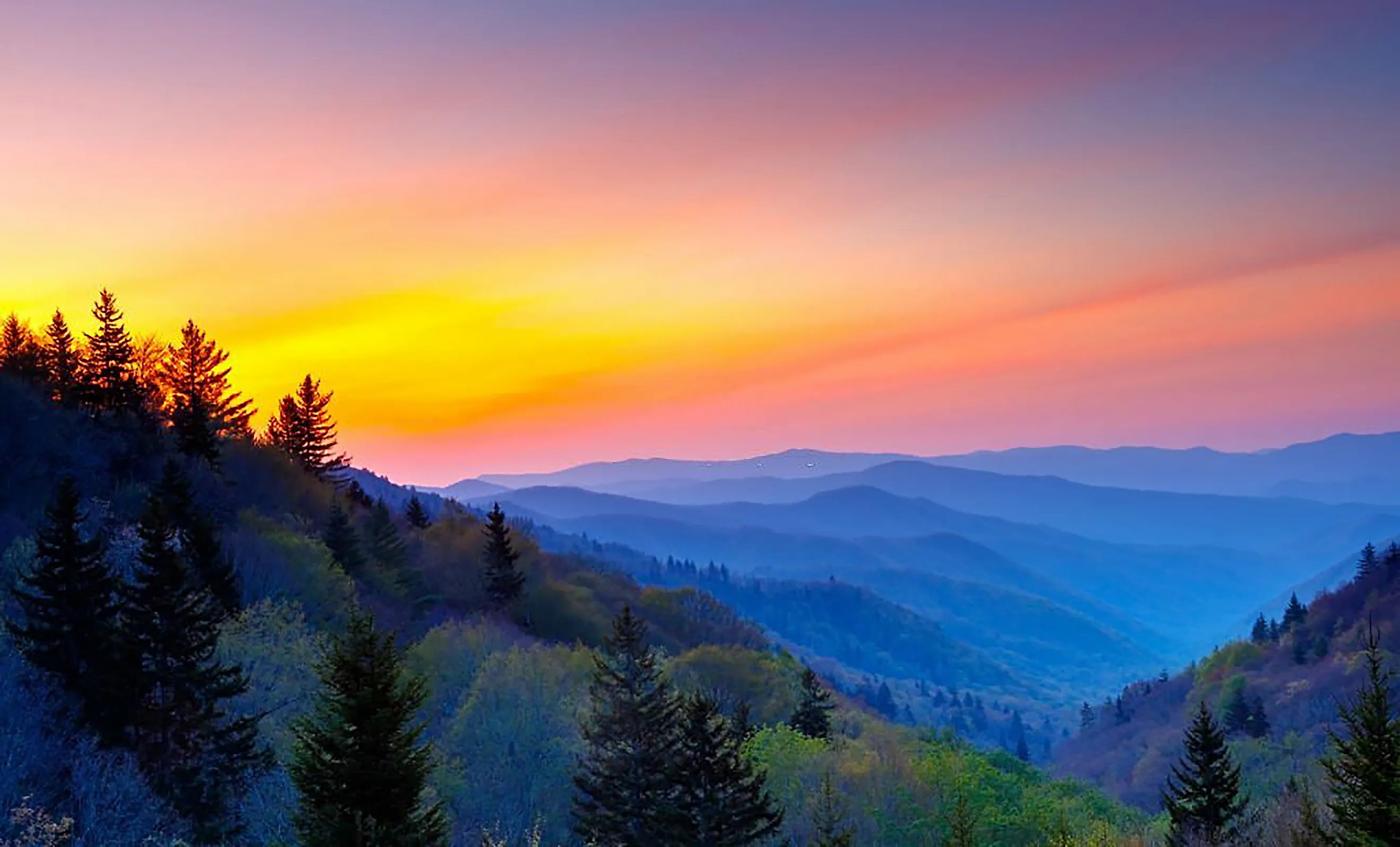
The most-visited national park in the United States is also, at its highest elevations, a temperate cloud forest. Great Smoky Mountains National Park covers about 816 square miles (2,114 square kilometers) along the Tennessee and North Carolina line, in the southern Appalachian Mountains. Above roughly 4,500 feet (1,370 meters), the red spruce and Fraser fir forest sits in cloud and fog for a large share of the year, and that persistent haze is what gave the Great Smoky Mountains their name. Those conditions support unusual biodiversity, including the endangered Carolina northern flying squirrel and some 30 salamander species, most of them lungless. Newfound Gap Road climbs to the main ridgeline, and the spur to Kuwohi, the peak formerly called Clingmans Dome, reaches the spruce-fir zone directly. The park charges no entrance fee, and more than 800 miles (1,290 kilometers) of trail lead off the ridge roads.
Olympic National Park, USA

Olympic National Park occupies most of the Olympic Peninsula in the northwest corner of Washington, separated from Canada by the Strait of Juan de Fuca rather than sharing a land border. The park covers 1,442 square miles (3,734 square kilometers), an area larger than the state of Rhode Island. Its western valleys receive 100 to 170 inches (250 to 430 centimeters) of rain a year, ranking them among the wettest places in the country. Fog off the Pacific settles into those valleys for much of the year and sustains the same canopy-soaking conditions found in tropical cloud forest, without the tropical heat. The Hall of Mosses, a 0.8-mile (1.3-kilometer) loop in the Hoh Rain Forest, passes through Sitka spruce and bigleaf maple hung with moss and epiphytes. The Hoh trailhead sits at the end of an 18-mile spur off Highway 101, a drive of two to three hours west of Seattle.
Sierra de las Minas, Guatemala

An east-west range in Guatemala's southeastern highlands holds an estimated 60 percent of the country's remaining cloud forest. The Sierra de las Minas rises from lowland valleys to peaks above 9,800 feet (3,000 meters), with the cloud forest belt on the upper slopes. The biosphere reserve there protects at least 885 species of birds, mammals, amphibians, and reptiles, along with more than 17 evergreen tree species endemic to the area. Jaguar, puma, ocelot, and margay all occur in the reserve, as do the resplendent quetzal and the critically endangered horned guan. The dry season, roughly November through April, brings the most reliable hiking conditions and the clearest mountain views. Access is limited, and the terrain is steep, so visiting with a guide is strongly recommended.
El Triunfo Biosphere Reserve, Mexico

El Triunfo protects the most diverse evergreen cloud forest in Mexico, in the Sierra Madre de Chiapas in the southern part of the country. The reserve covers 460 square miles (1,191 square kilometers), with elevations reaching 8,366 feet (2,550 meters). The mountains around it draw some of the heaviest rainfall in the country. Botanists have recorded 977 plant species inside its boundaries, along with 548 terrestrial vertebrates, about 22 percent of the vertebrate species known in Mexico. The 112 mammal species alone account for roughly 23 percent of the national total. Resplendent quetzals, horned guans, and Baird's tapir all depend on the forest, and nearly 400 bird species have been recorded there. Coffee grown in the buffer zone is the economic base of the surrounding communities, and organic production has since become part of the conservation strategy.
Sierra Madre Oriental Cloud Forests, Mexico

Cloud forest occupies less than 1 percent of Mexico's land area, and a long band of it clings to the eastern slope of the Sierra Madre Oriental in the northeast of the country. The range extends about 620 miles (1,000 kilometers) south of the Rio Grande through Coahuila, Nuevo León, Tamaulipas, San Luis Potosí, Querétaro, and Hidalgo into northern Puebla. Geologists often describe it as a southern continuation of the Rocky Mountains.
Its montane forests carry a closed evergreen canopy loaded with orchids, bromeliads, mosses, and ferns, above an understory of magnolia and oak. American black bears occupy the northern end of the range, while jaguars, ocelots, and white-nosed coatis occur farther south. Public access points include the El Cielo Biosphere Reserve in Tamaulipas, the Sierra Gorda Biosphere Reserve in Querétaro, and Xilitla in San Luis Potosí, all of them on rough mountain roads better suited to a high-clearance vehicle.
Where North America Stays In The Clouds
Cloud forests depend on terrain more than on latitude, which is why these forests cluster along mountain chains rather than within any single climate band. The Sierra Madre Oriental carries a narrow strip of it on its eastern slope, at the northern edge of tropical montane forest in North America, while Olympic National Park produces the same soaked, moss-hung canopy on the Pacific side of Washington with no tropical heat involved. Both depend on the mechanism the tropics rely on, namely, high ground standing in the way of wet air. That dependence is also the vulnerability researchers point to, since a rising cloud base leaves a forest with no higher ground left to occupy.