You Won't Believe This Town Is In Victoria
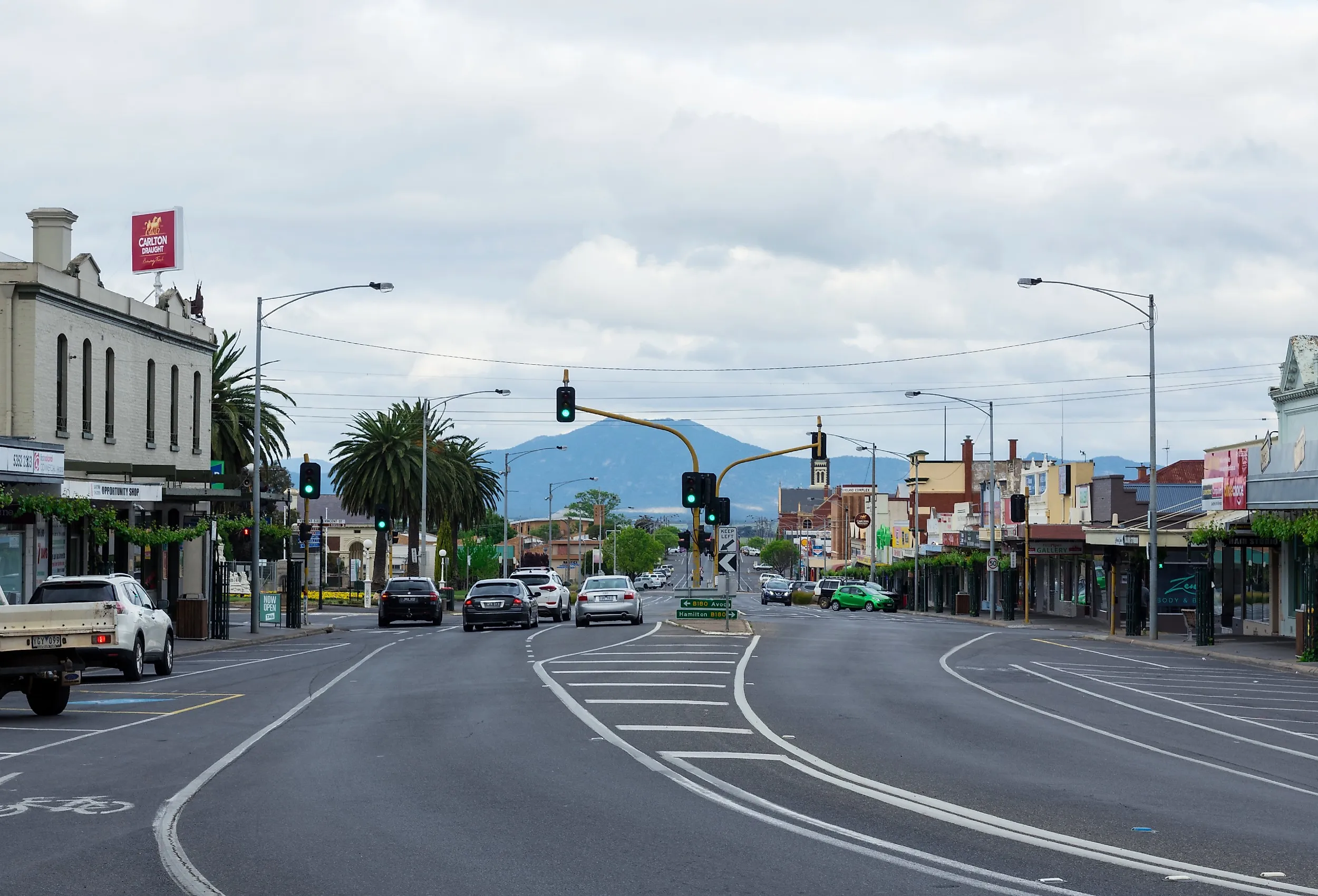
Most Victorian country towns trade on familiar selling points: a wine region, a river, a colonial-era main street. Ararat trades on something different. Built around two of the state's most significant 19th-century institutions for the criminally insane and mentally ill, Ararat preserves a chapter of Victorian history that most towns would rather not own. J Ward, the maximum-security prison-asylum that operated from 1859 until 1991, and Aradale Mental Hospital, the much larger asylum that ran from 1867 until the early 1990s, still stand. Both are open to the public, and both anchor a tourism economy that runs on guided tours, ghost tours, paranormal investigations, and cemetery walks. The result is unusual enough that you'll have a hard time placing the town inside the broader fabric of Victoria.
Aradale Mental Hospital

Aradale, originally called the Ararat Lunatic Asylum, was one of three large country asylums commissioned by the Victorian colonial government in the 1860s, alongside Kew and Beechworth. Construction began in 1864, the first patients arrived in 1865, and the facility was officially opened in 1867. At its peak, Aradale held close to 1,000 patients across roughly 70 buildings on a 100-hectare site. The complex was effectively self-sufficient: it included its own farm, orchard, vineyard, fire station, workshops, and morgue. By the time the asylum was decommissioned in the early 1990s, more than 13,000 patients and staff had died on site over its 130-year history.
Aradale runs guided day tours twice on Sundays and Wednesdays, each lasting roughly 90 minutes to two hours. Tours move through indoor and outdoor sections of the complex, including the wards, common rooms, and morgue, and the guides cover both the architectural history (the asylum was modeled on England's Colney Hatch and represents one of the best surviving examples of mid-Victorian asylum design in Australia) and the evolution of psychiatric treatment from the 1860s through the deinstitutionalisation movement of the 1980s.
J Ward

J Ward is older than Aradale by several years and operated continuously for 130 years. Construction began in 1859 as the Ararat County Gaol, a goldfields prison built from local bluestone in the Pentonville radial design. The gaol opened in October 1861 with 21 prisoners. By 1886, with the gold rush winding down and the gaol underused, the building was reproclaimed as J Ward of the Ararat Asylum, a maximum-security ward for criminally insane male patients. It was meant to be a temporary measure. It ran until January 1991.

Today, J Ward operates as a museum with daily public tours of about 90 minutes. Guides walk visitors through the cell blocks, exercise yards, and the gallows where three men were executed during the gaol period. Two inmates anchor the standard tour. Charles Fossard, a French immigrant convicted of murder in 1903, served nearly 71 years inside, the longest documented prison sentence in world history. Bill Wallace, arrested in 1926 for the murder of a man at a Melbourne café, was held at J Ward for 57 years before being transferred to Aradale's geriatric ward, where he died in 1989 at age 107, weeks short of his 108th birthday. Wallace held the Guinness record for the world's oldest prisoner until 2011.
Ararat Cemetery

Many of Aradale's deceased patients are buried in the Ararat Cemetery, often in unmarked or numbered graves rather than under named headstones. The cemetery walking tour traces those connections through archival records and oral histories. Tours are led by an archivist with access to admission records and case histories, and the focus is firmly on individual patients: who they were before institutionalisation, what brought them to Aradale, and what the available records reveal about their treatment. The walk runs roughly two hours and serves as a useful counterweight to the more sensational ghost tours, grounding Aradale's history in specific human lives.
Ghost Tours and Paranormal Investigations

The combination of execution sites, deinstitutionalised wards, and a 130-year operating history has made J Ward and Aradale fixtures on Australia's paranormal tourism circuit. The standard ghost tour runs at night for two hours through J Ward, covering the same physical spaces as the day tour (governor's quarters, gallows, kitchen, exercise yards) but framed around accounts of paranormal activity reported by staff, visitors, and former employees. Tours are run by Eerie Tours and Lantern Ghost Tours.

For visitors wanting a more involved experience, three-hour paranormal investigations include the ghost tour plus an hour of supervised use of the equipment investigators typically bring (EMF readers, EVP recorders, motion sensors, thermal cameras). The full overnight investigation runs 12 hours, accommodates groups of up to 15, and includes dinner and a sleeping arrangement inside the ward. Bring your own sleeping bag.
The Unexpected Ararat
Ararat's history with confinement and mental illness sits closer to the surface than most regional Victorian towns are willing to allow. That openness is what makes the place worth a visit: J Ward, Aradale, and the cemetery aren't hidden behind euphemism, and the tours don't soften the institutional record. For travellers interested in the social history of psychiatry, criminal justice, or 19th-century institutional architecture, few towns in Australia offer this much access to the source material.